
Quynh Luu: Many tourism projects are slow to be implemented.
Quynh Luu has always been considered a dynamic economic development area of the province. Over the years, many projects in various fields have been invested in and developed, including tourism projects in Quynh Beach. However, the progress and effectiveness of investment in this sector have been very slow. Many projects have been allocated land for 5-6 years but have not yet been implemented…
(Baonghean)Quynh Luu has always been considered a dynamic economic development area of the province. Over the years, many projects in various fields have been invested in and developed, including tourism projects in Quynh Beach. However, the progress and effectiveness of investment in this sector have been very slow. Many projects have been allocated land for 5-6 years but have not yet been implemented…
From 2001 to 2011, the Quynh Beach tourist area attracted 35 investment projects in tourism production and service businesses. Of these, 8 projects had completed land lease procedures, while 27 projects had not yet leased land or begun construction. Annually, the District People's Committee assigns specialized departments to monitor, review, and inspect the project implementation, but in reality, the investors are still slow in carrying out construction. Regarding the 4 Quynh Nghia Beach tourism projects that have leased land, the investors are: Mr. Ho Van Thoi, Mr. Hoang Duc Thang, Mr. Duong To Hoang, and Mr. Nguyen Hai Trung, all residing in Hanoi; all leased land since 2006.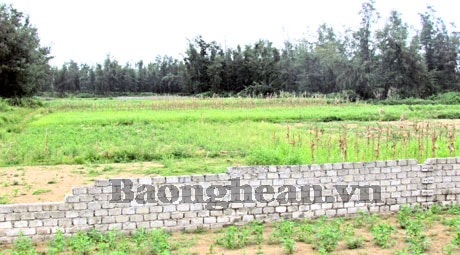
The Quỳnh Nghĩa coastal tourism projects have been leasing land since 2006, but to this day, these are still abandoned rice fields.
Following the approval, the investors completed the land lease procedures in the form of a one-time payment and were granted land use right certificates by the District People's Committee in 2007. The total area of the four projects is 30,750 m2, including 18,868 m2 of agricultural land and 11,882 m2 of forest land. Nearly six years have passed, and none of the four projects have been constructed; only low boundary walls made of flimsy concrete blocks have been built, with many sections already collapsing. The investors claim that they have not yet been able to convert the forest land to production and business land, thus preventing the projects from being implemented. However, this reason is unjustified, as the 18,868 m2 of production and business land is sufficient for constructing the necessary facilities for the projects.
The fact that these four projects were granted land leases and land use right certificates by the District People's Committee, but have remained unused for a long time, violates Clause 12, Article 38 of the 2003 Land Law. Regarding these projects, the Quynh Luu District People's Committee issued Inspection Conclusion No. 2199/KL-UBND dated December 19, 2011, concerning the use of leased land from 2005 to 2010 within the district. Accordingly, the investors were required to construct and operate the projects before June 2012. If they failed to do so by the deadline, the District People's Committee would reclaim the land in accordance with the law. However, to date, the projects remain only on paper and have not been implemented.
Mr. Pham Huu Hon, a land management official in Quynh Nghia commune, stated: "When receiving applications for land lease from investors for four tourism projects in Quynh Nghia commune, all four investors promised to start construction soon to bring the tourism facilities into operation. The local authorities hoped the projects would upgrade the commune's coastal tourism infrastructure and create more jobs and income for workers… However, nearly six years have passed, and the projects remain stalled. The local government has repeatedly met with, urged, and reminded the investors to start the projects, but they always give reasons to prolong the construction time; clearly, these projects are not feasible and we request that higher authorities reconsider them…"
In addition to the four projects mentioned above in Quynh Luu, there are three other projects under the provincial authority for land lease, including: Phuong Trang Guesthouse, invested by Phuong Trang Co., Ltd. in Quynh Phuong commune, with land leased since 2006. This project has already invested and is currently operating; Bai Tao Tourist Area project, invested by Phuong Ngoc Co., Ltd. in Quynh Phuong, with land leased since 2005. While a decision has been made, the land has not yet been handed over at the site, and only 20% of the total project has been invested in, with the remaining area yet to be developed. This is because more than 1,000 graves scattered across the leased land area have not yet been relocated to clear the site; and the eco-tourism and service area construction project, invested by Hanoi Tourism Joint Stock Company in Quynh Bang, with land leased since 2007. To date, the company has only planted a few coconut trees on the leased land and has not yet invested in the construction of facilities serving the project. The District People's Committee issued Conclusion No. 934/KL.UBND dated May 30, 2012, on the inspection of the progress of the project for which the Provincial People's Committee leased land in Quynh Luu district. The Department of Natural Resources and Environment was tasked with checking the progress, and if the investor does not implement the project by October 30, 2012, a dossier should be prepared to request the Provincial People's Committee to revoke the land.
Mr. Ho Sy Tung, Head of the Finance and Planning Department of Quynh Luu District, stated that the root cause of the slow investment and prolonged project implementation is essentially ineffective investment. Investors have already leased land and paid upfront, and are hesitant to proceed with construction due to concerns about ineffective investment and potential business losses. In reality, tourism in Quynh Luu is not yet highly effective; the scale of services on the beaches is small and fragmented, primarily catering to the food and beverage needs of domestic tourists within the district, with few overnight stays. This reality is unattractive to investors. The projects all have relatively large areas, and land has been allocated for 5-6 years but has not yet been implemented, affecting the socio-economic development of the district, resulting in budget losses, and failing to create jobs for workers…
Authorities at all levels need to quickly reclaim the land and return it to the people so that they can reinvest in production, increase their income, and stabilize their lives.
;)
Quynh Lan