
Are sausage casings made of nylon?
Instead of using pig intestines to make sausages, many sausage producers have switched to using a new type of casing that is similar to nylon.
Instead of using pig intestines to make sausages, many sausage producers have switched to using a new type of casing that is similar to nylon.
According to feedback from many consumers, recently, when buying sausages, people have noticed that the outer layer (which is traditionally made from pig intestines) is unusually tough. Many people, after chewing for a long time and finding it "difficult to swallow," suspect that it is a plastic wrapper rather than pig intestines as in the traditional method. This anomaly has yet to be explained by the authorities.
Mr. Tran Quoc Nhuan, Director of Hung Tuan Sausage Co., Ltd. (headquartered in District 11, Ho Chi Minh City), said that among all the steps in making sausage, the most time-consuming is still the process of preparing the pig intestines to make the sausage casing.
To make delicious sausage, you need to use fresh pig intestines, scraped clean until the outer layer is as thin as plastic. However, this manual method is only feasible on a family scale. According to Mr. Nhuan, most establishments or businesses that produce in large quantities have switched to using a special type of dried pig intestine that has already been pre-processed.
These facilities buy dried pig intestines and simply stuff them with ingredients before drying them into the finished product. These intestines are folded into stacks, each weighing about 100g and measuring up to 11-12m in length. Without prior knowledge that they are pig intestines, anyone would mistake them for plastic bags.
Mr. Nhuan also inquired about this type of casing, and the suppliers explained that pig intestines are processed using a technology similar to that used for "tanning leather." Therefore, even though a pig only has a few meters of intestine, this method allows for the joining of intestines to create hundreds of meters of length.
According to several owners of artisanal sausage production facilities in Binh Chanh District (Ho Chi Minh City), this special type of pig intestine is sold retail at some markets in Districts 5 and 6 and is imported from China. With the need to buy dried pig intestines for making sausages, after visiting many stalls in Binh Tay Market (District 6, Ho Chi Minh City) and An Dong Market (District 5, Ho Chi Minh City), we were directed by vendors to Thanh Ky stall in An Dong Market, known as a major supplier to several sausage production facilities and retail buyers.
As soon as we inquired about purchasing, the stall owner pulled out numerous stacks of "dried pig intestines" in large bags, offering to sell as much as we wanted. Surprisingly, one stack of dried pig intestines could yield a sausage length of 11-12 meters, yet the retail price was only 30,000 VND.
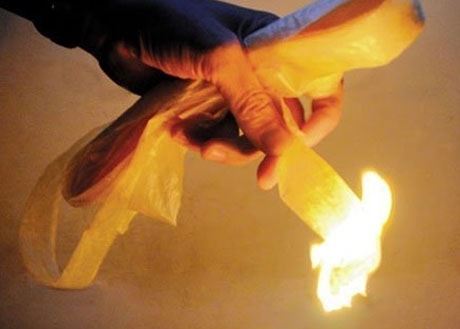
The sausage casing burned like plastic.
Meanwhile, for that price, you could only buy a maximum of 2 meters of fresh pig intestines to process yourself. According to the stall owner, because it's both cheap and convenient, this product is in high demand. Through some simple experiments we conducted, such as burning it over a fire and soaking it in water, the "pig intestines" purchased at the market seemed more like nylon or rubber than a food item. For example, when heated over a fire, the material contracted and shrank very quickly, emitting a burnt plastic smell (see photo), and when soaked in water for five to six hours, it was waterproof and showed no signs of disintegration.
Having personally witnessed a sausage production facility in Binh Chanh using this special type of "pig intestine," Mr. Banh Duc Lieu, Deputy Director of the Regional Veterinary Center VI, was also surprised. Mr. Lieu stated: "We will soon investigate this issue because, surprisingly, pig intestine is not on the list of animal products requiring quarantine by the veterinary authorities, while the origin of these products is unclear."
According to Dr. Tran Van Ky, head of professional affairs at the Southern office of the Vietnam Association of Food Safety and Technology, nylon or plastic in general is a type of chemical that is only used as outer packaging for food and does not belong to the group of additives, dyes, etc., used directly with food.
Even when used as packaging, plastics that do not meet safety requirements can release toxins, contaminate food, and harm the health of consumers. If dried pig intestines are counterfeited using plastic, the potential danger is even greater if consumers ingest them directly.
However, there is currently no research or definitive conclusion on the material of these sausage casings, making it difficult to provide recommendations on potential harm to consumers. Consumers should avoid purchasing products they suspect are unsafe, especially those not included in this regulatory list.
A representative from Vissan Company stated that the sausage casings currently use two sources: pig intestines and collagen casings. The collagen casings are made from synthetic food-grade materials, are elastic, edible, and non-toxic. Most collagen casings are imported. As for the dried pig intestines, when soaked in water they soften and turn off-white; although they are somewhat tough, they can still tear easily by hand.
According to Women - LY