
Most negative aspects of education are uncovered by the press.
"Most of the negative incidents we've dealt with recently were reported by the press. The findings were made by the education sector..."
"Most of the negative incidents we've dealt with recently were reported by the press. Discoveries of wrongdoings made proactively by the education sector are still few...", said Minister of Education and Training Pham Vu Luan.
Minister of Education and Training Pham Vu Luan has just signed document No. 2998 addressed to the chairmen of the People's Committees of provinces and centrally-administered cities regarding the direction of the 2013 high school graduation exam and university and college entrance exams.
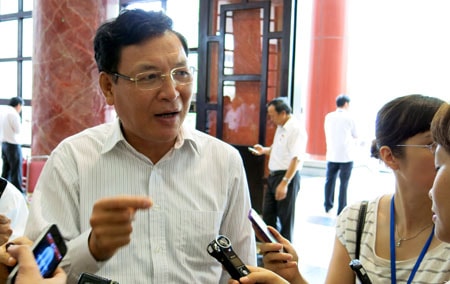 |
Minister of Education and Training Pham Vu Luan |
In this document, Minister Pham Vu Luan requested the chairmen of the People's Committees of localities to: "Instruct media agencies to thoroughly discuss with the responsible agencies before publishing sensitive information related to exam questions such as leaked exam questions, errors in exam questions, irregularities in the exam… (if any)."
This document has provoked a strong reaction from the public. On the sidelines of the National Assembly on the morning of May 21st, the press had a discussion with Minister Pham Vu Luan about this issue. Minister Luan explained:
- Nobody said it was forbidden to publish information. Reporters who receive such information should publish it, even if it's not reported to the school. If the Ministry or other relevant agency receives it but doesn't take action, the media can still publish it, even including statements like: "We reported it, but this agency, this person, or that person didn't thoroughly address the negative aspects of education."
I agree with creating pressure for the whole society to closely combat negative aspects in education. However, caution is needed. Don't just publish information without verification. Especially when students are taking exams; what if they are shocked and unable to complete the test?
The Ministry of Education and Training has issued a directive instructing media outlets to consult thoroughly with relevant authorities before publishing news about irregularities and negative practices in examinations, in order to carefully consider the matter and guide public opinion appropriately. There have been instances where various media outlets, especially online news sites, have reported on something only to later find out it was untrue upon verification. This has had negative consequences.
Therefore, we suggest that the press should report with caution and not just hear something and then publish it. We should discuss thoroughly and verify the facts before reporting. We should consult with the police and the education and training inspection agency and cooperate in investigating, verifying, and dissecting the issue for appropriate action. If you have already provided information and someone receives it but keeps quiet and doesn't take action, please publish it; the Ministry will never cover up for that. We should combat corruption in education responsibly and effectively to ensure a fair examination environment for our students.
The Ministry of Education and Training is determined to fight against corruption in examinations, and does not exclude the possibility of corruption within the management agencies and among teachers. Despite teachers' objections, the Ministry has met with school principals and decided to allow recording devices into examination rooms, but prohibits live streaming.
This action aims to gather evidence of irregularities in order to decisively address this issue. At press conferences and ministerial meetings, I have consistently stated that, up to this point, all the irregularities in examinations that have been discovered have come from the press. The Ministry's agencies have not provided me with any information yet. Therefore, there is no reason not to cooperate with the press. I suggest that localities discuss this with media outlets so that they can consider cooperating and there should be no limit on the publication of information about examination irregularities in the press.
He believes that negative information requires more time to process and thoroughly assess.
- That's right, there's no need to rush when dealing with violations or handling information about violations. If there's evidence, we can process it within a day or two; it doesn't cost anything. If after a day we can't verify it anymore, then we need to learn from this experience in terms of professional practice. But immediately exposing it and shocking people wouldn't be beneficial.
This year marks the first time the education sector has implemented measures to prevent exam cheating by allowing the use of audio and video recording devices in examination rooms. How do you assess the impact of implementing this measure?
- The first impact is psychological, because all the regulations in the examination system up to now are based on the assumption that teachers and administrators are good and supervise students strictly. In reality, some teachers and administrators also violate the rules. However, the current regulations lack this supervision; they only have outer and inner layers of isolation, but these layers are not effective. In my opinion, we need to create a proper system of supervision.
Students are also a part of the school system; there may be instances of cheating and misconduct, but many students are good, honest, and willing to fight for what they can, so there's no reason why we shouldn't utilize their support. Therefore, teachers feel as if an invisible camera is watching them from above, which will inevitably compel them to be more disciplined.
On the other hand, we must encourage honest students who dare to fight against negativity. Just as we honor good students who return lost items, excel in their studies, and are well-behaved, we must also commend and protect those students who dare to confront negativity. While the number of cases caught red-handed by students may not be quantifiable, their invaluable impact on teachers who may be contemplating such behavior is significant.
He asked, "If no wrongdoing has been detected in the education sector, how should the sector itself combat corruption?"
- We are strongly pursuing this, and while it hasn't been effective yet, we've had to resort to another approach: the press uncovering and providing information to the education sector.
Minister, how has the Ministry handled the irregularities in examinations that have been reported in the press recently?
- The majority of the negative incidents we've dealt with recently were reported by the press. I've officially thanked the media outlets. There have been few instances of violations discovered proactively by the education sector. Recently, the Ministry has begun to learn from experience and investigate and handle some schools with violations. A few years ago, negative incidents in education were frequently uncovered by the press.
Many journalists provided us with audio recordings, articles, and other documents, and the press also acknowledged that the Ministry had handled the violations very seriously. The press is a powerful force serving the fight against corruption in the education sector.
What are your hopes for the upcoming university and college entrance exams now that new regulations against cheating have been issued?
- We must fight step by step, of course, because "a thick rind requires sharp nails," as when we introduce policies to combat corruption, those involved in corruption will find other ways to counter it. We must persevere; there is no immediate cure.
We must propose solutions, monitor the actual situation, and if appropriate, continue to promote them. If inappropriate, we must adjust them, and if new phenomena emerge, we must update and supplement them, especially in the context of new technologies for broadcasting images and sounds without the need for earpieces. We must proceed step by step. The struggle must not only be ethical, but also technological, technical, and responsible. We must persistently update and analyze negative situations in order to address them.
What agency has the Ministry established to allow the press and the public to report negative practices and wrongdoings in education?
- The Ministry has a permanent inspectorate for this matter. During the exam period, there is a Standing Committee for Exam Steering Committee, and the phone numbers of the agencies and individuals responsible for receiving and handling information are publicly announced. Combating corruption through bureaucracy is not advisable; information about corruption in education can be provided through official documents, letters, emails, and phone calls.
We strictly adhere to journalistic regulations by never obtaining personal information from informants and only focusing on the specific violation to address the issue, coordinating with reporters and other media outlets for further investigation.
Thank you, sir!
According to Dan Viet - TH