

Civil servants "stealing work hours": what is the root cause?
(Baonghean) - Currently, many provinces and cities have regulations and methods to combat civil servants stealing working hours. However, the methods used by localities are still largely superficial. So how can we combat "work hour theft" at its root? Many National Assembly representatives have stated that approximately 30-50% of civil servants in government offices nationwide are unemployed. Based on that percentage, out of nearly 3 million currently salaried civil servants, between 900,000 and 1.5 million are redundant.
Each year, if we assume an average salary of 5 million VND/month, these redundant employees are siphoning off between 36,000 billion and 50,000 billion VND of taxpayers' money. This is a very legal form of corruption. If the government takes decisive measures to reduce the number of civil servants by 30-50%, there will certainly be no more idle people loitering in cafes. Currently, in central agencies, ministries, and provincial departments, many departments have overlapping work. Many people do the same job. Most of the work is done by department heads and deputy heads, while employees sit around doing nothing. The number of redundant civil servants is countless.
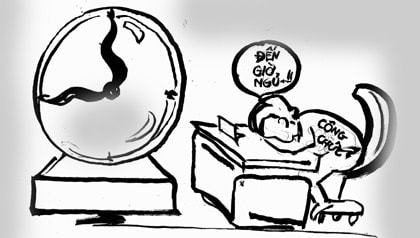
Illustration: Nam Phong
To streamline the system effectively, ensuring everyone has enough work for 8 hours a day and 26 days a month, the Ministry of Interior should adopt a different organizational structure than the current one. This would involve implementing a specialist-based system, eliminating departments within bureaus and agencies, and even abolishing departments within some ministries. Currently, the bureaucracy has become so bloated that the path from a specialist to a minister within a ministry is incredibly long. The organizational structure must be changed to a specialist-based system so that ministers and provincial governors can oversee each of their respective staff and specialists.
For example, each department or division only needs 4 to 5 skilled specialists to ensure smooth operation. After reorganizing the departmental (ministry) or provincial (provincial) structure, the number of staff will be determined through a selection process, with specialists assigned to handle individual tasks or two or three tasks per person. The criteria and content of the work will be issued by the Minister or the Provincial Chairman. Those who cannot handle the work will be retired or transferred to production agencies or enterprises, allowing them to work and pay themselves... This specialist-based organizational structure has many advantages. Specialists are autonomous in their work, proposing tasks directly to their superiors without going through intermediaries. They don't have idle time to waste outside of working hours, reducing the amount of taxpayers' money wasted on unproductive work.
Reducing the workforce and reorganizing the administrative apparatus cannot be just empty promises; it is an urgent task related to the integrity and responsiveness of the state apparatus to people's lives, related to the prestige of the Party and the government before the people, and related to the unreasonable waste of a huge amount of taxpayers' money!
The Prime Minister, the Ministry of Interior, and the Chairpersons of the People's Committees of the provinces must be held accountable to the people and the National Assembly for the ever-expanding bureaucracy and the lack of work for civil servants, instead of merely "disciplining" or "shaming" civil servants for "stealing working hours" as is currently the case...
Ngo Minh (Hue City)