

The revolutionary countryside is flourishing.
(Baonghean) - AboutIn Nghi Phong, Nghi Loc district, during those historic days of August, we clearly felt the resurgence of a rural area rich in revolutionary traditions. Now, Nghi Phong is gradually transforming and moving forward with rapid, comprehensive, and sustainable development.
The road to Nghi Phong commune is now wide, lined on both sides with rice paddies heavy with grain, and glimpses of spacious multi-story houses with tiled roofs. This revolutionary homeland has changed a great deal. Stopping at Phuong Cuong Temple (a National Historical and Cultural Monument), we heard stories about Nghi Phong's proud historical milestones. The people of Nghi Phong have a fervent patriotism and were early enlightened by the revolutionary cause.
In June 1930, the first Party cell in My Chiem, with 6 members, was established at Phuong Cuong Temple. Phuong Cuong Temple was also the operational base for many cadres, Party members, and the working offices of the Central Vietnam Regional Party Committee. When the Soviet 1930-31 revolution began, under the leadership of the Party cells, the revolutionary movement in Nghi Phong district developed strongly. The people of Nghi Phong rose up demanding a reduction in taxes and fighting against oppression and exploitation, culminating in the August 1945 revolution. On December 12, 1953, according to the Resolution of the Resistance and Administrative Committee of Inter-region IV on the division of administrative units, Ngu Hai commune, Nghi Loc district, was divided into three administrative units: Nghi Phong, Nghi Hai, and Nghi Xuan, and the name Nghi Phong commune has remained to this day.
During the two wars of resistance against French colonialism and American imperialism, the people of Nghi Phong mobilized all resources, readily meeting all needs to provide manpower and material support to the front lines, contributing to the cause of national liberation.
Today, continuing the tradition of its revolutionary homeland, Nghi Phong has overcome difficulties and exploited its local strengths to make breakthroughs and build a bright new image. With the policy of transforming the crop structure, shifting planting seasons, and applying science and technology to production, Nghi Phong's land, which previously produced two crops a year, now produces three main crops and develops high-yield, high-value crops. The commune has also established a model rice production field with high income in Phong Hoa and Phong Dien hamlets, covering 3 hectares; and two model vegetable production fields in Phong My and Phong Yen hamlets, covering 2 hectares.
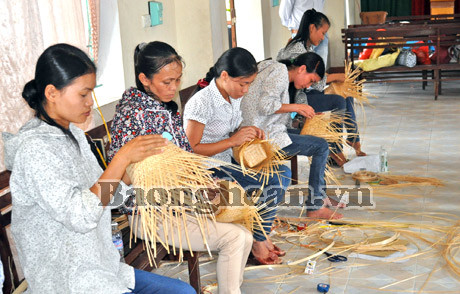
Bamboo and rattan weaving – a traditional craft that is being revived in Nghi Phong.
Alongside this, livestock and poultry farming, oriented towards commercial production, has developed strongly. To date, the entire commune has 28 small and medium-sized farms. Nghi Phong has 4 craft villages recognized by the province: Phong Canh, Phong Anh, and Phong Dien export-oriented rattan and bamboo weaving villages, and Phong Phu traditional paper-making village. In addition, many new industries such as electronics repair, mechanics, and transportation have also been established, providing employment for many workers. As a result, the poverty rate in the commune decreased to 9% by the end of 2012, the average per capita income was 21 million VND/person/year; and the average economic growth rate reached 11-12%.
Thanks to economic development and people's unity, the Party Committee has effectively mobilized resources to invest in infrastructure and welfare projects, making the rural areas increasingly prosperous. In recent years, many infrastructure projects have been built in Nghi Phong. The rural road system has been basically paved with concrete, meeting the standards of the New Rural Area program. Currently, the commune is focusing on investing in internal village and field roads.
Implementing the new rural development program, in the first six months of 2013, the entire commune donated 3,435 square meters of garden land for rural road construction, demolished over 200 meters of fences, and 1,600 square meters of agricultural land to expand the grounds and village cultural centers. Multi-story school buildings were constructed, including a primary and kindergarten school meeting national standards, with the goal of building a secondary school meeting national standards by the end of 2013. The commune also achieved national standards in healthcare; 12 out of 22 villages and 3 schools/health stations were recognized as cultural villages and units.
Along with leading economic development and improving people's lives, the Party Committee of the commune also regularly pays attention to and cares for building a strong political system. Political security and social order are maintained and stable, and the people of both Catholic and non-Catholic faiths are united in building their homeland. The Party Committee has achieved the "clean and strong" status for 7 consecutive years and has been recognized by the Nghi Loc District Party Committee as an exemplary "clean and strong" Party Committee for 4 consecutive years…
Thanh Le