

Africa: From "the continent of hope" to "the continent of hope"
The 21st African Union (AU) Summit is taking place in Addis Ababa, Ethiopia, to commemorate the 50th anniversary of the Organization of African Unity (OAU), the predecessor of the current AU, with a call for all Africans to realize the dream of a united, peaceful, and prosperous continent.
The 21st African Union (AU) Summit is taking place in Addis Ababa, Ethiopia, to commemorate the 50th anniversary of the Organization of African Unity (OAU), the predecessor of the current AU, with a call for all Africans to realize the dream of a united, peaceful, and prosperous continent.
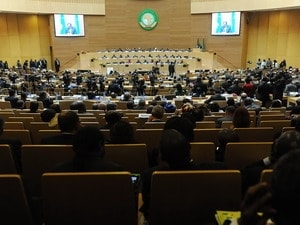
A panoramic view of the annual session within the framework of the AU Summit in January this year. (Source: AFP/VNA)
This is considered a significant milestone in the development of this continent.
Half a century ago, on May 25, 1963, the pioneering leaders of the African national liberation movement met in Addis Ababa to establish the OAU with the goal of promoting solidarity, unity, and enhanced regional cooperation to improve the living conditions of the people.
The OAU Charter, signed on the spot by the heads of state of 32 countries and later by 21 others, emphasizes: "We all desire a united Africa, united not only in concept but also in our desire to move forward together."
From its inception, the OAU demonstrated a spirit of solidarity and unity by closely coordinating with each other in the tireless struggle for the self-determination of peoples and human rights, helping numerous nations gain independence.
Not only did the OAU make a significant contribution to the liberation struggle across the continent to escape colonialism and apartheid, but it also provided a single framework for collective action in Africa.
However, in the context of a changing global order and the need to accelerate the integration process, OAU member states recognized the need to transform the organization into one with new objectives and a new name.
Therefore, the AU was established at the OAU Summit in Lomé, Togo, on July 11, 2000. Inheriting the spirit of solidarity and unity of the OAU, over the past decade, the AU has played a crucial role in addressing the multifaceted challenges facing Africa and enhancing the continent's standing on the international stage. From being perceived as a "continent of hope," Africa is now referred to as a "continent of hope."
Since its inception, the AU has rapidly pursued its goal of strengthening international and regional cooperation, advocating for African interests in international forums to serve the continent's revitalization.
Pursuing one of its primary goals, "promoting peace, security, and stability on the continent," the AU has deployed interventions to address instability in many member states, with the deployment of a large and effective peacekeeping force in Somalia being one of its notable achievements.
Economically, backed by the AU, the African economy has experienced positive growth over the past decade and currently boasts a growth rate exceeding 5%, making it the second-fastest-growing economic region in the world, amidst the financial crises in many other regions. And Africa's momentum is likely to continue, as recent surveys reveal vast reserves of oil and gas, particularly natural gas, in several countries across the continent.
Many economists share the view that Africa, rich in natural resources and with a young population, could experience an economic boom if it could resolve its protracted conflicts, improve its institutions, attract investment, and strengthen regional and international integration.
Speaking ahead of the "Golden Anniversary Celebration," Dr. Nkosazana Dlamini-Zuma, Chair of the AU Commission, stated: "This year could be a turning point for Africa, because never before in history have we had so many advantages, never before have we had so much potential for development. We also never before have we had such a young, dynamic, and highly educated population. These advantages need to be transformed into meaningful opportunities towards lasting prosperity and peace for the entire continent."
Alongside the progress made in many areas, the AU is also facing enormous challenges, particularly in its efforts to ensure a peaceful environment for development.
Currently, nearly 10 African countries are embroiled in conflict, with the transition of government in Somalia being threatened by the Al Shabaab Islamist militant group, the crisis in Mali turning the country into a gateway for al-Qaeda to penetrate deeper into Africa, and the uprising in the Democratic Republic of Congo potentially destabilizing neighboring countries.
In addition, poverty, unemployment, inequality, and disease, especially HIV/AIDS, are also challenges that cannot be solved overnight.
A crucial immediate and long-term task for the AU is to heal the rifts among member states, particularly the increasingly sharp political divide between French-speaking and English-speaking countries.
Therefore, the AU's declaration of 2013 as the "Year of Pan-Africanism and African Revival" serves as a reminder of the spirit of solidarity and unity for development that the continent's leaders emphasized half a century ago.
According to (VNA) - DT
;
Other news
- China: Over 30 people dead due to floods.(17/05/2013)
- Tornadoes devastate the US, leaving 100 dead or injured.(17/05/2013)
- India: Heatwave reaches 45 degrees Celsius.(17/05/2013)
- Chinese coast guard vessel enters disputed waters again.(17/05/2013)
- The Philippines denies Taiwan's accusation of shooting someone dead.(18/05/2013)
- North Korea replaces its Vice Minister of Defense.(18/05/2013)
- Cannes Film Festival thrown into chaos after shooting.(18/05/2013)
- North Korea fired three short-range guided missiles.(18/05/2013)
- Iraq: Multiple bombings leave over 110 casualties.(20/05/2013)
- Thailand: Red Shirts commemorate the 3rd anniversary of "bloodshed".(20/05/2013)
.
.
.
.
.