
Vẫn còn nhiều việc phải làm
Nguồn tài nguyên phong phú, chỉ là một trong những điều kiện quan trọng để phát triển ngành công nghiệp xản xuất xi măng. Kèm theo đó, còn rất nhiều vấn đề liên quan như: Cơ chế, chính sách thu hút đầu tư; thu hút được nhà đầu tư có tiềm lực, tâm huyết; hạ tầng kỹ thuật; Quy hoạch, định hướng phát triển; thời cơ … Bởi chưa hội tụ đầy đủ những yếu tố đó, Nghệ An đang gặp khó khăn trong thực hiện mục tiêu trở thành trung tâm sản xuất xi măng lớn của cả nước.
(Baonghean) Nguồn tài nguyên phong phú, chỉ là một trong những điều kiện quan trọng để phát triển ngành công nghiệp xản xuất xi măng. Kèm theo đó, còn rất nhiều vấn đề liên quan như: Cơ chế, chính sách thu hút đầu tư; thu hút được nhà đầu tư có tiềm lực, tâm huyết; hạ tầng kỹ thuật; Quy hoạch, định hướng phát triển; thời cơ … Bởi chưa hội tụ đầy đủ những yếu tố đó, Nghệ An đang gặp khó khăn trong thực hiện mục tiêu trở thành trung tâm sản xuất xi măng lớn của cả nước.
Những “Gam màu xám”
Ngành công nghiệp sản xuất xi măng của Nghệ An được đánh giá là có bề dày truyền thống. Với sự ra đời từ rất sớm của Nhà máy xi măng Cầu Đước và Nhà máy xi măng 12/9 Anh Sơn, đúng ra, đây sẽ là nền tảng vững chắc để tỉnh ta phát triển mạnh mẽ ngành sản xuất xi măng, nhưng thực tế lại khác.
Trên lý thuyết, nếu cộng tổng công suất của tất cả các nhà máy xi măng hiện có trên địa bàn tỉnh thì có con số 1,648 triệu tấn/năm (gồm: Xi măng Hoàng Mai 1,4 triệu tấn; Xi măng Cầu Đước 0,072 triệu tấn; Xi măng Dầu khí 12/9 là 0.088 triệu tấn và xi măng Hợp Sơn 0,088 triệu tấn). Nhưng thực tế, ngoại trừ Xi măng Hoàng Mai (đi vào sản xuất từ năm 2002) với công nghệ lò quay, là sản xuất - kinh doanh ổn định, còn lại hầu hết các nhà máy xi măng đều “tụt dốc”.
Nhà máy xi măng Cầu Đước, với dây chuyền sản xuất lò đứng công nghệ lạc hậu, sản phẩm chất lượng không cao, khó tiêu thụ. Đã vậy, khi hoạt động còn gây ô nhiễm môi trường. Sản phẩm chủ lực của nhà máy hiện nay, không phải là xi măng, chủ yếu mua nguyên liệu Clanhker về nghiền, với sản lượng rất ít. Hiện nay, nhà máy chuyển hướng sang làm các loại vật liệu xây dựng. Còn tại xi măng Dầu khí 12/9 và Hợp Sơn - Anh Sơn cũng do công nghệ sản xuất lạc hậu (lò quay), nên cũng đang trong tình trạng, sản xuất cầm chừng, chờ đợi đầu tư dự án mới. Công nghệ làm xi măng lạc hậu, năng lực sản xuất kém, sản phẩm khó cạnh tranh với thị trường…, đó là những “gam màu xám” của các doanh nghiệp trong ngành sản xuất xi măng ở Nghệ An.
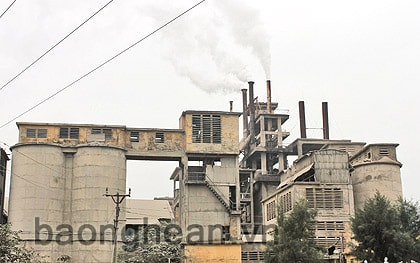
Sản xuất xi măng công nghệ lò quay đã lạc hậu ở Công ty CP xi măng Cầu Đước.
Limestone and clay are the main raw materials for the cement industry. Many localities in the province, such as Quynh Luu, Hoang Mai, Nghia Dan, Do Luong, Anh Son, and Con Cuong, have abundant resources. However, due to outdated cement plant technology, low capacity, and inconsistent quarrying processes, the value of limestone-based products has not been fully realized. Furthermore, quarrying wastes resources, causes significant environmental and ecological damage. According to surveys and explorations by relevant agencies, the province has reserves of over 4 billion cubic meters of limestone, over 1 billion tons of clay, and hundreds of millions of tons of additives such as basalt, kaolin, and iron ore. In addition, there are approximately 4-5 million tons of coal (in Tuong Duong and Con Cuong), a type of long-fired coal with high calorific value, suitable for cement firing. With such large reserves, any investor in the cement industry would be attracted and want to get involved. Thus, the resource advantage of the cement industry in our province is enormous, but it has not been effectively exploited; in fact, this resource is being exploited to serve cement production projects in other provinces.
For generations, the Len, Kim Giao, Rang Cua, and Da Bac mountain ranges, composed of limestone and clay, held no economic significance or value for the people of Tan Thang commune and the surrounding areas of Quynh Luu district. However, recent surveys indicate that this area contains approximately 241 million tons of limestone and 36 million tons of high-quality clay, making it ideal for cement production. With these results, the local people have reason to hope that in the future, cement projects will be invested in the commune, providing them with jobs and income, and gradually transforming the rural landscape. Similar to Tan Thang, the people of Len Roi - Tan Ky area are very happy to learn that, after exploration and surveying, the limestone resources here have a total reserve of over 2,782 million tons, of good quality, and the Saigon Investment Group has decided to invest in implementing a project to build a large-scale cement and building materials production complex in Tan Ky.
However, to date, this valuable resource remains… a resource, because the project investor has “withdrawn.” The local people are facing environmental pollution and indiscriminate exploitation of the resource. Many unlicensed quarrying operations have sprung up. The mining process does not meet the requirements and regulations of the State, creating a constant danger that threatens the lives of workers due to the risk of mine collapse (not long ago, a quarry collapse occurred in Len Roi. Authorities arrested those involved for failing to comply with the law)…
As mentioned above, limestone and clay resources in our province are abundant, but they have not been effectively managed and exploited to serve the cement industry. One of the reasons for this situation is the lack of proper planning. This has created difficulties for investors in obtaining information and implementing projects. After a period of project implementation, the Tan Thang cement project's investor has now had its plan adjusted and supplemented from a reserve mineral mine plan to a plan for exploration and exploitation of mineral reserves as raw materials for cement production until 2020.
The Hoang Mai 2 cement plant project is also facing concerns about raw material sources, and several other projects are encountering difficulties and obstacles in planning raw material mining areas. The lack of synchronized planning for raw material areas greatly affects investor confidence. In recent years, our province has continuously innovated investment promotion efforts, issuing mechanisms and policies to attract investment in a transparent manner, resulting in many investment projects in the cement production sector.
However, some projects initially launched with considerable fanfare but quickly faded into obscurity. A prime example is the Saigon Investment Group's project to build a large-scale cement and building materials industrial complex in Tan Ky. The project, which began with a long-term investment, commenced construction of the Saigon - Tan Ky cement plant (May 19, 2010) with a designed capacity of nearly 1 million tons of cement per year in phase 1 (total investment of approximately 1,500 billion VND). Phase 2 would expand the capacity to 10,000 tons of clinker per day, with two production lines, equivalent to 4 million tons of cement per year.
Following the groundbreaking ceremony for the factory, which brought much hope to the people of Tan Ky and the provincial authorities, the project was met with high expectations. However, the wait dragged on for quite a long time, and ultimately, the province had to withdraw the investment license. Mr. Hong Truong, former General Director of the Saigon - Tan Ky Cement Plant project, once shared: “Due to difficulties in securing capital, if we continued investing, we would have to borrow from banks at commercial interest rates, and even then, it would be very difficult to obtain loans. The cement industry requires a long time, so investing with commercial interest rate loans would not be feasible.” There are many reasons for this failure, but it is clear that the investor lacked resources and chose an inappropriate investment phase (timing). Despite spending considerable funds on investment preparation, groundbreaking, land compensation, construction of auxiliary facilities, social activities, and charity work, the investor had to abandon the project.
For example, at the Hop Son cement project (formerly the 19/5 Anh Son Cement Plant), due to the investor's insufficient financial capacity to continue the project and the project's progress being delayed for years, the province revoked the investment certificate. It can be seen that from 2010 to the end of 2012, the cement market experienced complex developments, with many cement plants nationwide facing losses as production exceeded demand. Furthermore, this was exacerbated by Resolution 11-CP and the tightening of investment policies, along with the tightening and relatively high lending policies and interest rates of credit institutions. Because of these difficulties, several new cement investment projects, or joint ventures and partnerships, encountered difficulties in implementation in our province, such as Cau Duoc Cement, Do Luong Cement, and 12/9 Oil and Gas Cement…
Tín hiệu ấm dần...
Since the beginning of 2013, the cement and building materials market has shown signs of warming up. Cement consumption is currently growing at 10-15%, and is projected to continue increasing at 5-10% per year in the coming period. This positive outlook for the cement industry is due to the government's implementation of various stimulus policies, measures to alleviate difficulties for businesses, banks reducing lending interest rates, and the commencement of new construction investment projects. Furthermore, demand for household consumption is also trending upwards. This can be seen as a new opportunity for launching investment projects in the cement manufacturing sector.
Anticipating this trend, Tan Thang Cement, after a long period of "slow" investment, decided to accelerate progress in early August by organizing a contract signing ceremony and implementing the EP package for equipment supply with a total value of over 93.3 million USD. The equipment suppliers are world-renowned brands in cement production technology. According to the plan, after completing phase 1 of the project in 2016, Tan Thang Cement Plant will supply the cement market with 2 million tons of high-quality products annually. Mr. Nguyen Cao Dien, General Director of Tan Thang Cement Joint Stock Company, stated: “Identifying the market trends for cement consumption in Vietnam and the region, which demand high quality, reasonable prices, and sufficient capacity to fulfill contracts for large projects, the company has decided to invest in the most modern and advanced cement production technology currently available in the world, which is environmentally friendly, produces high-quality products, and creates a competitive advantage in the market.”
Currently, in Nghe An province, the Hoang Mai Cement Plant supplies over 1.4 million tons of cement annually, while other cement plants produce between 300,000 and 400,000 tons. However, according to surveys and statistics from relevant authorities, Nghe An province consumed 2.7 million tons of cement in 2011. Thus, there is still significant potential for cement plant projects within the province. Forecasts indicate that by 2015, cement consumption in the province will fluctuate between 3.3 and 4.95 million tons, and by 2020, it will reach approximately 7.2 to 8.8 million tons. This is significant and provides impetus for some investors to boldly enter the cement production sector.
The 12/9 Petroleum Cement Joint Stock Company in Anh Son district seized this opportunity and has been working diligently to complete a project with a capacity of 550,000 tons per year, using modern rotary kiln technology according to European standards. The project has a total investment of over 1.1 trillion VND and has completed several major components, including cement silos, heat exchange towers, bagging facilities, general warehouses, cement grinding plants, and kiln bases. The company is determined to complete the project in the fourth quarter of 2003 and begin producing its first tons of product in early 2014. Thanks to the abundant limestone raw material area (the planned mining area of the 12/9 cement company) with reserves of 49.5 million tons, the plant has favorable conditions for long-term operation.
Một dự án xi măng khác cũng đang nỗ lực triển khai, là Nhà máy xi măng Đô Lương. Sau nhiều năm lao đao, chuyển đổi qua nhiều chủ đầu tư mà vẫn khó có “bến đậu”. Hiện nay, Tập đoàn xi măng The Vissai – Ninh Bình đã chấp thuận tiếp nhận dự án, đồng thời lắp đặt thiết bị, công nghệ tiên tiến đạt công suất 2 triệu tấn/năm (thiết kế của dự án trước đây là công suất hơn 900 nghìn tấn/năm). Trước quyết tâm lớn của nhà đầu tư, UBND tỉnh đã có văn bản trình các cấp, ngành liên quan xem xét giải quyết. Rõ ràng, sự tăng tốc đầu tư của một số dự án xi măng là cách lựa chọn phù hợp với giai đoạn hiện nay.
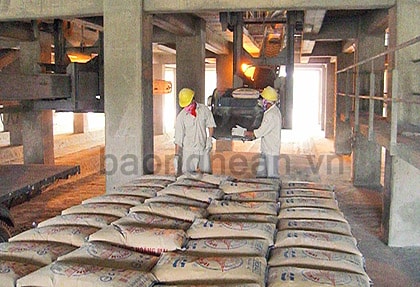
Cement products of Vicem Hoang Joint Stock Company.
Seize the opportunity...
In the coming period, it is likely that only 7 out of 46 cement projects (in the planning stage) nationwide will be completed and put into production (many cement projects have not been implemented due to a lack of investment capital). Therefore, from 2015 onwards, a shortage is predicted in the cement product segment, especially high-quality cement. According to economic experts, the current period is favorable for cement projects (already approved by the Government) to accelerate their completion.
According to the Vietnam Cement Industry Development Plan for the period 2011-2020 and orientation to 2030, as stipulated in Decision No. 1488/QD-TTg dated August 29, 2011, of the Prime Minister, Nghe An is one of four regions with significant potential for cement industry development nationwide, including: the Red River Delta region (Quang Ninh, Hai Phong, Hai Duong, former Ha Tay); Ninh Binh; Ha Nam; and the North Central region (Thanh Hoa, Nghe An, Quang Binh). Therefore, the goal of developing Nghe An into a major cement production center is appropriate; the remaining issue is how the province will organize its implementation.
To stimulate the development of the cement industry, in the coming period, along with continuing to improve the investment environment, reviewing, supplementing, and building preferential mechanisms and policies to support and encourage investment capital for cement production, and promoting the effectiveness of the "one-stop shop" and "integrated one-stop shop" mechanisms to quickly resolve investors' requests during project implementation, the issue of planning and granting raw material mine licenses needs timely attention. Currently, the procedures for granting mine licenses are quite complex, involving approval from many levels of government agencies. A comprehensive approach is needed: after evaluating and selecting suitable investors, the relevant provincial authorities should be responsible for supporting and creating favorable conditions for them.
In addition, the province needs to provide decisive direction to further improve the labor market information system, especially in training a skilled and high-quality workforce for cement manufacturing enterprises. Focus state budget support on building off-site infrastructure for projects. Apply financial and credit support policies and strengthen local capital mobilization from state-owned banks and credit institutions, shifting lending methods to project-based lending, directing capital flows into priority areas such as cement production and consumption...
To become a major cement production center of the country, Nghe An cannot rely solely on its abundant resources; much work remains to be done. However, with the attention and support of all levels and sectors, the strong innovation in the province's management and direction, the dedication and efforts of investors, and the agreement and support of the people, we will certainly achieve the goal of "becoming a major cement production center of the country."
Text and photos: Hoang Vinh