

Final article: Shamans then and now
(Baonghean) - Some say: When the people's intellectual level is raised to the point where they can erase their belief in heaven, gods, fate, and destiny, then religious beliefs will cease, and shamans will no longer have a reason to exist. This is quite reasonable, no one can argue with that! But when will that "when" be, and again, when exactly? Religious belief is a traditional belief, ingrained in people's consciousness, concerning mysterious natural forces and phenomena that humans have been unable to explain from ancient times to the present day.
(Baonghean) - Some say: When the people's intellectual level is raised to the point where they can erase their belief in heaven, gods, fate, and destiny, then religious beliefs will cease, and shamans will no longer have a reason to exist. This is quite reasonable, no one can argue with that! But when will that "when" be, and again, when exactly? Religious belief is a traditional belief, ingrained in people's consciousness, concerning mysterious natural forces and phenomena that humans have been unable to explain from ancient times to the present day.
We cannot count the total number of shamans practicing their profession in the villages of the Thai people across this vast western region of Nghe An province. In Quy Hop district alone, the total number of shamans in 12 out of 21 communes and towns, where the majority (or all) are Thai and Tho people, has reached nearly 60, meaning an average of 5 shamans per commune (data from 2006). There are also a similar number of unofficial shaman practitioners, not to mention the recent emergence of those practicing shamanism for superstitious purposes, which is impossible to control!
Some shamans are invited to perform rituals almost 25/30 days a month, constantly working according to clients' requests, performing all kinds of rituals, too many to list. Some even perform two official ceremonies and an unofficial, short-lived ceremony at night in a single day. However, the income of these shamans is meager. For each ceremony, depending on its nature and scale, the family contributes money in the offering tray, called "páng money." This money is meant to ensure the shaman performs the ritual smoothly and returns home safely to heaven and earth... essentially, it's the shaman's fee for the ceremony. This amount is usually between 50,000 and 100,000 dong per ceremony; wealthier families may contribute more, but no one contributes as much as 300,000 dong per ceremony.
The custom of paying shamans has always been limited; it's not a matter of wealth and giving as much as one wants. Conversely, shamans only dare to ask for a certain amount, demanding more would be a sin against heaven and the people performing the rituals. Performing rituals all day long, many shamans become exhausted, even requiring hospitalization or home visits for examinations and medication. One experienced shaman confided to us that once you've taken on this profession, you can't refuse a ritual when people invite you, unless you have a prior appointment or are seriously ill. Not attending a ritual means giving up the profession, and heaven won't forgive you for that... That's the life of a shaman. After the ritual was over, I asked my family to make me a bowl of instant noodles so I could swallow it. The table was full of food and drink, but I was exhausted; how could I possibly eat anything? Why is it that the more prosperous and wealthy people become, the more they call upon and need shamans?
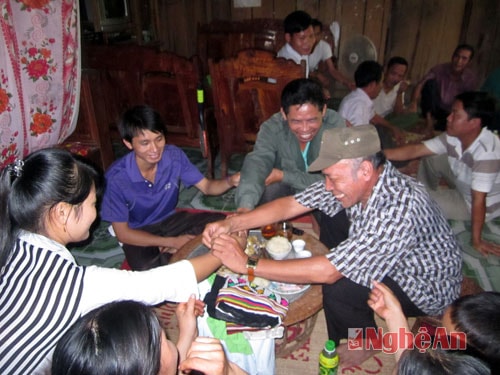 |
| The shaman performs a ceremony to welcome the bride to his home in Mon village, Thach Giam commune, Tuong Duong district. Photo: Huu Vi. |
Almost everything related to spirituality involves rituals, and these rituals are performed with the help of shamans. This is true even for ordinary people; educated government officials and civil servants also constantly seek out shamans to perform rituals to ward off bad luck and misfortune during their time in office.
So, shamans will likely continue to exist for a long time. That being said, we are not encouraging or paving the way for the shamanic profession to flourish. In the not-so-distant past, the shamanic profession has been repeatedly considered bad, harmful, and in need of elimination. In reality, many shamans have exploited the people's beliefs and faith to practice their profession unscrupulously, going against the original ideology, ethics, and traditions of the shamanic profession. As a result, many shamans have been condemned, despised by Thai society, and never invited to perform rituals for the rest of their lives.
There was a time when we cracked down hard on the shamanic profession. Frontline officials at all levels confiscated numerous parasols, paper fans, and chopsticks used by shaman Mot, and dozens of swords and other tools used by shaman Mon. All activities related to spirituality were abolished, disbanded, and all other materials used for rituals were confiscated on the spot and taken to the public treasury. The families were fined, and the shamans were summoned to the commune for re-education and to sign pledges not to practice shamanism again. The shamanic profession of the Thai people in western Nghe An was virtually wiped out for a long time; no one saw a single shaman anymore...
It wasn't until recent years, with the opening up of new mechanisms, the lives of the people gradually improved, and democracy expanded in cultural and spiritual aspects to move towards integration into the global economy… that the shamanic profession began to reappear. Many young shamans have started practicing the profession exactly like the veteran shamans of the past. Many have gone to learn shamanism hoping to find a new position for themselves in the community, given the country's economic and cultural openness! It's not just the young; there are even retired officials, no longer in power at their workplaces, who suddenly dreamt of being "given a divine mandate," then went to learn shamanism and quickly became skilled shamans… hence the recent emergence of "party-member shamans" as well…
Take the case of Mr. K (Quỳ Hợp district), for example. He was a state official, a party member, and had even worked for the Fatherland Front at the district level. He used to collect countless swords used by the Mon shamans, filling the space under his desk... But after retiring, he learned the shamanic trade and quickly became a famous Mon shaman in his commune…
| RELATED NEWS |
|---|
So, no one is forbidding shamans from practicing their profession. But today's society is moving in a completely new direction. Now, night after night, shamans sit watching television, encountering all sorts of new things about people and life, not just in their own villages, but all over the globe. People and events from some far-off place suddenly appear vividly before them, not from the Mường Then (a specific place name), but from the "scientific realm" created and brought about by people living on earth. It's laughable that some people today still go to learn the shamanic profession, hoping to make a living with their saliva and a little memory, and hoping to regain their lost position in the community in other fields, through the shamanic profession!
Thai Tam