

Tran Quang Dieu Street - A familiar street corner
(Baonghean)Long, winding streets, crisscrossed with countless small and large roads, undergo rapid changes... making it difficult for many to remember even a single street name. Strangely, even those who have lived on these streets for a long time rarely boast about their residence; it seems they want to preserve a special emotional connection to the street. Tran Quang Dieu Street (Vinh City), a name often difficult for people from other areas to recognize, only to realize upon arrival that they have walked and sat on this street countless times before...
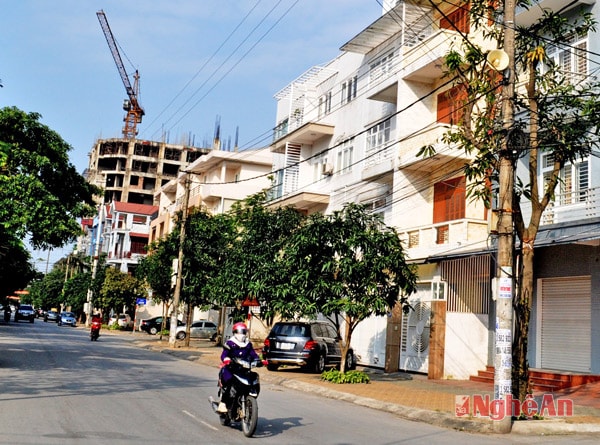 |
| East of Tran Quang Dieu Street (Vinh City). |
| RELATED NEWS |
|---|
Several decades ago, the street served as the frontage for the state-owned offices of many provincial departments and agencies. At that time, the road was only paved with gravel, with small paths occasionally carved through vegetable and peanut fields to connect to Truong Thi Street for officials going to and from these departments and agencies. When the offices of these agencies were expanded and built more modernly on the west side to align with Truong Thi Street, Tran Quang Dieu Street was widened thanks to the planning of residential areas on the east side. However, the street still retains a quietness, causing people from other streets to remember the way there but forget the street name. Perhaps this is because most residents are civil servants, with children attending daycare, parents commuting to and from work, and the commercial services on the main street haven't yet spread here, resulting in less of the usual street life and interaction.
Just a few years ago, the street had a quiet atmosphere, the lingering scent of milk flowers carried on the late autumn breeze, with a few visitors coming to simple cafes like Moc, 4A, and especially Cafe Quynh, whose owner was an electronics enthusiast with sound systems worth tens of thousands of dollars, specializing in listening to music by Trinh Cong Son, Pham Duy, Van Cao, Nguyen Van Thuong... with old vinyl records of Khanh Ly, Kieu Hung, and Tran Hieu from decades ago. In the few small corners of the street, there were only a handful of draft beer and roasted peanut stalls, or perhaps a slightly better option with beef tendon soup, but the owners were all polite and accommodating, attracting a diverse clientele of civil servants, laborers, and retired teachers.
Now, apart from the agencies: the Provincial Police's Immigration Department, the Cadre Health Protection Board, the Truong Thi Ward headquarters... which have maintained their appearance for decades; along both sides of the street, there are rapid changes due to the continuous renovation of single-story houses into three or four-story buildings, the clearing of land for the construction of modern apartment complexes and hotels, and especially the rapid proliferation of small cafes and eateries attracting customers, making the street much livelier, but without the usual hustle and bustle of city streets...
Perhaps, the saying that every street has its own inherent purpose is true for Tran Quang Dieu Street. People from all corners of Vinh City come here to find relaxation, meet up, and conduct business. Next to Cafe 67 (a gathering place for Honda 67 motorcycle enthusiasts) is the house of a renowned retired musician. Every morning, he leisurely rides his motorbike to the provincial-level professional association meeting, feeling strangely content by the peacefulness of this beloved bustling street. Opposite the musician's house is the villa of a widowed contractor, over 70 years old, but with rosy cheeks, dressed youthfully, driving a car, his gray hair styled with gel, elegant yet still possessing the sophistication of a seasoned man; he's a familiar face at every breakfast spot and every cafe on the street, and no one ever sees him lacking in decorum.
The street is so refined that even the handsome shoe shiner, who looks like a movie star, meticulously polishes every detail, whether the shoes are expensive or worn by ordinary people, yet he still charges the same price—just a few thousand dong, as he has for the past three or four years. The bustling street is also familiar with a disabled man in a wheelchair. No one knows where he lives, but every morning he diligently rolls his withered legs along the street, never begging for help. However, at every intersection, he patiently stops, waiting for an acquaintance to help him push his wheelchair across the road. It turns out he's collecting acts of kindness from others...
What's strange is that this street, bustling with people drinking coffee and enjoying food from morning till night, still maintains a quiet, unassuming atmosphere—rarely noisy, rarely rude, with owners and customers feeling like kindred spirits. I've been back on this street for three years, witnessing its rapid changes. But my soul is still lingering in the enchanting scent of milk flowers in late autumn, wafting along the street; in the quietness of the late-night street where even those jogging late seem to tread lightly; in the fleeting moments beside the rough concrete blocks on the sidewalk—not entirely moss-covered, not necessarily serving as meaningful historical evidence, but three-dimensional structures on the smooth sidewalk along the wall of Truong Thi Secondary School, speaking in the street's words as what remains of the old Truong Thi railway factory, where those who love the street can stop and sit, reminiscing about the time when the street was born...
Tran Quang Dieu Street intersects more than a dozen large and small streets named after famous figures (An Duong Vuong, Dinh Bat Tuy, Ngo Sy Lien, Tran Thu Do...); people traveling in and out of these neighborhoods from Phong Dinh Cang Street or from Truong Thi Street along the East-West axis are familiar with the names of the streets running across it. This is also one reason why people easily forget the name of Tran Quang Dieu Street, although they cannot forget that, if they want to linger, meet, and relax a little along this "journey across," they cannot help but seek out a small space clinging to this street along its length, following the familiar footsteps they have visited so many times.
Winter has passed. There's no lingering mist by the lake in the early morning, no bustling street dust in the dawn... but on one of those rare sunny mornings, amidst the chill of spring, anyone who loves Vinh City should try visiting Tran Quang Dieu Street, sipping a cup of coffee on the "coffee street," and surely they'll feel a rare sense of humility in this new street in the Red City…
| Tran Quang Dieu was one of the key military commanders of the Tay Son Rebellion (his birthplace is currently unknown); his wife was Admiral Bui Thi Xuan, another famous general of the Tay Son dynasty. After the victory of the Ky Dau year in 1789, Tran Quang Dieu, then serving in the central army under Nguyen Hue (later Emperor Quang Trung), was appointed governor of Nghe An, simultaneously defending the province and overseeing the construction of Phuong Hoang Trung Do citadel there. Later, under the reigns of Emperor Quang Trung and Emperor Canh Thinh (Quang Toan), he made many great contributions and was promoted to the rank of Grand Tutor. When the Tay Son army officially fell to the Nguyen army, in early 1802, Tran Quang Dieu led his troops through Laos to Nghe An to join forces with Emperor Canh Thinh. However, upon reaching Quy Hop district and entering Huong Son territory, he learned that Nghe An citadel had fallen. Tran Quang Dieu and his wife and children returned to Thanh Chuong district. A few days later, his entire family was captured by the Nguyen army and later sentenced to death. Streets in many cities across the country are named after him. |
Dinh Sam