
To ensure the sustainable development of Cua Tile-Making Village
(Baonghean) - The Cua tile-making village (Nghia Hoan - Tan Ky) was recognized as a traditional craft village by the Provincial People's Committee in 2006. It is one of the rare craft villages in the country that has continued to develop during the economic downturn and has won many prestigious titles. However, due to undemocratic practices, conflicts have arisen, leading to prolonged disputes. The situation is now threatening to bring the craft village to a standstill.
(Baonghean) - The Cua tile-making village (Nghia Hoan - Tan Ky) was recognized as a traditional craft village by the Provincial People's Committee in 2006. It is one of the rare craft villages in the country that has continued to develop during the economic downturn and has won many prestigious titles. However, due to undemocratic practices, conflicts have arisen, leading to prolonged disputes. The situation is now threatening to bring the craft village to a standstill.
The remarkable development of the Cừa tile-making craft.
Cừa – a place name in Nghĩa Hoàn commune, about 12 km from the center of Tân Kỳ district. Originally a poor rural area, it has now transformed thanks to a mine of sticky black clay suitable for brick and tile making. According to some locals, in early 1980, Mr. Hoàng Anh Kiếm, originally from Hà Nam Ninh, came to work here and discovered the valuable clay mine in Cừa field. He invested money to build a Cừa tile kiln. To expand the scale, in 1984-1985, Mr. Kiếm persuaded four more households – Hoàng Văn Tự, Hoàng Văn Tần, Đặng Xuân Quế, and Thái Bá Ngô – to open tile kilns. Due to the profitability of tile making, the number of households investing in tile making continued to increase. By 2006, the Cừa tile-making village had 125 participating households with 137 tile kilns, some households having two kilns, and this has remained stable to this day. The products of the Cừa tile-making village are supplied to markets throughout the central provinces, favored by consumers for their durability, smooth finish, beautiful designs, and more affordable prices compared to many other tiles of similar quality. As a result, most tile makers in Nghĩa Hoàn own tall, beautiful houses and expensive cars. The development of this craft has also contributed to the increasing prosperity of Nghĩa Hoàn town. To recognize, honor, and further develop the Cừa tile-making village, the People's Committee of Nghệ An province officially recognized it as a Cừa tile-making village in Decision No. 956/QD.UBND dated March 21, 2006.
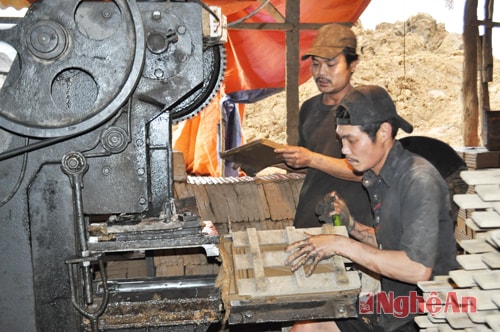 |
| The Cua Nghia Hoan tile-making village provides employment for nearly 1,000 workers. |
After being recognized as a traditional craft village, the households jointly established the Cừa Tile-Making Village Cooperative with an initial charter capital of 1,272 million VND, a total of 125 members, 959 skilled workers, and nearly 1,500 unskilled workers. While in 2005, the village only achieved a revenue of 41,040 million VND and after-tax profit of 1,750 million VND, after 3 years of establishing the cooperative, it reached a revenue of 80,900 million VND, after-tax profit of 13,060 million VND, and contributed 2 billion VND to the state budget. By 2012, the cooperative's total revenue reached 120 billion VND, after-tax profit reached 17.826 billion VND, contributed 2.1 billion VND to the state budget, average income was 66.5 million VND per worker per year, and average income per member was 190 million VND per year. The majority of the villagers in the craft village are wealthy households (80 out of 125 households), owning nearly 100 cars of various types and 16 bulldozers. Income from Cừa tiles accounts for 54.4% of the entire Nghia Hoan commune's economy. Many households are successful producers, such as Nguyen Van Hanh, Hoang Van Binh, Dang Xuan Luong, Vo Van Cau, Ho Xuan Dong, etc.
To achieve this, the Cooperative's management board has invested capital in expanding production and business, innovating technology, equipment, and infrastructure. They have actively and proactively cooperated with mass media agencies to promote the Cừa tile brand. They have also proactively collaborated with partners and sales agents inside and outside the province to sell products and expand the market. The Cooperative has also organized seminars on technological innovation and product quality improvement. Production facilities have proactively invested in stamping machines, extrusion machines, and infrastructure, innovating production equipment from the clay preparation stage to the finished product. As a result, Cừa tiles are increasingly durable, aesthetically pleasing, and accepted by the market at reasonable prices. The Cooperative is determined to build a small industrial zone to ensure environmental hygiene and protect the health of workers. In phase 1, members of the craft village have implemented the construction and installation of a high-tech raw material feeding system with a total value of 9.3 billion VND.
From 2003 to 2012, the cooperative received 6 commendations from the Provincial People's Committee for its achievements in the excellent production and business movement; 5 commendations from the Ministry of Industry and Trade and the Vietnam Cooperative Union; and the title of "Strong Production and Business Cooperative Nationwide" in 2008. In 2010, it was awarded the title of "Outstanding Labor Collective" by the Nghe An Provincial People's Committee; and the title of "Outstanding Advanced Cooperative Nationwide" for 10 years (2003-2012) by the Vietnam Cooperative Union. In 2013, it received a certificate of honor and a commemorative medal from the Central Association of Vietnamese Craft Villages. The Vietnam Institute of Quality awarded it the Gold Medal for Vietnamese Quality; the Hanoi People's Newspaper awarded it the Gold Cup for Sustainable Development of Traditional Brands; and Mr. Nguyen Van Hanh, the Chairman of the Cooperative, received 2 commendations from the Provincial People's Committee for his outstanding performance in 2008-2009 and 2011-2012.
In the success of the craft village today, many cooperative members and local leaders acknowledge the dedication and contributions of the Cooperative Chairman, Nguyen Van Hanh. As the first chairman since the cooperative's establishment, he has spearheaded and overseen all operations. Mr. Hanh has reformed economic thinking, introduced new technologies into production, resulting in increasingly higher quality tiles, reduced labor costs, and shorter working hours. In his role as manager, the cooperative forecasts market demand annually, regulates overall production, and stipulates that each household cannot produce more than 500,000 tiles per year. This eliminates the "big fish eat small fish" mentality, where everyone works independently. Now, there is no longer a situation where some people produce too much and others too little. The kilns operate independently based on the floor price set by the cooperative; the cooperative only manages quality, electricity, collects taxes from households, and ensures security and order in the craft village. These regulations are all reflected in the charter and the annual plan presented at the General Assembly. Mr. Hanh has also successfully leveraged the Party and State's policies on developing cooperative economics and traditional craft villages to build increasingly modern cooperatives and craft villages, leaving a positive impression on customers. The work of nurturing brand development has been effective.
We need to "separate the wheat from the chaff."
Despite achieving some successes, the hasty, undemocratic approach and personal misconduct of the Cooperative Chairman have led to prolonged conflicts and disputes among the members of the Cừa tile-making village cooperative. If not resolved definitively, the village could face a deadlock. Members Nguyen Trong Huong and Vo Van Cau reported: The General Assembly of the Cừa tile-making village cooperative for the 2009-2014 term elected three people to the Management Board and one auditor. During his tenure, Mr. Nguyen Van Hanh repeatedly insulted Mr. Nguyen Hai Khanh and Mr. Dang Xuan Sy – Vice-Chairmen of the Cooperative, and Mr. Thai Ba Cuong – auditor, during meetings. As a result, these individuals submitted resignation letters. Subsequently, Mr. Nguyen Van Hanh unilaterally appointed Mr. Nguyen Tien Cuong as Vice-Chairman without the approval of the General Assembly. Therefore, nearly 50% of the members submitted petitions requesting an extraordinary general meeting, but Mr. Nguyen Van Hanh did not organize the extraordinary general meeting.
Some cooperative members also alleged: Regarding economic management: In 2009, Mr. Nguyen Van Hanh signed a contract to purchase an excavator for the cooperative worth 2,040,000,000 VND, but the official invoices only showed 1,700,000,000 VND, with over 300 million VND showing signs of misappropriation. In 2010, Mr. Nguyen Van Hanh signed a contract to purchase a production line from An Phu Company worth nearly 360 million VND; to date, the contract has expired, but the technology has not been handed over, causing economic losses to the cooperative amounting to the aforementioned sum…
The conflict intensified when the cooperative launched a project to upgrade its production line for high-quality roof tiles, worth 10 billion VND, using contributions from its members. This was phase 1 of a modern tile production line aimed at eliminating manual brick and tile kilns, in line with the government's policy. Of the 125 members, only 53 households participated in contributing. The remaining members cited several reasons: many households hadn't contributed enough money, some lacked confidence, and some believed that if the government was eliminating manual brick kilns, it should support the investment, and they didn't want to contribute their own money. They argued that investing in a new production line and new tunnel kilns would inevitably lead to the elimination of their old tile kilns, and they would bear the losses.
Following an inspection, on December 31, 2013, the Tan Ky District People's Committee issued Conclusion No. 19, pointing out seven violations committed by the Management Board and Mr. Nguyen Van Hanh, the Chairman of the Cua Tile-Making Village Cooperative. These violations are:
1. Mr. Nguyen Van Hanh, representing the cooperative, signed a contract with An Phu Company to supply a production line with a total contract value of 2,882 million VND, but failed to secure the necessary land for installation. As a result, the contract could not be fulfilled, and the 350 million VND transferred to An Phu Company has not yet been refunded.
2. The management board of the cooperative, headed by Mr. Nguyen Van Hanh, due to limited legal awareness and lax management and operation of the cooperative's economy, made payments for the purchase of an excavator contrary to the terms of the contract, violating financial principles. Although there is no basis to conclude on signs of personal gain, this act has caused suspicion and negative public opinion among the cooperative members, resulting in a loss of 34 million VND in state budget VAT.
3. Mr. Hanh did not develop a plan and followed the correct procedures to build a pilot furnace for producing new products using the new technology. Although the cooperative installed a hydraulic press to create new products through the pilot furnace, resulting in profit and initial improvements in product quality, the profits were not commensurate with the total investment costs.
4- Ông Hạnh không xây dựng kế hoạch chi tiết, không xây dựng dự toán đầu tư cụm công nghiệp theo chủ trương của Đảng, Nhà nước để toàn thể xã viên bàn bạc, vì vậy dẫn đến nhiều xã viên thiếu quyết tâm đầu tư, nghi ngờ lẫn nhau;
5- Ông Hạnh sử dụng tiền của HTX làm từ thiện, hỗ trợ các tổ chức, cá nhân có một số mục chi còn thiếu dân chủ;
6- Ông Hạnh không có phương án phù hợp để duy trì và nâng cao hiệu quả hoạt động của nhà xưởng dùng để sữa chữa máy móc cho xã viên, mặc dù đã đầu tư 205.084.000 đồng vào xây dựng nhà xưởng;
7- Ông Hạnh chưa công khai đầy đủ hoạt động kinh tế và chưa công khai quyết toán vốn điều lệ của HTX... UBND huyện Tân Kỳ cũng đã yêu cầu HTX, trực tiếp là ông Nguyễn Văn Hạnh khắc phục các sai phạm nêu trên.
Qua kết luận của UBND huyện Tân Kỳ và quá trình tìm hiểu cho thấy, mặc dù có vai trò đóng góp quan trọng đối với sự phát triển của Làng nghề ngói Cừa, song không phải vì thế mà Ban quản lý HTX và cá nhân ông Chủ nhiệm Nguyễn Văn Hạnh có quyền để xẩy ra những sai phạm nghiêm trọng như vậy. Điều này đang đẩy Làng nghề ngói Cừa lâm vào bế tắc. Ban quản lý HTX và cá nhân ông Nguyễn Văn Hạnh cần thật sự rút ra bài học kinh nghiệm sâu sắc. Trong quá trình thực hiện các nhiệm vụ phát triển làng nghề, cần phải công khai, dân chủ, thực hiện đúng quy trình để tạo được sự đồng thuận của các thành viên Ban quản lý và xã viên HTX, có như thế HTX làng nghề ngói Cừa mới phát triển một cách bền vững.
Trong điều kiện hiện nay, sự cạnh tranh của thị trường ngói ngày càng khốc liệt, trong khi đó mỏ đất tốt ở Cừa đang ngày một cạn kiệt, chỉ còn lại là đất thừa đất tận dụng. Nếu HTX không đầu tư đổi mới công nghệ, không có máy làm đất, ngói làm ra không đều, không mịn, giá thành không cạnh tranh thì rất khó chiếm lĩnh thị trường. Ban quản lý HTX không chỉ đơn thuần là vận hành HTX, thu thuế hộ, thu tiền điện hộ… mà còn phải tâm huyết, không ngại đổi mới, biết đầu tư, tổ chức về chiến lược sản xuất, kinh doanh, để sản phẩm ngói Cừa không ngừng tăng sức cạnh tranh trên thị trường. Vì vậy, các xã viên HTX Làng nghề ngói Cừa cần đồng thuận, sáng suốt, “gạn đục, khơi trong”, đánh giá đúng “công” và “tội” của Ban quản lý cũng như cá nhân ông Nguyễn Văn Hạnh trong quá trình phát triển làng nghề, tạo điều kiện cho Ban quản lý làm việc, đưa làng nghề ngày một phát triển… Các xã viên HTX cũng đừng vì những định kiến cá nhân mà tổ chức khiếu kiện kéo dài theo kiểu “đạp đổ”, gây mất ổn định làng nghề. Điều này đang làm ảnh hưởng xấu tới “thương hiệu” ngói Cừa, làm cho Làng nghề ngói Cừa không những có nguy cơ ngày một đi xuống, mà tài sản, vốn liếng của các xã viên còn bị thâm hụt, thua lỗ, quyền lợi các thành viên của HTX sẽ không được đảm bảo.
Xã viên Hồ Xuân Đông ở đội 1, ngói Cừa: “Tôi nhận thấy ông Hạnh là người tâm huyết với làng nghề, làm được nhiều việc cho làng nghề, nhưng nóng tính, khi quyết định thì ít khi thông qua toàn dân mà chỉ bàn bạc ở tổ, đội, chứ ông Hạnh không vụ lợi. Bản thân tôi từ khi tham gia HTX, đời sống của gia đình tôi hơn hẳn. Nhà cửa của xã viên ai cũng đàng hoàng, mọi người có xe hơi. Chỉ từ khi HTX có thương hiệu, sản xuất càng mạnh hơn. Nghề ngói hơn hẳn các nghề khác ở Tân Kỳ”. Còn ông Nguyễn Cường một xã viên khác cho rằng: “Trước đây mọi người sản xuất nhỏ lẻ, mạnh mún, tự lo mọi thứ, nay vào HTX được Nhà nước đầu tư đường sá thuận lợi, điện, hỗ trợ công nghệ… hoạt động có quy củ, có tổ chức, thu chi ghi chép rõ ràng. Trước HTX góp công, góp sức, nay phải góp vốn, đầu tư làm ăn lớn. Nếu HTX không chọn được người biết quản lý đồng vốn của xã viên để làm ăn cho hiệu quả thì gay to”. Ông Hà Văn Biển – Chủ tịch UBND xã Nghĩa Hoàn: HTX đầu tư dây chuyền sản xuất phôi ngói mới rất tốt. Chúng tôi hoàn toàn nhất trí cao. Có thể nói, nếu việc tham gia đầu tư vào dây chuyền mới là việc sống còn, ai không tham gia sau này cũng phá sản. Bởi mỏ đất hiện nay là đất thừa thẹo, đất tận dụng, nếu không có máy làm đất, ngói làm ra không đều, không mịn thì rất khó bán. Tham gia vào dây chuyền làm phôi, ban đêm lao động được nghỉ ngơi, không phải đập, đùn đất. |
Bài, ảnh: Trân Châu