
To ensure the sustainable development of Cua Tile-Making Village
(Baonghean) - The Cua tile-making village (Nghia Hoan - Tan Ky) was recognized as a traditional craft village by the Provincial People's Committee in 2006. It is one of the rare craft villages in the country that has continued to develop during the economic downturn and has won many prestigious titles. However, due to undemocratic practices, conflicts have arisen, leading to prolonged disputes. The situation is now threatening to bring the craft village to a standstill.
(Baonghean) - The Cua tile-making village (Nghia Hoan - Tan Ky) was recognized as a traditional craft village by the Provincial People's Committee in 2006. It is one of the rare craft villages in the country that has continued to develop during the economic downturn and has won many prestigious titles. However, due to undemocratic practices, conflicts have arisen, leading to prolonged disputes. The situation is now threatening to bring the craft village to a standstill.
The remarkable development of the Cừa tile-making craft.
Cừa – a place name in Nghĩa Hoàn commune, about 12 km from the center of Tân Kỳ district. Originally a poor rural area, it has now transformed thanks to a mine of sticky black clay suitable for brick and tile making. According to some locals, in early 1980, Mr. Hoàng Anh Kiếm, originally from Hà Nam Ninh, came to work here and discovered the valuable clay mine in Cừa field. He invested money to build a Cừa tile kiln. To expand the scale, in 1984-1985, Mr. Kiếm persuaded four more households – Hoàng Văn Tự, Hoàng Văn Tần, Đặng Xuân Quế, and Thái Bá Ngô – to open tile kilns. Due to the profitability of tile making, the number of households investing in tile making continued to increase. By 2006, the Cừa tile-making village had 125 participating households with 137 tile kilns, some households having two kilns, and this has remained stable to this day. The products of the Cừa tile-making village are supplied to markets throughout the central provinces, favored by consumers for their durability, smooth finish, beautiful designs, and more affordable prices compared to many other tiles of similar quality. As a result, most tile makers in Nghĩa Hoàn own tall, beautiful houses and expensive cars. The development of this craft has also contributed to the increasing prosperity of Nghĩa Hoàn town. To recognize, honor, and further develop the Cừa tile-making village, the People's Committee of Nghệ An province officially recognized it as a Cừa tile-making village in Decision No. 956/QD.UBND dated March 21, 2006.
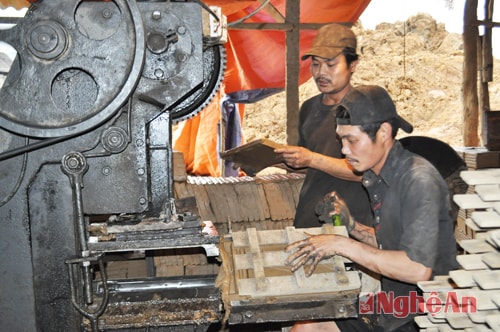 |
| The Cua Nghia Hoan tile-making village provides employment for nearly 1,000 workers. |
After being recognized as a traditional craft village, the households jointly established the Cừa Tile-Making Village Cooperative with an initial charter capital of 1,272 million VND, a total of 125 members, 959 skilled workers, and nearly 1,500 unskilled workers. While in 2005, the village only achieved a revenue of 41,040 million VND and after-tax profit of 1,750 million VND, after 3 years of establishing the cooperative, it reached a revenue of 80,900 million VND, after-tax profit of 13,060 million VND, and contributed 2 billion VND to the state budget. By 2012, the cooperative's total revenue reached 120 billion VND, after-tax profit reached 17.826 billion VND, contributed 2.1 billion VND to the state budget, average income was 66.5 million VND per worker per year, and average income per member was 190 million VND per year. The majority of the villagers in the craft village are wealthy households (80 out of 125 households), owning nearly 100 cars of various types and 16 bulldozers. Income from Cừa tiles accounts for 54.4% of the entire Nghia Hoan commune's economy. Many households are successful producers, such as Nguyen Van Hanh, Hoang Van Binh, Dang Xuan Luong, Vo Van Cau, Ho Xuan Dong, etc.
To achieve this, the Cooperative's management board has invested capital in expanding production and business, innovating technology, equipment, and infrastructure. They have actively and proactively cooperated with mass media agencies to promote the Cừa tile brand. They have also proactively collaborated with partners and sales agents inside and outside the province to sell products and expand the market. The Cooperative has also organized seminars on technological innovation and product quality improvement. Production facilities have proactively invested in stamping machines, extrusion machines, and infrastructure, innovating production equipment from the clay preparation stage to the finished product. As a result, Cừa tiles are increasingly durable, aesthetically pleasing, and accepted by the market at reasonable prices. The Cooperative is determined to build a small industrial zone to ensure environmental hygiene and protect the health of workers. In phase 1, members of the craft village have implemented the construction and installation of a high-tech raw material feeding system with a total value of 9.3 billion VND.
From 2003 to 2012, the cooperative received 6 commendations from the Provincial People's Committee for its achievements in the excellent production and business movement; 5 commendations from the Ministry of Industry and Trade and the Vietnam Cooperative Union; and the title of "Strong Production and Business Cooperative Nationwide" in 2008. In 2010, it was awarded the title of "Outstanding Labor Collective" by the Nghe An Provincial People's Committee; and the title of "Outstanding Advanced Cooperative Nationwide" for 10 years (2003-2012) by the Vietnam Cooperative Union. In 2013, it received a certificate of honor and a commemorative medal from the Central Association of Vietnamese Craft Villages. The Vietnam Institute of Quality awarded it the Gold Medal for Vietnamese Quality; the Hanoi People's Newspaper awarded it the Gold Cup for Sustainable Development of Traditional Brands; and Mr. Nguyen Van Hanh, the Chairman of the Cooperative, received 2 commendations from the Provincial People's Committee for his outstanding performance in 2008-2009 and 2011-2012.
In the success of the craft village today, many cooperative members and local leaders acknowledge the dedication and contributions of the Cooperative Chairman, Nguyen Van Hanh. As the first chairman since the cooperative's establishment, he has spearheaded and overseen all operations. Mr. Hanh has reformed economic thinking, introduced new technologies into production, resulting in increasingly higher quality tiles, reduced labor costs, and shorter working hours. In his role as manager, the cooperative forecasts market demand annually, regulates overall production, and stipulates that each household cannot produce more than 500,000 tiles per year. This eliminates the "big fish eat small fish" mentality, where everyone works independently. Now, there is no longer a situation where some people produce too much and others too little. The kilns operate independently based on the floor price set by the cooperative; the cooperative only manages quality, electricity, collects taxes from households, and ensures security and order in the craft village. These regulations are all reflected in the charter and the annual plan presented at the General Assembly. Mr. Hanh has also successfully leveraged the Party and State's policies on developing cooperative economics and traditional craft villages to build increasingly modern cooperatives and craft villages, leaving a positive impression on customers. The work of nurturing brand development has been effective.
We need to "separate the wheat from the chaff."
Despite achieving some successes, the hasty, undemocratic approach and personal misconduct of the Cooperative Chairman have led to prolonged conflicts and disputes among the members of the Cừa tile-making village cooperative. If not resolved definitively, the village could face a deadlock. Members Nguyen Trong Huong and Vo Van Cau reported: The General Assembly of the Cừa tile-making village cooperative for the 2009-2014 term elected three people to the Management Board and one auditor. During his tenure, Mr. Nguyen Van Hanh repeatedly insulted Mr. Nguyen Hai Khanh and Mr. Dang Xuan Sy – Vice-Chairmen of the Cooperative, and Mr. Thai Ba Cuong – auditor, during meetings. As a result, these individuals submitted resignation letters. Subsequently, Mr. Nguyen Van Hanh unilaterally appointed Mr. Nguyen Tien Cuong as Vice-Chairman without the approval of the General Assembly. Therefore, nearly 50% of the cooperative members submitted petitions requesting an extraordinary general meeting, but Mr. Nguyen Van Hanh did not organize the extraordinary general meeting.
Some cooperative members also alleged: Regarding economic management: In 2009, Mr. Nguyen Van Hanh signed a contract to purchase an excavator for the cooperative worth 2,040,000,000 VND, but the official invoices only showed 1,700,000,000 VND, with over 300 million VND showing signs of misappropriation. In 2010, Mr. Nguyen Van Hanh signed a contract to purchase a production line from An Phu Company worth nearly 360 million VND; to date, the contract has expired, but the technology has not been handed over, causing economic losses to the cooperative amounting to the aforementioned sum…
The conflict intensified when the cooperative launched a project to upgrade its production line for high-quality roof tiles, worth 10 billion VND, using contributions from its members. This was phase 1 of a modern tile production line aimed at eliminating manual brick and tile kilns, in line with the government's policy. Of the 125 members, only 53 households participated in contributing. The remaining members cited several reasons: many households hadn't contributed enough money, some lacked confidence, and some believed that if the government was eliminating manual brick kilns, it should support the investment, and they didn't want to contribute their own money. They argued that investing in a new production line and new tunnel kilns would inevitably lead to the elimination of their old tile kilns, and they would bear the losses.
Following an inspection, on December 31, 2013, the Tan Ky District People's Committee issued Conclusion No. 19, pointing out seven violations committed by the Management Board and Mr. Nguyen Van Hanh, the Chairman of the Cua Tile-Making Village Cooperative. These violations are:
1. Mr. Nguyen Van Hanh, representing the cooperative, signed a contract with An Phu Company to supply a production line with a total contract value of 2,882 million VND, but failed to secure the necessary land for installation. As a result, the contract could not be fulfilled, and the 350 million VND transferred to An Phu Company has not yet been refunded.
2. The management board of the cooperative, headed by Mr. Nguyen Van Hanh, due to limited legal awareness and lax management and operation of the cooperative's economy, made payments for the purchase of an excavator contrary to the terms of the contract, violating financial principles. Although there is no basis to conclude on signs of personal gain, this act has caused suspicion and negative public opinion among the cooperative members, resulting in a loss of 34 million VND in state budget VAT.
3. Mr. Hanh did not develop a plan and followed the correct procedures to build a pilot furnace for producing new products using the new technology. Although the cooperative installed a hydraulic press to create new products through the pilot furnace, resulting in profit and initial improvements in product quality, the profits were not commensurate with the total investment costs.
4. Mr. Hanh did not develop a detailed plan or prepare an investment budget for the industrial cluster in accordance with the Party and State's policy for all cooperative members to discuss, thus leading to many cooperative members lacking the determination to invest and harboring suspicions among themselves;
5. Mr. Hanh used the cooperative's money for charitable purposes, supporting organizations and individuals, but some of the expenditures lacked transparency.
6. Mr. Hanh did not have a suitable plan to maintain and improve the efficiency of the workshop used for repairing machinery for cooperative members, despite having invested 205,084,000 VND in its construction;
7. Mr. Hanh has not fully disclosed the economic activities and has not publicly disclosed the capital settlement of the cooperative... The Tan Ky District People's Committee has also requested the cooperative, specifically Mr. Nguyen Van Hanh, to rectify the aforementioned violations.
Based on the conclusions of the Tan Ky District People's Committee and subsequent investigation, it is evident that, despite their significant contribution to the development of the Cua Tile-Making Village, the Cooperative Management Board and its Chairman, Mr. Nguyen Van Hanh, do not have the right to allow such serious violations to occur. This is pushing the Cua Tile-Making Village into a deadlock. The Cooperative Management Board and Mr. Nguyen Van Hanh need to learn a profound lesson. In carrying out tasks to develop the village, transparency, democracy, and adherence to proper procedures are essential to gain the consensus of the Management Board members and cooperative members. Only then can the Cua Tile-Making Village Cooperative develop sustainably.
In the current market, tile market competition is increasingly fierce, while the supply of good quality clay in Cừa is dwindling, leaving only leftover and usable soil. If the cooperative doesn't invest in technological innovation and machinery for clay preparation, the tiles produced will be uneven, not smooth, and uncompetitive, making it difficult to capture the market. The cooperative's management board should not simply operate the cooperative, collect taxes, and handle electricity payments, but must also be dedicated, unafraid of innovation, and invest in strategic production and business planning to ensure Cừa tiles continuously enhance their competitiveness in the market. Therefore, the members of the Cừa Tile-Making Village Cooperative need to be united, discerning, and properly assess the "merits" and "faults" of the Management Board and Mr. Nguyen Van Hanh personally in the development of the village, creating favorable conditions for the Management Board to work and further develop the village. Cooperative members should also avoid prolonged lawsuits based on personal prejudices that threaten to "destroy" the village, causing instability. This is negatively impacting the "brand" of Cừa tiles, putting the village at risk of decline, depleting the assets and capital of the members, and jeopardizing the rights of the cooperative members.
Cooperative member Ho Xuan Dong from Team 1, Cua tile factory: “I find Mr. Hanh to be a dedicated person who has done many things for the village, but he is hot-tempered. When making decisions, he rarely consults everyone but only discusses them within the group or team, and Mr. Hanh is not self-serving. Since joining the cooperative, my family's life has improved significantly. All the members have decent houses, and many own cars. Since the cooperative gained a brand name, production has become even stronger. The tile-making profession is far superior to other professions in Tan Ky.” Another cooperative member, Mr. Nguyen Cuong, added: “Previously, everyone produced on a small scale, independently, and took care of everything themselves. Now, with the cooperative's investment in roads, electricity, and technological support from the government, operations are more organized and structured, with clear records of income and expenses. Before, the cooperative contributed labor and effort; now, we have to contribute capital and invest in large-scale business. If the cooperative doesn't choose someone who knows how to manage the members' capital effectively, it will be a big problem.” Mr. Ha Van Bien – Chairman of the People's Committee of Nghia Hoan Commune: The cooperative's investment in a new tile blank production line is excellent. We completely agree. It can be said that participating in this new production line is crucial for survival; anyone who doesn't will go bankrupt later. The current clay mine uses leftover, scrap clay, and without machinery to process the clay, the tiles produced will be uneven and rough, making them difficult to sell. By participating in the blank production line, workers can rest at night and don't have to pound or push the clay. |
Text and photos:Pearl


