

Hung Dung Ward: The mark of 20 years from "village" to "town"
(Baonghean) - Lang Do (Red Village) is a name that commemorates a time of heroic and tenacious revolutionary struggle by the people of the former Yen Dung Thuong region, now Hung Dung. It also serves as a driving force for the people of this land to strive in building their homeland, especially in the past 20 years, since Hung Dung officially transitioned from a "commune" to a "ward".
(Baonghean) - Lang Do (Red Village) is a name that commemorates a time of heroic and tenacious revolutionary struggle by the people of the former Yen Dung Thuong region, now Hung Dung. It also serves as a driving force for the people of this land to strive in building their homeland, especially in the past 20 years, since Hung Dung officially transitioned from a "commune" to a "ward".
Heroic land
Perhaps there are few places quite like Yen Dung Thuong, a land where even its name embodies a spirit of heroism and bravery. History records that many traces of the Dong Son civilization remain here, and it was considered a "protective barrier" during the period when Emperor Quang Trung chose Chan Loc district in Nghe An to build his capital.
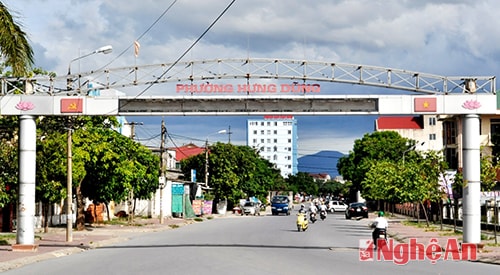 |
| A view of Hung Dung ward (Vinh City) |
This area has undergone several name changes, from Dung Quyet, Yen Dung Thuong, Yen Dung, to Van Phong, a former commune of Hung Nguyen district. The name Hung Dung officially came into use in 1953 and became part of Vinh City from 1957, when Vinh city began to expand… The name Lang Do (Red Village), however, is associated with the historical event of the Nghe An - Thinh Hoa Soviet of 1930-1931. Here, on April 3, 1930, under the direct guidance of the Vinh Provincial Party Committee, the Party branch of Yen Dung Thuong commune was established at the Duc Thanh Mausoleum - Mu Nuoi hamlet. In August 1930, the Central Vietnam Regional Party Committee and its agencies were established in Yen Dung Thuong commune. Under the direction of the Central Vietnam Regional Party Committee and the Vinh Provincial Party Committee, in September 1930, Yen Dung Thuong commune organized a large rally at Dinh Trung demanding that the village headman and local officials hand over their seals, books, and documents. Simultaneously, they declared the abolition of the old government and the establishment of a Soviet government led by the Party branch, with its headquarters located at Dinh Trung. During this struggle, the people of Yen Dung Thuong suffered great losses. At times, the enemy brought soldiers to build fortifications in the commune and carried out extremely brutal repression. Fifteen outstanding individuals, Party members and key cadres of the commune, were executed or imprisoned by the enemy. However, this did not intimidate the people; on the contrary, it fueled their indignation and indomitable fighting spirit until the revolution succeeded.
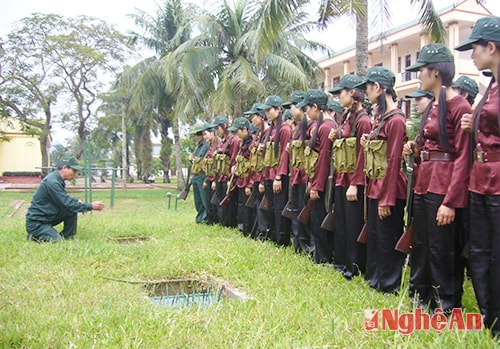 |
| Female militia members of Lang Do village undergo military training. |
During the anti-American war, Hung Dung was known as the "village surrounding the artillery," because it was a key strategic location with many military and political targets, and therefore frequently bombarded by the enemy. Through 592 battles, the land of Hung Dung was almost completely leveled by the enemy with 5,674 bombs, 104 rockets, and 350 artillery shells… But it was also here that the people and soldiers of Hung Dung repeatedly coordinated with anti-aircraft units to shoot down enemy aircraft and capture many American pilots. Therefore, the verse: "Borrowing the moonlight of the night / Opening the way / For vehicles to return to Tan Ve / For artillery to land in Phong Xuan…" remains etched in the memory of the people of Hung Dung, a reminder of that fiery era.
The "revolution" from "commune" to "ward," from "village" to "city."
Until the early 1990s, Hung Dung was still a poor agricultural commune. Only about 5-7% of households were well-off, 20% had level 4 tiled houses, and the rest were mostly thatched houses; there were no multi-story buildings. Hung Dung only truly broke through after August 23, 1994, when the Prime Minister issued a Decree establishing Hung Dung ward. Faced with a lack of and inconsistent infrastructure, and the reality of the people's difficult, poor, and backward living conditions, the Party Committee and government of Hung Dung ward were extremely concerned. This reality was also the reason why, during the three terms of the 23rd, 24th, and 25th Party Congresses (from 1990 to 2005), the Congress Resolutions always focused on the main contents of accelerating urbanization, shifting the economic structure, and building a cultural life. However, this was no easy task, as the region's old customs still relied on small-scale production, and the ideology of private ownership remained deeply ingrained in the people. Therefore, implementation had to begin with propaganda and mobilization efforts. The goal was to make the people aware and understand that the benefits from the common cause would bring individual advantages to each family and welfare to the entire society. With determination and the right choices, the people of Hung Dung unanimously supported and together created an urban revolution. In this revolution, hundreds of families voluntarily donated thousands of square meters of land, dismantled dozens of buildings, and contributed thousands of man-days of labor... serving the cause of urban development. These results not only had material value, but also opened up new ways of doing things, new perceptions, and eradicated the ideology of small-scale, peasant production.
This also serves as a foundation for the ward to gradually shift its economic structure, starting with exploiting favorable locations to encourage residents to expand and develop their businesses and trade, contributing to increased budget revenue. In addition, cooperatives are transforming their operations towards multi-sectoral approaches. Small-scale handicraft cooperatives, in particular, have innovated their capital mobilization methods, developing membership through household and legal entity representation to increase human resources and technical means, meeting the demands of market competition. Simultaneously, the ward continues to focus on agricultural economics by arranging a rational structure of crops, livestock, and seasons to increase productivity. Regarding culture, the ward aims to develop in a way that both promotes the traditional cultural values of the homeland and preserves the traditions and cultural values of each family lineage, thereby building a unique and sustainable cultural life characteristic of the region.
These efforts have now been reflected in the numbers: 100% of the blocks in Hung Dung ward now have cultural centers with an investment value of approximately 1 billion VND, mostly with an area of over 600 m2, contributing to the creation of synchronized cultural institutions; 100% of schools have been upgraded to multi-story buildings and have standard auxiliary facilities; 99% of the ward's internal roads have been concreted, and many other economic and public welfare projects have been completed, with a total investment of nearly 50 billion VND, of which the people contributed about 7 billion VND (not including land value and labor). Reflecting on the past 20 years, Mr. Nguyen Duc Trung - Secretary of the Party Committee of Hung Dung ward - said: "That period left the most memorable marks and can be likened to a revolution. This result stems from the spirit of unity, proactively overcoming difficulties, dynamism, and creativity in leadership and management." It represents the unwavering pursuit of goals in all areas, regardless of the circumstances. It also demonstrates the unity and solidarity of the people in the region, reflecting the strength and traditional will of the ancient Red Village, the culmination of countless generations who have fallen and strived wholeheartedly for the liberation and development of their homeland and country.
Looking back over the past 20 years is also an opportunity for the Party Committee, government, and people of Hung Dung to identify strengths and weaknesses so that in the coming time, Hung Dung ward can take faster and more breakthrough steps, moving towards developing into a central urban area of the city.
Text and photos:My Ha