
Red address for traditional education
(Baonghean) - “Nghe An and Ha Tinh truly deserve the title of ‘Red’” - the praise of Comrade Nguyen Ai Quoc for the people of Nghe An and Ha Tinh affirmed the historical significance and influence of the Nghe An-Ha Tinh Soviet Uprising in the hearts of every son and daughter of the Central region in particular and the entire country in general. 85 years - a long journey with countless ups and downs of history, but the fervent patriotism and the spirit of solidarity against foreign invaders of the 1930-1931 period remain intact in today's era.
(Baonghean) - “Nghe An and Ha Tinh truly deserve the title of ‘Red’” - the praise of Comrade Nguyen Ai Quoc for the people of Nghe An and Ha Tinh affirmed the historical significance and influence of the Nghe An-Ha Tinh Soviet Uprising in the hearts of every son and daughter of the Central region in particular and the entire country in general. 85 years - a long journey with countless ups and downs of history, but the fervent patriotism and the spirit of solidarity against foreign invaders of the 1930-1931 period remain intact in today's era.
In the handbook of historical revolutionary sites, the Thai Lao Martyrs' Memorial, located along National Highway 46 passing through Hung Nguyen town, cannot be overlooked. This is a memorial to the 217 martyrs who fell on September 12, 1930, when the Nghe Tinh Soviet Uprising reached its peak with the uprising of approximately 8,000 farmers. Of those who perished in the massacre by the French colonialists at that time, a few were brought back by their relatives for burial, but the majority lie in a mass grave in the Thai Lao field.
In 1956, the Nghe An Provincial Department of Culture was assigned by the Provincial Party Committee and the Provincial People's Committee to build the Thai Lao Martyrs' Cemetery. In 1960, the cemetery was completed on a relatively modest scale, only about 200 square meters. In 1961, during President Ho Chi Minh's second visit to his hometown, he visited the Thai Lao Martyrs' Memorial and instructed: "The blood of the martyrs who sacrificed themselves in the Nghe Tinh Soviet movement has further embellished the Party's flag. Cadres and people must build and protect this area into a revolutionary historical site." In 1988, the Ministry of Culture, Sports and Tourism issued a decision recognizing the Thai Lao Martyrs' Memorial as a national historical site. By 2009, the Provincial People's Committee developed a project to renovate and upgrade the memorial area to a scale of 12.9 hectares. Currently, many basic structures have been completed, such as the church, the cemetery, the triple-arched gate, etc., and construction is underway on other items.
Aware of the importance of preserving and promoting historical values, a team of staff members is assigned to be on duty at Thai Lao Martyrs' Cemetery, ensuring the maintenance and cleaning of the landscape, welcoming visitors and delegations who come to offer incense and flowers, as well as serving the people who come to commemorate the souls of the martyrs. In addition, students from schools throughout the province, and particularly in Hung Nguyen district, such as Thai Lao High School and Le Hong Phong Junior High School, regularly organize groups to clean up the cemetery, participate in activities, listen to explanations and learn about the history of the struggle of their ancestors.
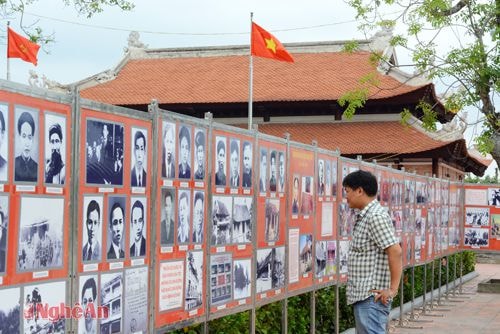 |
| A thematic photo exhibition titled "The Nghe Tinh Soviet of 1930-1931" is being held in the grounds of the Thai Lao Martyrs' Memorial Area (Hung Nguyen). |
Another stop for those interested in learning about the revolutionary traditions of the resilient Nghe An province is the Nghe Tinh Soviet Museum, with its spacious grounds nestled on Dao Tan Street. Located near the Vinh Ancient Citadel, it preserves the profound and ancient charm of a city undergoing daily transformation. The museum houses artifacts that bear witness to the heroic and indomitable struggle of the working class and peasants. Established in 1960, it holds the status of a specialized museum dedicated to the Nghe Tinh Soviet Uprising – an invaluable legacy of the first revolutionary movement under the Party's leadership. Currently, it houses 15,000 documents and artifacts, including 6,500 original documents and artifacts, 2,000 pages of French-language materials, 5,000 files of revolutionary fighters, and hundreds of memoirs. Approximately 500 of the most representative artifacts were selected for display, attracting tens of millions of visitors from all over the country and abroad.
Each exhibit, each artifact, is linked to authentic stories, partly recreating the vibrant and powerful atmosphere of the Nghe Tinh Soviet struggle movement of yesteryear. Leaflets; drums that once resonated during the 1930-1931 uprisings, rallying the people; weapons of the Red Self-Defense units in Anh Son and Thanh Chuong; objects used for printing and concealing documents, serving revolutionary cadres' meetings; reliefs depicting the struggle of that era… all are preserved intact, seemingly waiting for a call to action. The image of thousands of farmers and workers protesting for reduced taxes, shorter working hours, and equal rights, despite the oppressive colonial rule, will flood the minds of visitors to the museum.
More than just a place to preserve artifacts, the Soviet-Nghe Tinh Museum is also a school of revolutionary history, educating and instilling patriotism and national pride in the younger generation. Each year, the museum welcomes 17,000-18,000 visitors, of which over 10,000 are students, demonstrating the significant need for historical knowledge among the future leaders of the country. Comrade Nguyen Xuan Thuy - Director of the Museum, said: “Since 2007, the Nghe Tinh Soviet Museum has advised the Provincial People's Committee, the Department of Culture, Sports and Tourism, and the Department of Education and Training to sign a cooperation plan to bring the Nghe Tinh Soviet tradition education into schools. To date, the program has achieved many positive results, including the production of one documentary film and two extracurricular lectures on the Nghe Tinh Soviet for 9th and 12th grade students. Every year, the Museum also cooperates with the Vinh City Department of Education and Training to bring students to visit and study, organize extracurricular activities at the Museum, and regularly cooperates with the education sector to organize 10-12 cultural exchange competitions, historical research contests, and mobile exhibitions to bring images of the Nghe Tinh Soviet to schools, contributing positively to educating the younger generation about patriotic and revolutionary traditions, and is recognized by the people.”
Thu Giang