

Setting targets for the Congress: It is necessary to adhere closely to reality and make accurate predictions.
(Baonghean) - Resolutions of Party congresses at all levels are comprehensive documents, encompassing assessments of the implementation of targets and tasks, drawing lessons learned, and setting key goals, tasks, and solutions for the next term. However, at some grassroots-level congresses, the preparation of political reports, especially the setting of goals and targets, requires adjustments and forecasts that closely reflect the actual situation.
Accurately assess the reality.
Directive No. 36-CT/TW, dated May 30, 2014, of the Politburo on Party Congresses at all levels leading up to the 12th National Congress of the Party clearly states: “The political report of the Party committee must accurately assess the situation, strengths, weaknesses, and causes, especially subjective causes; link the review of leadership in implementing the Party committee's political tasks with the implementation of the Party Charter, Central Committee resolutions, especially Resolution No. 4 (11th Congress) on Party building and the study and emulation of Ho Chi Minh's moral example; clearly define the goals and tasks of the Party committee in the fields of socio-economic development, national defense and security, foreign affairs, and Party building in the next term.” Through monitoring the preparation and organization of Party Congresses at all levels in the province, the above directive has been thoroughly understood and implemented relatively systematically by grassroots Party organizations, creating new momentum and enthusiasm for the new term.
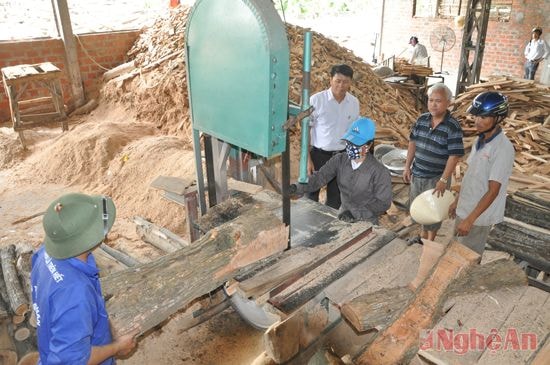 |
| A timber processing facility in Nghia Khanh commune (Nghia Dan district). |
In Nghia My commune (Thai Hoa town), starting from a purely agricultural commune, the socio-economic conditions were more difficult compared to the general level of the town. However, in the spirit of closely adhering to the resolution's objectives associated with building new rural areas, during the 2010-2015 term, under the leadership of the commune's Party Committee, Nghia My implemented solutions to effectively utilize internal resources and external resources for development. Particularly in the economic field, recognizing that as a purely agricultural commune, it must develop through agriculture because it is closely linked to the lives of the majority of the people, Nghia My commune established a 50-hectare model field specializing in the production of high-yield, high-quality hybrid rice; simultaneously, it implemented models for vegetable production such as green squash with a yield of 70 tons/ha; and livestock farming gradually shifted from small-scale, scattered farming to family farms and semi-industrial livestock farming… contributing to increasing the value per unit of cultivated area. Agricultural transformations have contributed to the commune's economic growth rate of 21.8% during the 2010-2015 term, significantly higher than the set target. Furthermore, the commune achieved the New Rural Development (NRD) goal in 2014. However, the Party Committee of the commune seriously assessed that two targets set forth in the Congress Resolution have not been met: the New Cultural Family and the Cultural Village; and regarding Party building, two targets have also not been achieved: the Party Committee has not consistently achieved the "Strong and Excellent" rating, and the recruitment of new Party members has not reached 50% of the target. In the spirit of reviewing the achievements and shortcomings, Nghia My commune has set out directions for the 2015-2020 term. Comrade Le Van Tuu, Secretary of the Nghia My Commune Party Committee, stated: “The commune Party Committee has been very objective in evaluating the implementation of the Resolution, proposing solutions to overcome existing weaknesses and shortcomings. Based on this, we have unanimously agreed on the goal of effectively exploiting the local potential and strengths, continuing to improve and sustain the new rural development criteria, and striving to be one of the top communes in Thai Hoa Town.”
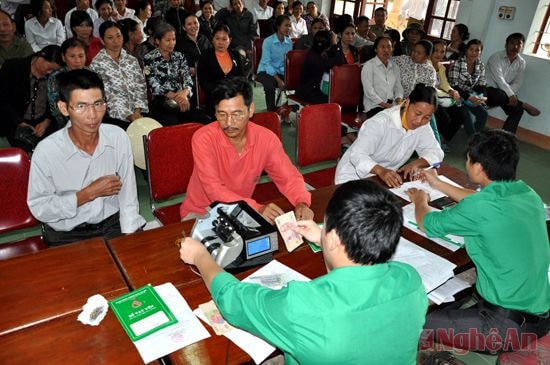 |
| Officials from the Dien Chau branch of the Social Policy Bank disburse funds to residents of Dien Lam commune. |
Entering the Nghia Khanh Commune Party Congress (Nghia Dan District) for the 2015-2020 term, cadres and Party members here are very excited because the commune has achieved quite comprehensive results during the term. Economic growth reached 17.5% (compared to the target of 15%), average per capita production value reached 21.86 million VND (compared to the target of 18.19%), and the poverty rate was only 4.9% (compared to the target of 5-7%). Furthermore, during the 2010-2015 term, Nghia Khanh was the first commune in Nghia Dan District to successfully implement land consolidation and exchange, increasing mechanization in various stages of production, creating a shift in the local labor structure. Nghia Khanh is currently completing the procedures for assessment to achieve the new rural standard. Former Party Secretary of Cu Xuan Long commune shared: “When setting goals and targets, the commune's Party committee always focuses its intellect and bases them on the actual conditions of the locality such as land, labor, and the ability to shift the economic structure... while also consulting with district leaders and specialized departments to develop them. Accordingly, Nghia Khanh's goal in the next term will be to become the central market town of the southwestern region of Nghia Dan district.”
The Que Phong District Party Committee is one of the grassroots-level Party committees selected by the Provincial Party Standing Committee to hold a pilot congress. During the 2010-2015 term, the most outstanding achievement of this mountainous district's Party committee was in the agricultural sector, with many effective models implemented and replicated, forming key products and specialty crops and livestock with high economic value such as passion fruit and Japonica rice. These achievements, combined with the efficient use of resources, contributed to reducing the district's poverty rate from 59% in 2010 to 34.36% in 2015. However, the Political Report of the Que Phong District Party Congress for the 2015-2020 term also clearly indicated that economic growth fell below its potential, averaging only 17.83% annually (the Congress target was 29-29.5%/year). Some economic indicators were not met or were met at low levels, the economic structure has shifted in the right direction but lacks sustainability, and the implementation of the New Rural Development Program is still slow. Que Phong district has not yet escaped from poverty.
Meanwhile, in Con Cuong District Party Committee, although significant achievements have been made in socio-economic development, national defense, and security over the past five years under the leadership of Party committees at all levels, a general assessment reveals that some targets and tasks have not been met as initially projected, such as hydropower, pulp production for export, urban development, and transportation infrastructure projects. Some large-scale projects have fallen short of their targets, such as tea cultivation (385 hectares/planned 900-1,150 hectares, production of 4,088 tons/planned 14,432 tons), pulp production for export (45,000 tons), and electricity generation not yet operational. This has led to many important economic indicators failing to meet the targets set by the 25th Party Congress, specifically: the average growth rate only reached 4.94%/16-17% of the Congress target. Budget revenue fell short of the projected target of 56 billion VND/120 billion VND set at the congress. Investment capital mobilization for development reached over 2,000 billion VND/8,000-9,000 billion VND, only achieving 28%. During the discussion, Comrade Vi Xuan Giap, Secretary of the Con Cuong District Party Committee, stated: “These shortcomings are due to the general impact of the economic downturn, and also because the Government has temporarily suspended the separation and establishment of the new Tra Lan town, thus the province has not prioritized investment in building a central economic, cultural, and social urban area in the Southwest region of Nghe An province. Meanwhile, the socio-economic infrastructure remains weak and does not meet development needs. Furthermore, some targets were set too high, not reflecting reality, capabilities, and resources. The programs and projects developed have low feasibility.” According to our findings, these shortcomings have been seriously addressed by the Con Cuong District Party Committee and incorporated into the Political Report prepared for the District Party Congress for the 2015-2020 term.
Vision and forecasting capabilities for the entire period
Through several examples from grassroots and higher-level Party committees that have held or are currently holding Party Congresses for the 2015-2020 term, it can be seen that the work of preparing the Political Report, especially the assessment of implementation results, has been frankly evaluated by grassroots Party organizations, acknowledging both strengths and weaknesses. This is a necessary step to set directions and goals for the next five-year term that are "both grounded in reality and ensure a proactive approach." For instance, based on the actual results achieved, the recent Party Congress of Que Phong district identified agriculture, rural areas, and farmers as the top priority in its development orientation and guidance. Accordingly, agriculture is defined as a comprehensive, efficient, and sustainable development, promoting close cooperation among the "four stakeholders": farmers, scientists, businesses, and the state, based on effectively exploiting the value of plants and animals suitable to the local climate and soil conditions, especially indigenous plant and animal varieties. This is also considered the main direction for Que Phong to escape poverty, as Comrade Lu Dinh Thi, Secretary of the Que Phong District Party Committee, stated: "During the 2015-2020 term, based on the achievements in various fields, especially the development of economic models, Que Phong district strives to escape poverty quickly and sustainably, becoming one of the relatively prosperous districts in the high mountainous region of Nghe An province by 2020." This goal of the Que Phong District Party Committee is considered to be both practical and proactive, meeting the development potential and expectations set by the province for this border district. Compared to other mountainous districts of Nghe An province, especially the other two 30a districts of Ky Son and Tuong Duong, Que Phong has many potentials and advantages for development, and deserves to be the pioneering district to escape poverty among the three 30a districts of the province.
Also related to the congress's objectives, the Provincial Party Standing Committee recently reviewed the Quy Chau District Party Congress. Although not on the list of 30a districts, Quy Chau remains one of the poorest localities in the province. The achievements during the 24th term of the Quy Chau District Party Congress, 2010-2015, are encouraging. However, according to the assessment of the delegates attending the Congress review, Quy Chau's economy has not yet made a breakthrough, has not created a highlight, and its economic models are not clearly defined. The poverty rate, although reduced, is still at 36%. Therefore, in light of the District Party Committee's goal of lifting Quy Chau out of poverty by 2020, the Provincial Party Standing Committee has offered many suggestions on development orientations for the locality, such as focusing on developing small-scale industries with traditional craft villages and villages with traditional crafts; By combining raw material production with processing, promoting the cultural identity of ethnic groups, and developing tourism models, Quy Chau aims to achieve sustainable poverty alleviation and eventually leave the district as a poor district.
For example, the draft Political Report of the Quy Hop District Party Committee, presented by Comrade Phan Dinh Dat, Permanent Deputy Secretary of the District Party Committee, at the recent review meeting of the Provincial Party Committee's Standing Committee, shows that: In the overall goal for the next five years, Quy Hop aims to "strive to have a dynamic and efficient industrial development, becoming the most prosperous district in the Northwest region of Nghe An." This is a strong and ambitious goal, consistent with Quy Hop's potential and strengths, especially in the development of mining and mineral processing industries. The Nghia Dan District Party Committee, after a term considered quite successful with the attraction and commencement of several large agricultural production projects, has created a significant shift in thinking and practice to effectively exploit this land rich in potential. Furthermore, Nghia Dan has been selected by the Central Government and the province to develop a high-tech agricultural zone. Therefore, the district's goal for the 2015-2020 term is to strive to become the economic center of the Northwest region and achieve the status of a new rural district. Along with Nghia Dan, four other districts have also set the goal of achieving this status by 2020: Quynh Luu, Dien Chau, Hung Nguyen, and Yen Thanh. Clearly, this demonstrates a high level of political determination, consistent with the directives of the Central Government, the province, and the aspirations of the entire population.
Resolutions of Party Congresses at all levels are the "soul," concentrating the essence and wisdom of cadres, Party members, and the people to collectively review and orient the fundamental and key steps for the new term. This unique characteristic demands that the resolution's drafting be truly objective, visionary, closely linked to the situation and characteristics of each locality and sector, and adhere closely to the specific goals and targets. Following the Congress, an action program must be developed and implemented. Only then will the overall goal of the resolution truly serve as a guiding principle for the actions of grassroots Party organizations; each specific goal set will be a milestone for each cadre, Party member, and the people to strive for. From there, each five-year term will be a journey witnessing the comprehensive development and transformation of the homeland and the unit.
Huu Nghia - Thanh Duy