

Memories of a time of war and fire...
(Baonghean) - On a September morning, Vinh City seemed to come alive with the warm sunshine illuminating its streets. Although September 2nd had passed, Phan Chu Trinh street was still filled with the vibrant red of flags, celebrating the historic days of the nation. I turned into alley 134, looking for house number 8. It was the residence of Mr. Nguyen Van Chinh, a pre-revolution cadre who had spent his youth passionately involved in the revolutionary struggle of his homeland...
Deeply cherishing Uncle Ho's teachings.
Born in 1918 into a Confucian family with a revolutionary tradition in Hung Chau commune, Hung Nguyen district, young Nguyen Van Chinh was early instilled with the patriotic spirit and revolutionary fervor of his predecessors. As a child, Nguyen Van Chinh attended the General School of Literature. In 1931, when Nguyen Van Chinh was 12 years old, the Nghe Tinh Soviet Uprising was brutally suppressed by the French colonialists. His father and older brother were captured and imprisoned, their home was occupied, and his family was scattered. Nguyen Van Chinh himself sought refuge in the mountainous district of Quy Chau. To escape the oppressive atmosphere of terror in Nghe An at that time, in 1940, young Nguyen Van Chinh traveled by train to Khanh Hoa province. There, under the guise of a farmer, Nguyen Van Chinh connected with grassroots revolutionary groups and participated in revolutionary activities. During this period, back home, the enemy continuously raided and arrested those participating in the revolution within secret societies. Under the guise of "pacifying" the area, the French colonialists arrested and eliminated many Party cadres. Faced with this situation, Mr. Hoang Vien – a revolutionary leader in Hung Chau commune (Hung Nguyen district) – contacted Nguyen Van Chinh to arrange for people to seek refuge in South Central Vietnam.
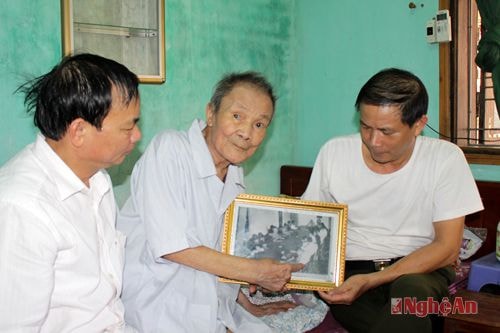 |
| Mr. Nguyen Van Chinh introduces a photograph taken with President Ho Chi Minh on December 8, 1961. |
Mr. Chính recounted that during this period, he brought four or five young men to Khánh Hòa and Ninh Thuận provinces. “In the rural mountainous district of Ninh Hòa, Khánh Hòa province, we earned a living by working as hired farmhands, brewing rượu (rice wine), and raising pigs. It provided us with food while also concealing our activities from the enemy. I only remember the names of two comrades at that time: Lê Bốn and Hoàng Nhỏ,” Mr. Chính said. After more than two years in Khánh Hòa, in 1943, Mr. Nguyễn Văn Chính returned to Nghệ An and continued his clandestine activities at the base. In May 1945, the comrades in the provisional Việt Minh committee of Nam Đàn district assigned Mr. Chính the task of building a Việt Minh base in Nghi Lệ village and the Nam Đàn town area. He was then elected Secretary of the Việt Minh in Xuân Khoa commune and participated in the seizure of power in Nam Đàn district on August 23, 1945. In January 1946, Mr. Nguyễn Văn Chính was admitted to the Party, and in September of that year, he became a member of the Executive Committee of the Nam Đàn District Party Committee.
Throughout his revolutionary career, Mr. Nguyen Van Chinh undertook many tasks, but the work he was most dedicated to for many years was finance, commerce, and trade. From 1947, Mr. Chinh was entrusted with the important responsibility of being a finance officer in the Zone 4 Party Committee, managing the trade branches in Thai Binh and Nghe An provinces. He said: “Our Party was very wise to closely supervise the trade tasks, because the economic situation after 1945 was particularly difficult. Food was scarce, while the whole country was focused on the resistance war against French colonialism.”
In a report on the results of operations compiled by Mr. Nguyen Van Chinh in 2006, there is a passage that reads: “In 1949, I was the manager of the Viet Thang Sub-Department in Thai Binh province. At the end of that year, the enemy occupied Thai Binh province. After 5 days of arranging documents and money, I found a way to break through the enemy's encirclement, bringing 9 colleagues and the company's assets to Vinh safely. In November 1953, I was the Deputy Head of the Trade Sub-Department of Ha Tinh province. I was assigned to represent the Trade Sub-Department of Inter-Region 4 in serving the Central Laos campaign. In carrying out this mission, I organized 12 forward trade stations from Huong Khe district (Ha Tinh) to Nam Phao village in Laos. Within 4 months, I and 50 cadres organized the transportation and reception of 1,050 beef cattle, 80 tons of food including sugar, beans, peanuts, and many other general goods to supply the soldiers and civilian workers on the front lines...” Mr. Nguyen Van Chinh held important positions such as: Deputy Head of the Trade Office in Thanh Hoa, Nghe An, and Ha Tinh provinces; Head of the Nghe An Provincial Department of Commerce; Provincial Party Committee member, Head of the Provincial Finance and Trade Committee; Chairman of the Provincial Inspection Committee, Head of the Provincial Party Committee's Finance and Commerce Committee...
In every position and task, Mr. Nguyen Van Chinh excelled. For his contributions to the Party and the revolution, he was awarded numerous medals, commendations, and certificates of merit by the Party and the State. These included the Third-Class Independence Medal, the Third-Class Resistance Medal, and the First-Class Anti-American War Medal. Most recently, he was awarded the 70-Year Party Membership Badge. Mr. Nguyen Van Chinh said that in his life of dedication to the revolution, he has many stories to tell, many unforgettable memories. Especially the times he met President Ho Chi Minh when the President visited his hometown. He remembers most vividly the year 1961 when President Ho Chi Minh visited Nghe An for the second time. At the Department of Commerce, the President gave many instructions to the staff and workers, and Mr. Chinh still remembers the President's words: "The peanut is made of iron and steel / the peanut goes to a neighboring country, the peanut brings steel back."
Uncle Ho also said: "The people of Nghe An, in a year, spend their money on snacks, using up tons of steel." According to Mr. Chinh, in the 1960s, Nghe An province was a major peanut-growing region, a high-value export product. Peanuts were exported to the Soviet Union and Eastern Europe to import iron and steel for national construction. However, at times, wasteful spending affected the budget. That's why Uncle Ho said: "In a year, their money is spent on snacks, using up tons of steel." Mr. Chinh said that he would never forget Uncle Ho's gentle yet profound teaching.
Continuing the tradition
Mr. Nguyen Van Chinh stated that his participation in revolutionary activities stemmed from his connection to the patriotic spirit of his homeland and family. Mr. Chinh was the sixth of nine siblings. His father, Mr. Nguyen Ngo Dat, was a revolutionary activist before 1930. According to documents from the Nghe An Provincial Party Committee and family records, Mr. Nguyen Ngo Dat was intelligent and studious as a child. Although he did not achieve academic success, he quickly embraced the revolutionary cause, connecting with like-minded individuals and joining the Tan Viet Revolutionary Party.
On February 3, 1930, following the founding of the Communist Party of Vietnam in Nghe An, the revolutionary struggle became vigorous and intense. In the first half of 1930, the Party branch in Phuc My village (Hung Chau, Hung Nguyen) was established with three members: Nguyen Ngo Dat, Le Vien, and Nguyen Thuyen. Nguyen Ngo Dat was elected Secretary. Subsequently, Nguyen Ngo Dat was elected to the District Party Committee and assigned to oversee the Van Vien commune (comprising 10 villages in Hung Nguyen). During this period, all printing activities of the Hung Nguyen District Party Committee and the Central Vietnam Regional Party Committee took place at Nguyen Ngo Dat's house in Phuc My village. Sensing the organization's activities, the enemy repeatedly raided and searched the house, stealing many of the family's possessions. Later, they even set up a military outpost right at Mr. Dat's home.
After the Soviet Uprising was suppressed and terrorized, Nguyen Ngo Dat and many comrades went underground, simultaneously directing the mass struggle. Even on the night of April 30, 1931, Nguyen Ngo Dat commanded a self-defense unit in a surprise attack on an enemy outpost located in his own garden. Among those who worked with him in the revolution, Dat had a particularly special comrade: his son, Nguyen Xuan Thanh. Both father and son were core members of the grassroots revolutionary movement and were both admitted to the Party in 1930.
On the night of July 14, 1931, while secretly operating in Yen Dung Thuong village (Hung Dung), Mr. Dat and his son, Nguyen Xuan Thanh, were discovered and surrounded by the enemy. Mr. Dat escaped, but his son was captured. In August of that year, the enemy captured Mr. Nguyen Ngo Dat in Ky Anh district, Ha Tinh province, and imprisoned him in Buon Ma Thuot prison, where he died on September 18, 1932. Mr. Nguyen Xuan Thanh was released from prison in 1933. He held various positions: Member of the Viet Minh Executive Committee of Nghe An province, Member of the Standing Committee of the Provincial Party Committee and Political Commissar of the Provincial Military Command; Finance officer of the Zone 4 Party Committee; Head of the Provincial Party Committee's Intelligence Department, Head of the Nghe An Provincial Public Security Department; Officer of the State Planning Committee; Director of General Department 5 - Ministry of Public Security.
Mr. Nguyen Van Chinh said that his participation in revolutionary activities was a continuation of his family's tradition, of his father and ancestors. He knew it involved danger, sacrifice, and loss, but as he said, "it's in my blood now, I can't do otherwise." He smiled: "It's been a long time since I've been outside, but I know the streets and my hometown have changed dramatically." Yes! Our homeland is constantly changing and developing, and the achievements of today are largely due to the contributions of our revolutionary predecessors, including Mr. Nguyen Van Chinh's family.
Dao Tuan