

Phase 1 of the Ban Mong water reservoir project has reached 56% completion.
(Baonghean.vn) – These figures were compiled by the Compensation, Support, and Resettlement Council of Quy Chau District, as of the end of November 2015.
Phase I of the Ban Mong reservoir project includes auxiliary dams, the Chau Binh drainage canal, and the reservoir connecting canal, with a total land area of 119 hectares to be acquired. To date, Quy Chau district has acquired and handed over the construction site in the area of auxiliary dam 1, waste dumps No. 1, 2, 3, 4, 5, and the Chau Binh drainage canal from K0+000 to K8+108, etc., with a total area of 66.68 hectares, equivalent to 56%.
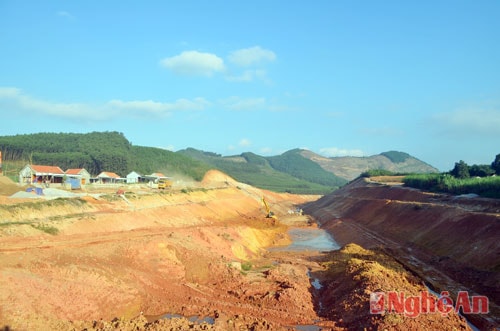 |
| The Chau Binh drainage canal is part of the Ban Mong reservoir project currently under construction. |
The progress of land clearance is assessed as not having met the set plan's objectives. The reasons include the fact that during the compensation and support process, some households did not agree with the unit prices for land, trees, crops, and architectural structures; at the same time, 28 households had been stably producing on the land area of Co Ba Forestry Farm for many years, making it difficult to prepare compensation and support documents for land clearance;…
On the other hand, funding for compensation and support payments remains insufficient. To date, the Quy Chau District Compensation, Support, and Resettlement Council has prepared compensation dossiers for 455 out of 531 affected households and approved compensation, support, and resettlement plans for 368 households with a total budget of 100.12 billion VND. However, only over 88 billion VND has been disbursed so far, leaving a shortfall of nearly 12 billion VND.
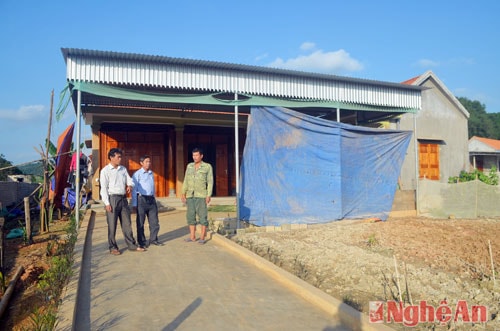 |
| The family of Mr. Nguyen Tran Luyen, from Quynh 2 village, Chau Binh commune (far right), rebuilt their house in an interspersed style after receiving compensation. |
Currently, the district is focusing on comprehensive solutions to accelerate the land clearance process; at the same time, it is implementing steps to build infrastructure for resettlement areas for affected households that need to be relocated, striving to complete it in 2016.
Thanh Duy