

Ghenh Bridge collapse: Railway establishes 57 new train pairs to transport passengers.
Following the incident where a barge collided with and collapsed the Ghenh Bridge, the Vietnam Railways Corporation (VNR) announced that the railway sector has adjusted train schedules, reducing the number of freight and passenger trains by 3-4 pairs per day.
However, the Vietnam Railways Corporation had to set up 57 new pairs of trains to transfer passengers on the Saigon-Song Than section and combine this with passenger transfers by car on the Song Than-Bien Hoa section.
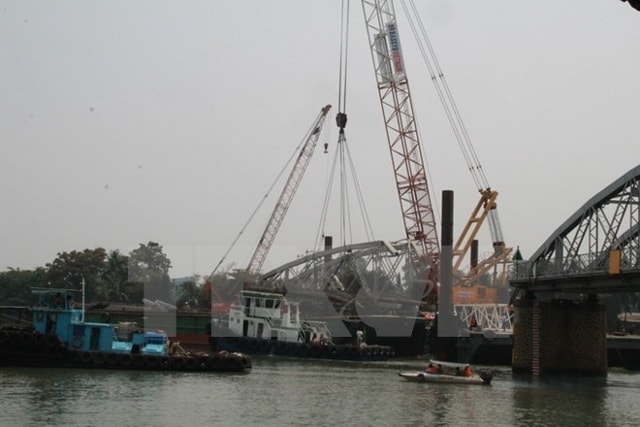 |
| Span number 3 of the Ghenh Bridge has been successfully salvaged from a depth of 13 meters at the bottom of the river. |
According to VNR's report, the corporation currently maintains 8 pairs of trains per day, including 3 pairs of trains (TN1/2, SE3/4, SE5/6) on the Hanoi-Saigon route; 1 pair of trains (SE25/26) on the Saigon-Quy Nhon route; 1 pair of trains (SE21/22) on the Saigon-Vinh route; and 1 pair of trains (SNT5/2) on the Saigon-Nha Trang route. All of these trains require a transfer service between Song Than and Bien Hoa by bus. The Hanoi-Nha Trang route operates 2 pairs of trains (SE1/2, SE7/8).
Thus, the number of train pairs that had to be reduced due to the Ghenh Bridge collapse was 3 pairs per day. However, VNR had to create 57 new train pairs to transfer passengers on the Saigon-Song Than route and combine this with passenger transfers by car on the Song Than-Bien Hoa route.
Regarding freight transport, immediately after the Ghenh Bridge collapse, VNR (Vietnam Railways) reorganized the loading and unloading locations for all trains on the route and simultaneously disbanded trains, reloading at Trang Bom and Ho Nai stations. Currently, all goods for 14 trains have been unloaded, and loading and unloading has been restored for 4 pairs of trains per day on the route. Thus, the number of freight train pairs reduced due to the bridge collapse is 4 pairs per day.
To increase transport and handling capacity, the railway industry is also urgently implementing the renovation and upgrading of stations, freight yards, and loading/unloading tracks at Bien Hoa station (expected to be completed before April 22), Ho Nai and Trang Bom stations (expected to be completed before April 12) to minimize the impact on train passengers and cargo owners; and implementing measures to ensure the safety of the railway infrastructure system and train operations.
In order to maintain stability in freight and passenger transport, and minimize the impact on train passengers and cargo owners, the Vietnam Railways Corporation will, in the coming period, relocate carriages, machinery and equipment, reorganize the entire technical inspection team, and prepare carriages from Saigon to Bien Hoa; rebuild the train schedule, locomotive allocation, carriage transfer, fuel supply, adjust ticket sales plans, and develop customer support solutions… in order to be able to operate additional train services.
On April 1st, the Ghenh Bridge wasofficially commenced construction.and we are striving to ensure that the construction is completed on schedule before July 15th.
The newly constructed Ghenh Bridge has three spans, each measuring 75m in length. The bridge girders are made of steel arch trusses. The new Ghenh Bridge will have its longitudinal profile of the rail track raised by approximately 2.2m compared to the old Ghenh Bridge, meeting the Class 3 navigation clearance requirements. The upstream walkway will be widened to 2.4m to allow two-way traffic for motorcycles and bicycles, with each side being 1.2m wide.
To mobilize all resources and promptly address the damage caused by the Ghenh Bridge collapse, the Vietnam Railways Corporation has launched a campaign to urgently restore the Ghenh Bridge by all means to increase transport output and revenue; and to build and put the Ghenh Bridge into operation as soon as possible with the goal of "Safety - Quality - Progress - Efficiency".
According to Vietnam+