

A remedy for insomnia using the Mimosa pudica plant.
For those suffering from nervous exhaustion and insomnia, take 15g of chastetree (or in combination with 15g of silverweed and 30g of sorrel), decoct and drink.
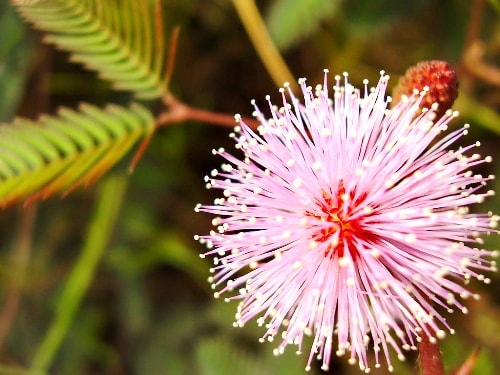 |
Mimosa pudica, also known as sensitive plant or shame plant. Photo: trochoivui. |
According to Dr. Vo Van Chi, author of the Dictionary of Vietnamese Medicinal Plants, the plant known as "trinh nu" (sensitive plant) is also called "mac mi" or "xau ho" (shy plant). Its scientific name is Mimosa pudica L., belonging to the Fabaceae family (legumes).
This plant grows in the wild, with a small, highly branched stem and hook-shaped thorns. The leaves are bipinnately compound, with petioles arranged like a duck's foot, folding up at the slightest touch. Each leaf bears 15 to 20 pairs of leaflets. The flowers are small, reddish-purple, clustered in a head shape, with a long common stalk in the leaf axil. The fruit cluster is star-shaped, constricted between the seeds, and covered with many stiff hairs.
The maidenhair fern usually grows along roadsides, grasslands, embankments, and wastelands, on dry, barren land, and is intolerant of waterlogging. It flowers from June to October and bears fruit from October to January of the following year. This plant...It originates in the tropical regions of the Americas. In Vietnam, the plant grows everywhere. This plant is also found in tropical countries all over the world.
People harvest virgin's flowers in summer and autumn, remove impurities, and dry them.The entire plant is used, commonly called Ham Thu Thao. The plant has...Sweet and astringent taste, cool in nature, slightly toxic, with calming, sedative, expectorant, cough-relieving, hemostatic, astringent, and anti-AIDS effects.
Pharmacological analysis revealed that the plant contains the following components: Mimoside, mimosine, Se compounds, D-penitol, 2”-o-rhamnosylisoorientin, 2”-o-rhamnosylorientin, protein, and tannin. The plant is rich in amino acids: Asp. (12.6%), Thr. (4.9%), Ser. (4.7%), Glu. (13.4%), Pro. (5.7%), Gly. (7.1%), Ala. (5.8%), Val. (4.7%), Met. (2.1%), Ile. (3.3%), Leu. (13.8%), Tyr. (4.8%), Phe. (5.4%), His. (2.5%), Lys. (4.4%), and Arg. (4.8%). The leaves contain mimosine, mimoside, D-terpineol, and many Se compounds, including selenite, contractile protein, ATP, adenosine triphosphate, ATPase, and adenosine triphosphate.
Pharmacological studies have shown that the entire plant of the chastetree has antiviral activity against HIV and inhibits Staphylococcus aureus Rosenbach, Neisseria catarrhal, and Escherichia coli. The alkaloids in chastetree and root decoction inhibit Asian influenza type A virus and nasal diseases. The root decoction also has antitussive effects. The branches and leaves of the chastetree, when processed into an extract, can be used as a treatment for adenocarcinoma.
The plant known as "Trinh Nu" (Vitex agnus-castus) is commonly used to treat nervous exhaustion, insomnia, bronchitis, conjunctivitis, hepatitis, enteritis, urinary stones, rheumatism, paralysis, and high blood pressure. The dosage is 10 to 15 grams. Do not exceed this dose. It is contraindicated for pregnant women. Note: This substance...Mimosine in chastetree is mildly toxic; people who consume plants containing this toxin may experience hair loss.
Dr. Vo Van Chi introduces some medicinal remedies from the chaste tree as follows:
1. Nervous exhaustion, insomnia: Use 15 g of *Vitex agnus-castus* alone or in combination with 15 g of *Vernonia cinerea* and 30 g of *Oxalis repens*. Brew and drink.
2. Chronic bronchitis: 30 g of *Vitex trifolia* (Vitex trifolia), 16 g of *Peristrophe bivalvis* (root and leaves). Boil all ingredients in water and divide into two doses to be taken daily.
3. Lower back pain, muscle and bone aches:20-30g rRoast the virgin's root, soak it in alcohol, then stir-fry until golden brown, and brew it into a decoction for drinking. It can also be combined with 20g each of chrysanthemum root and pomelo peel, and 10g each of Dinh Lang root and licorice root.
4. Treatment for AIDS, mild fever, general discomfort, red rash, and weeping skin: Use equal parts of *Chaste Tree* (Vitex trifolia), *Thuja orientalis*, *Phellodendron amurense*, *Portulaca oleracea*, *Cassia obtusifolia*, and *Pomegranate peel*. Boil all ingredients together, strain the liquid, and use it for bathing or washing. Additionally, mix 2 grams of powdered realgar with egg white and apply to the affected area.
According to VNE
| RELATED NEWS |
|---|