

The entire province is striving to plant 89,000 hectares of rice in the spring crop.
(Baonghean.vn) – On the afternoon of November 11th, the Department of Agriculture and Rural Development held a conference to implement the 2017 spring crop production plan.
Comrade Dinh Viet Hong - Vice Chairman of the Provincial People's Committee, attended and directed the conference. Comrades Hoang Nghia Hieu - Director of the Department of Agriculture and Rural Development; and Nguyen Van Lap - Deputy Director of the Department of Agriculture and Rural Development, co-chaired the conference.
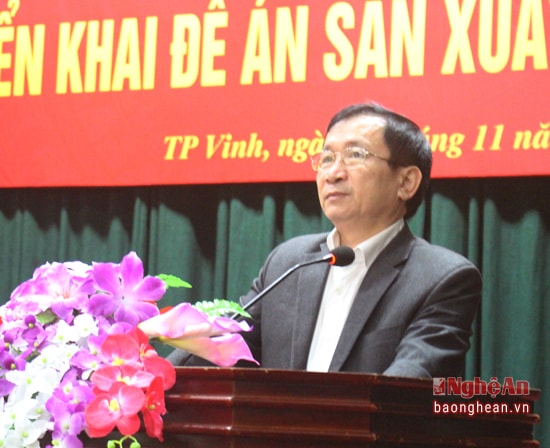 |
| Comrade Dinh Viet Hong - Vice Chairman of the Provincial People's Committee - attended and directed the conference. |
With the goal of achieving a food production output of 1,206,260 tons by 2017, Nghe An province aims to cultivate 89,000 hectares of rice (45,000 hectares of hybrid rice and 45,000 hectares of purebred rice). Notably, this includes 30,000 hectares of high-quality rice. In addition, the province plans to cultivate 108,000 hectares of corn (19,000 hectares for grain and 3,000 hectares for animal feed); 10,000 hectares of vegetables; and 1,000 hectares of various types of beans.
In 2017, the beginning of spring fell on February 4th (January 9th, 2017 according to the lunar calendar), therefore rice seedlings will be transplanted after the Lunar New Year. Based on the growth time of each variety, the sowing and transplanting schedule will be arranged to ensure that the spring rice plants flower between April 25th and May 5th; transplanting too early will prevent the rice from developing panicles and flowering in cold weather.
For areas prone to flooding during the summer-autumn crop season, it is recommended to arrange for spring rice to flower between April 20th and 25th, selecting varieties with a growth period of around 125 days, and sowing seedlings between January 15th and 20th; corn should be sown between February 1st and 28th. For peanuts, take advantage of moist soil and warm weather to sow around the beginning of spring, finishing before February 18th and avoiding sowing too early. In midland, mountainous, and highland areas prone to early drought, planting should be done earlier to prevent damage from late-season drought.
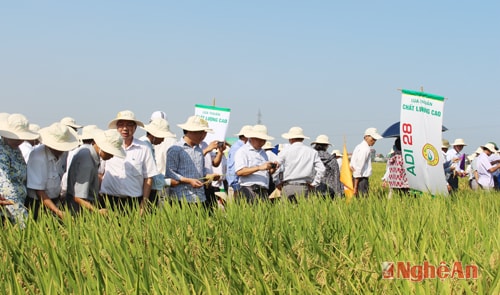 |
| Testing of high-quality rice varieties in the spring crop of 2015 in Dien Lien commune, Dien Chau district. |
In his remarks at the conference, Mr. Dinh Viet Hong, Vice Chairman of the Provincial People's Committee, emphasized: Spring crop production plays an extremely important role in ensuring the year's food production, therefore localities and relevant sectors must focus intensely and seriously implement comprehensive solutions to achieve the best results in the 2017 spring crop.
Besides strictly adhering to the planting schedule and organizing the transplanting of seedlings, it is necessary to do a good job of plant protection, promote the implementation and expansion of technical advancements in agricultural extension and plant protection work such as the improved rice intensive farming process (SRI), the 3 reductions and 3 increases program (ICM), etc.
Given the complex weather patterns, proactive measures are needed to cope with drought, especially in downstream areas, semi-mountainous regions, and mountainous areas. In particular, relevant agencies must further strengthen state management of the production and trading of plant varieties and pesticides, using only those varieties included in the 2017 Spring Crop Production Plan of the Department of Agriculture and Rural Development. Simultaneously, effective crop restructuring and model development should be implemented, along with solutions to strengthen joint ventures and production linkages between farmers and businesses.
Phu Huong