

Regarding the death of breeding pigs provided to poor households in Thanh Chuong.
(Baonghean) - Implementing the "pig breeding support program for the poor," in 2016, Thanh Chuong district distributed 952 pigs in two batches to poor and near-poor households in 13 communes under Program 135. However, after distribution, some pigs fell ill and died, causing concern among the people.
Ms. Nguyen Thi Khanh's family is a near-poor household in Hamlet 3, Thanh Khe Commune. At the end of November 2016, her family received two piglets, each weighing 15 kg, worth 5 million VND, as capital for livestock development. However, after only a few days, one of the two piglets died. Ms. Khanh said: “Of the two piglets brought home, one was not active and ate little. Three days later, the piglet became lethargic, so the family reported it to the commune's veterinary officer for inspection, but no illness was detected. At 3 pm, the piglet struggled and died.” After the piglet died, the supplier came to inspect and promised to provide another piglet, but to this day, they have not received one. The remaining piglet is very healthy and growing quickly.
Ms. Tran Thi Thin, an agricultural official in Thanh Khe commune, said: In 2016, the entire commune received 62 pigs, with each poor and near-poor household in 7 particularly disadvantaged hamlets receiving 2 breeding pigs to develop their economy, weighing between 13 and 25 kg each. Besides one pig that died, six other pigs belonging to six different households were immediately replaced by the villagers after receiving them, due to signs of loss of appetite and lethargy. According to Ms. Thin, these unhealthy pigs may have had weak immune systems, failing to adapt to changes in their living environment, feed, and care regimen.
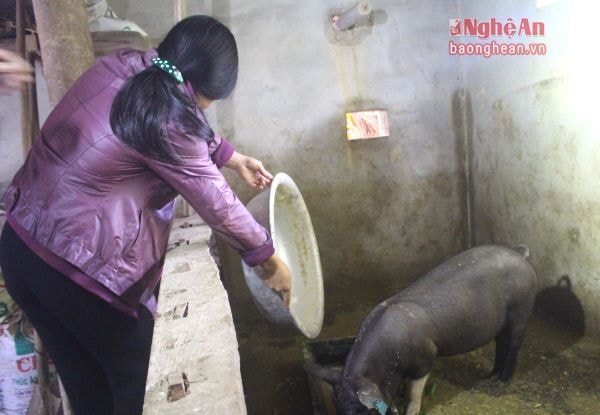 |
| Ms. Nguyen Thi Khanh is taking care of the remaining pig. |
Mr. Phan Van Hoa's family, in Hamlet 6, Thanh Thinh Commune, also received two piglets, but one died. Mr. Hoa said: His family received two piglets of similar weight, about 25 kg each. While one ate well and was active, the other ate less, was lethargic, and died after about 20 days. They had to receive a smaller piglet as a replacement. Currently, the healthy pig weighs over 80 kg and will be ready for breeding in a few months. Mr. Tran Van Duc, Head of the Agriculture Committee of Thanh Thinh Commune, said: Of the 62 piglets distributed at the end of September and beginning of October 2016, four died after being raised for 20-29 days. These pigs showed no signs of stomach pain, diarrhea, or fever, only reduced appetite. The cause may be due to changes in feed, water, living environment, or the fact that some poor households lacked adequate care facilities.
It is known that the entire supply of breeding pigs was directly contracted by the Department of Agriculture and Rural Development of Thanh Chuong district with Duc Hung Trading and Construction Co., Ltd. - located in Do Luong district; Ngan An Construction Joint Stock Company in Que Phong district; and Nga Chin Joint Stock Company in Nam Dan district. With up to 40 pigs falling ill and dying recently, people are worried about the quality of the breeding stock, because under the same breeding conditions, only a few pigs died or farmers had to request replacements. Mr. Tran Phi Hung, Head of the Department of Agriculture and Rural Development of Thanh Chuong district, said: As part of the program, 13 communes in Thanh Chuong received support in the form of cattle and pig breeding stock to create conditions for people to develop their economy.
In 2016, a total of 952 pigs were distributed in two phases (early August and early November), benefiting 456 poor and near-poor households. This is a very practical program that helps households escape poverty. However, in the first phase, 17 pigs died and had to be replaced, and in the second phase, 23 pigs died. Additionally, some pigs showed signs of fatigue and loss of appetite, which were treated by veterinary officers, who also advised better care. Most of the pigs that died were replaced with new ones.
Initial investigations determined that the cause was likely due to the pigs' weakened immune system after transportation, coupled with changes in feed, water sources, care conditions, and climate. All pigs underwent thorough inspection and control procedures before being distributed to the people, confirming they were completely free of disease. Following the pig deaths, the district worked with the breeding stock suppliers, coordinating inspections and providing new piglets to affected families, in accordance with the contract's provision of live pigs for at least one month.
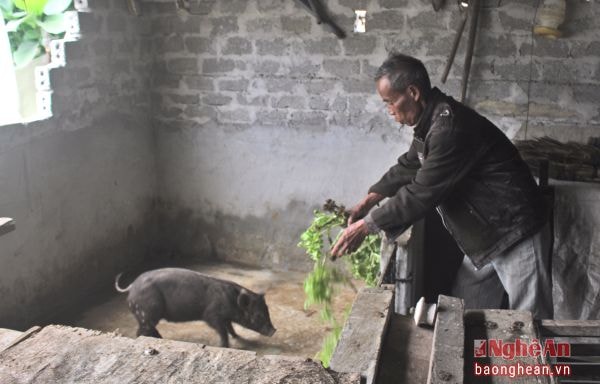 |
| The breeding pigs were re-allocated to Mr. Phan Van Hoa's family. |
The redistribution of breeding stock to households whose piglets have died is essential for poor households to quickly restore livestock farming, and the supplying units are completing the necessary procedures to implement this. However, Thanh Chuong district is also clearly defining its responsibilities and is coordinating with relevant agencies and the supplying units to investigate and reach a final conclusion to announce the cause to the people. This will prevent speculation and negative public opinion that could affect a meaningful and effective humanitarian program implemented by the locality in the past.
Phu Huong