
Overcoming local resistance
(Baonghean) - Chau Cuong is a commune with potential in Quy Hop district, but for a long time it was a stagnant and underdeveloped locality. In the last 3 years, Chau Cuong has undergone a comprehensive transformation.
(Baonghean) - Chau Cuong is a commune with potential in Quy Hop district, but for a long time it was a stagnant and underdeveloped locality. In the last 3 years, Chau Cuong has undergone a comprehensive transformation.
Nghe An Newspaper had a dialogue with Mr. Luu Xuan Diem - a district official seconded to serve as Deputy Secretary of the Party Committee and Chairman of the People's Committee of the commune (since 2014) - regarding several related issues.
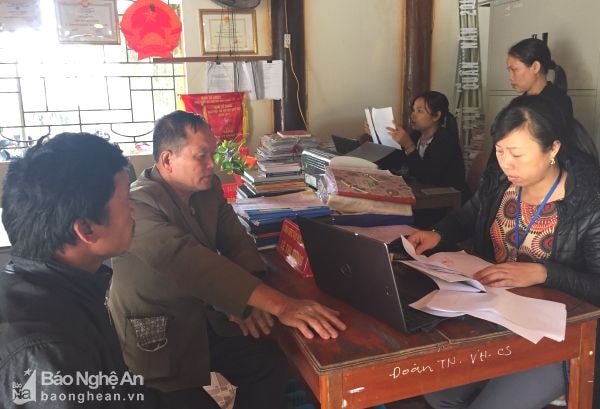 |
| Officials in Chau Cuong commune are improving their service attitude towards the local people. Photo: Ngo Kien |
PV:Previously, Chau Cuong was a weak and stagnant locality. In your opinion, what were the reasons for this?
Mr. Luu Xuan Diem:Chau Cuong commune has 96% of its population belonging to the Thai ethnic group, living in 11 hamlets and villages. It has a large natural area (8,400 hectares, approximately one-tenth the size of Quy Hop district) and possesses tin ore and white stone resources suitable for industrial and craft development. However, the commune still faces many difficulties in socio-economic development.
Through investigation and assessment of the situation, the commune Party committee frankly pointed out that the cause of the prolonged weakness and stagnation in Chau Cuong was that commune officials were still hesitant, afraid of confrontation, afraid of struggle, and afraid of action.
In handling work, Party committees and authorities still allow personal relationships to influence their decisions, almost completely lacking a proactive mindset. Instead, they mainly adopt a passive, complacent attitude, prioritizing pleasing others over work efficiency. Consequently, effective workers are not valued, production management receives little attention, and inertia is very high among both officials and the people.
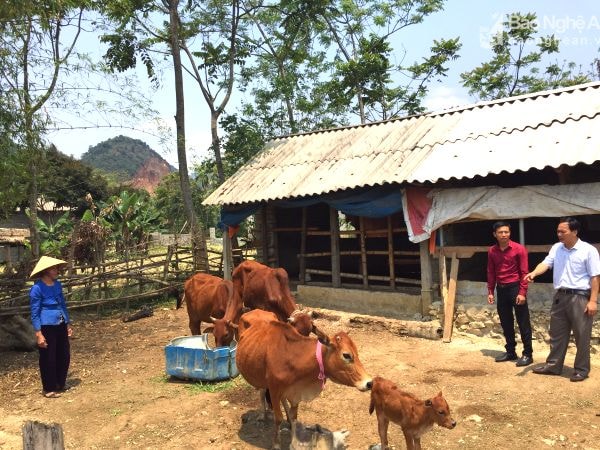 |
| Officials from Chau Cuong commune (Quy Hop district) inspect the practice of keeping buffalo and cattle in captivity in Ha Dong village. Photo: Ngo Kien. |
PV:Bringing about change, especially when the mindset of dependence and aversion to difficulty has become deeply ingrained, is no easy task. So what solutions has Chau Cuong implemented to overcome these challenges?
Mr. Luu Xuan Diem:The first concern is changing the mindset and methods of Party committee and People's Committee officials at the commune level. Specifically, they must match words with actions and set an example through concrete deeds. Therefore, they must focus on resolving each issue individually and with clear effectiveness.
Recognizing transportation as a key driver of economic development, the Party Committee launched a road construction campaign. Through the commune's propaganda and mobilization efforts, the entire population supported the initiative, with households donating trees and land, and people voluntarily contributing funds and labor to build 20 km of road. Cadres, workers, and employees from agencies, units, and schools in the area were mobilized to select the 2 km of most difficult inter-village roads as a model, setting an example for the people.
Building on the success of the road construction campaign, Chau Cuong continued to implement the construction of 5 km of rural roads and the hardening of many irrigation canals to combat drought.
Recognizing that cultivating only two crops per year in Chau Cuong commune was wasteful, the Party committee and local government discussed the matter thoroughly and passed a resolution to increase it to three crops. In 2015, Chau Cuong commune implemented three crops simultaneously for the first time, and the effectiveness was confirmed. The commune collaborated with reputable businesses to ensure quality, from supplying seeds and materials to contracting for the purchase of agricultural products. For the third corn crop, farmers can choose to sell the kernels or the whole plant directly in the field.
In addition, the commune launched a movement to renovate abandoned and neglected gardens, mobilizing people to cut down trees, with the commune providing equipment for digging and leveling the land; focusing on eliminating free-range grazing, changing the breed of local buffalo and cattle to lower quality, and encouraging people to raise livestock in confinement.
Quỳ Hợp District has recently selected Châu Cường to implement the model "Ensuring security in buffalo and cattle farming" for the period 2017-2021; and successfully organized the "Peaceful Bell" model to raise awareness of maintaining public order and security in the area.
Through concrete actions, the material and spiritual lives of the people are improved, and at the same time, officials are trained and their thinking, skills, and methods are enhanced to meet the demands of their tasks.
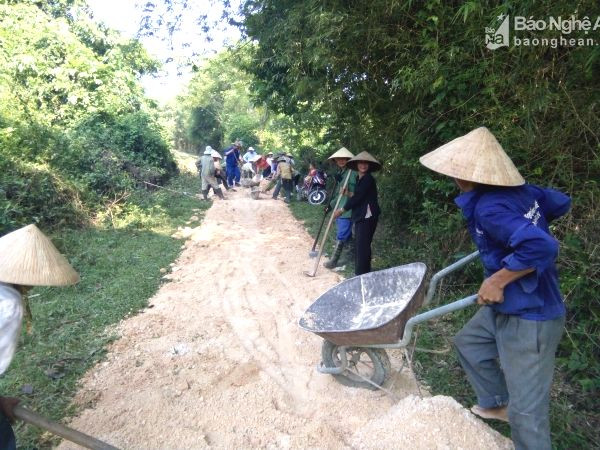 |
| Road construction in Chau Cuong commune (Quy Hop district). Photo: Ngo Kien |
PV:Speaking frankly and honestly, from the perspective of a district official assigned to the communes, what is the current situation in mountainous communes, in your opinion? Can you offer some suggestions to higher authorities?
Mr. Luu Xuan Diem:A very "sensitive" limitation in many communes today is the tendency to be overly deferential, avoid confrontation, and be localized. This reduces the spirit of criticism and self-criticism, and leads to a lack of frankness in work. With officials like that, how can there be effectiveness or breakthroughs?
Furthermore, in elections, they often view positions as being linked to benefits, rather than considering the responsibilities and capabilities associated with them. Therefore, they often vote for relatives, prioritizing the interests of their family members, rather than considering their competence. Consequently, in elections, the majority, or majority vote, sometimes fails to reflect the true nature of democracy, and at times is merely a manifestation of parochialism.
At the commune level, the roles and positions of civil servants are relatively clear, as they are professionally trained and their daily tasks are well-defined. In contrast, elected officials often hold positions with unclear responsibilities and their quality is not up to par. There is a situation where some individuals with minor talents are then groomed and elected to leadership positions. This stifles debate and deprives capable individuals of the opportunity and environment to develop their skills.
In my opinion, some strong solutions are needed, such as: Strengthening rotation, not only vertical rotation (from district to commune), but also horizontal rotation (from one commune to another) to avoid local parochialism. In areas showing signs of weakness and stagnation, a breakthrough should be created by appointing capable, enthusiastic, and determined officials to lead in innovative actions.
Each job position needs specific responsibilities: who does it, for how long, and how it's done. These responsibilities must be clearly monitored and evaluated. If assigned tasks are not completed or the results are unclear, changes or transfers should be made promptly. Avoid prolonging the tenure of staff who work irresponsibly and haphazardly.
PV:Thank you, sir!
Ngo Kien
(Perform)