(Baonghean.vn) - After 1945, to serve its own great power interests, the US government carried out dozens of military interventions in countries around the world.
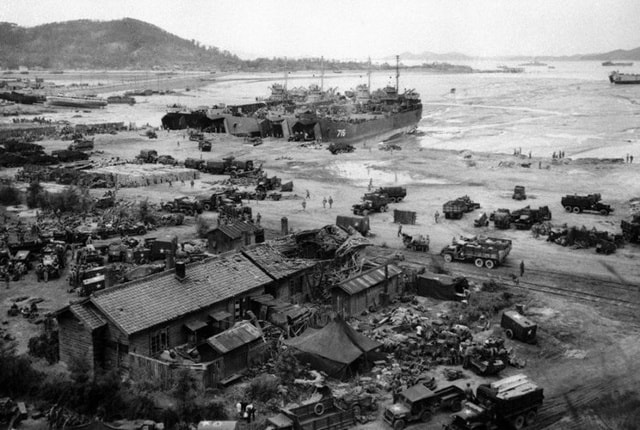 |
| In 1950, acting on behalf of the United Nations, a coalition of 16 countries led by the United States intervened militarily in the Korean Peninsula to save the South Korean regime from collapse due to an attack from the North. They pushed back the North Korean army to the Chinese border, forcing Chinese volunteer troops to cross the Yalu River to provide assistance. This fierce battle ended when the two sides reached a ceasefire agreement on July 27, 1953. Since then, the two Koreas have nominally remained in a state of war. Photo: Four US landing ships transporting troops and equipment to Incheon Beach, North Korea, on September 15, 1950. |
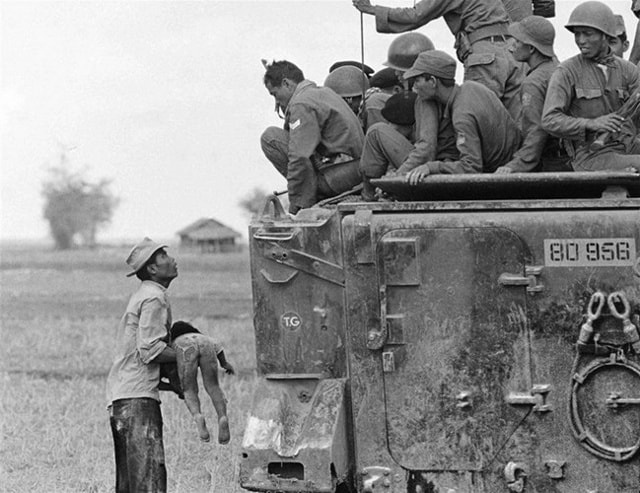 |
| From 1945 onwards, the United States began to support and assist France in its invasion and reoccupation of Vietnam. After 1954, it gradually ousted and replaced France, expanding its war of aggression to the entire South, dividing the country into two regions. This led to the Vietnam War, one of the most brutal and costly wars in American history. Ultimately, the US suffered a complete defeat on April 30, 1975, when the Liberation Army marched into Saigon, unifying the country after decades of division. [Image caption: A Vietnamese father embracing his son's body - This photograph, which won the Pulitzer Prize in 1965, was taken by photographer Horst Faas.] |
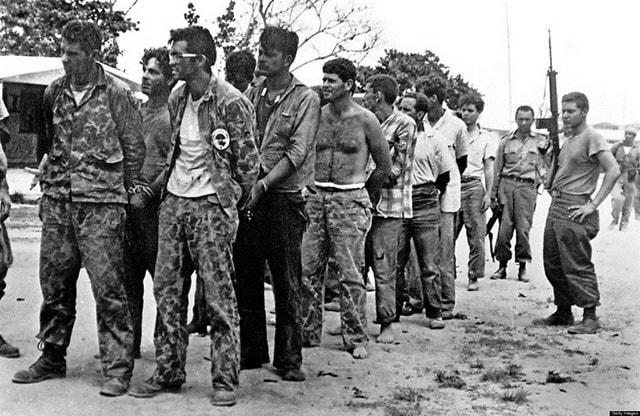 |
| On April 17, 1961, with the backing of the U.S. military and the CIA, a U.S.-trained Cuban exile army landed in the Bay of Giron in Cuba to carry out an invasion aimed at overthrowing the government of leader Fidel Castro. The battle lasted until April 19, with the exile forces suffering a complete defeat. This event is considered a major embarrassment for the CIA and the administration of President John F. Kennedy, who had taken office just four months earlier. (Image: Prisoners captured by the Cuban Revolutionary Army.) |
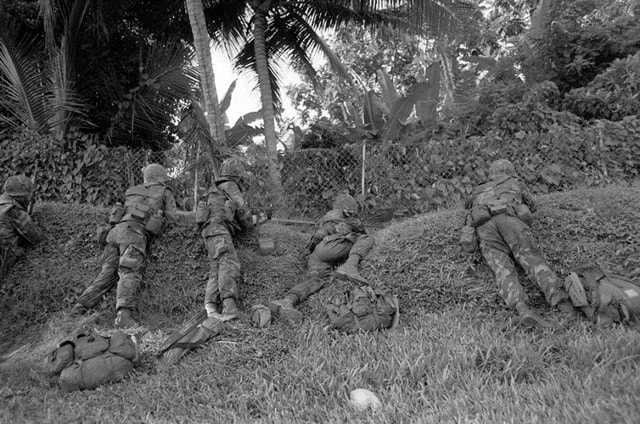 |
| Since 1979, relations between the United States and the island nation of Grenada had become strained due to the Grenadian government's apparent support for Cuba and the Soviet Union. Citing the need to "protect the safety of American citizens" and prevent the influence of the Soviet Union and Cuba in the Caribbean, on October 25, 1983, the US military launched an invasion of Grenada, establishing a new pro-American government. This US intervention was opposed by the UN General Assembly and many of America's Western allies. (Image: US Marines in action in Grenada.) |
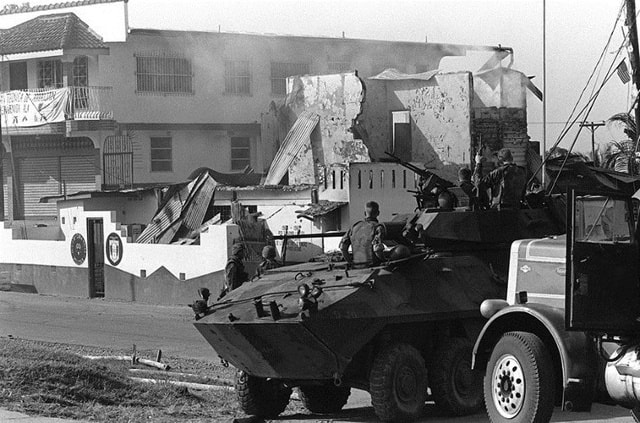 |
| Due to diplomatic tensions and conflicts between Panamanian soldiers and US military forces stationed in the Panama Canal Zone, on December 20, 1989, 27,000 US troops invaded Panama to overthrow President Noriega and install Guillermo Endara. On December 29, the United Nations General Assembly voted 75–20, with 40 votes against, condemning the invasion as a blatant violation of international law. (Photo: US troops in Panama.) |
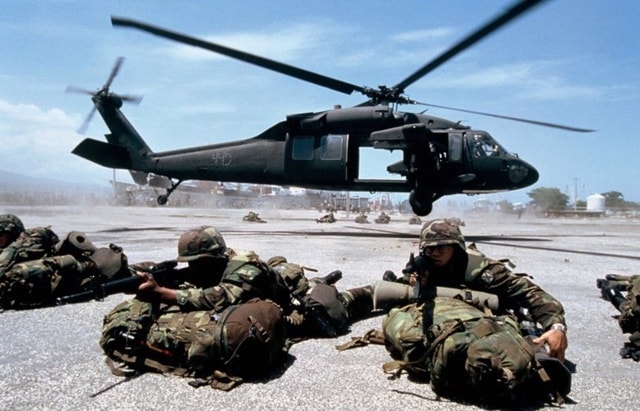 |
| In 1994, under the pretext of protecting democracy, the United States invaded Haiti, overthrowing the military government of General Raoul Cédras and restoring the former pro-American dictator Jean-Bertrand Aristide to power. Since then, key sectors of Haiti's economy have been controlled by American corporations, and today Haiti is the poorest country with the lowest standard of living in the Americas. (Image: US troops in action in Haiti.) |
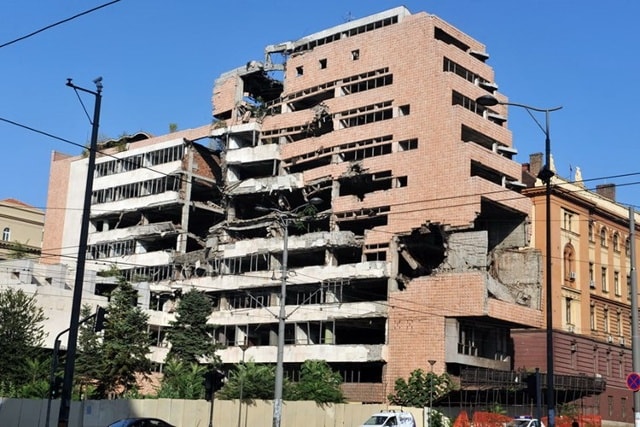 |
| In 1999, to consolidate Kosovo's secession, the US and NATO led a 13-nation coalition in a 78-day air campaign against the Federal Republic of Yugoslavia. Following the Kosovo War, the US and NATO further solidified the disintegration and fragmentation of the Federal Republic of Yugoslavia. (Image: A building in Belgrade, the capital of Yugoslavia, destroyed by a Western airstrike.) |
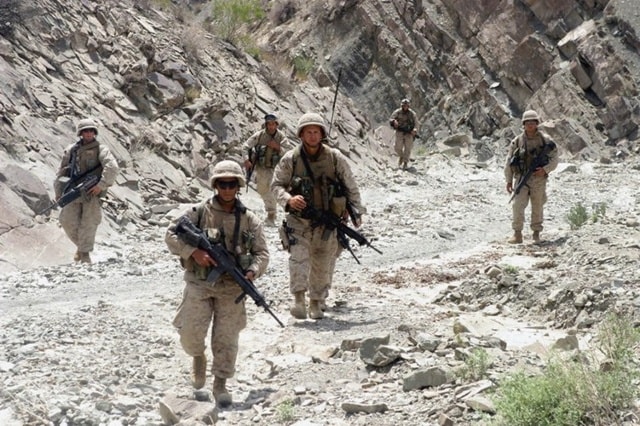 |
| In 2001, under the pretext of combating terrorism following the 9/11 attacks, the United States led a five-nation coalition to attack Afghanistan, defeating the Taliban and the extremist Islamic group Al-Qaeda led by Osama bin Laden, and deploying troops to occupy the Central Asian country. The Taliban and Al-Qaeda subsequently retreated into the Afghan mountains to continue their resistance. The situation in Afghanistan today remains extremely unstable. (Photo: US soldiers in Afghanistan.) |
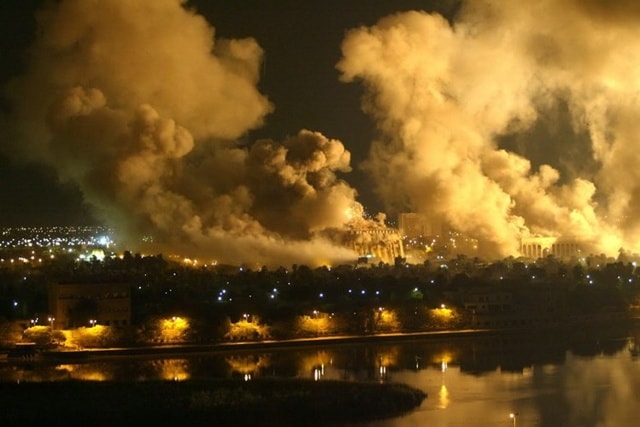 |
| In January 1991, President George H.W. Bush led US troops along with those from 33 other countries to the Persian Gulf in a military operation to pressure Iraq to withdraw its troops from Kuwait. Although victorious, the coalition failed to overthrow Iraqi President Saddam Hussein. Twelve years later, President George W. Bush accomplished this by invading Iraq on the grounds that Saddam Hussein possessed weapons of mass destruction – a claim never proven true. (Image: Iraqi capital Baghdad engulfed in smoke and flames after a US airstrike in 2003.) |
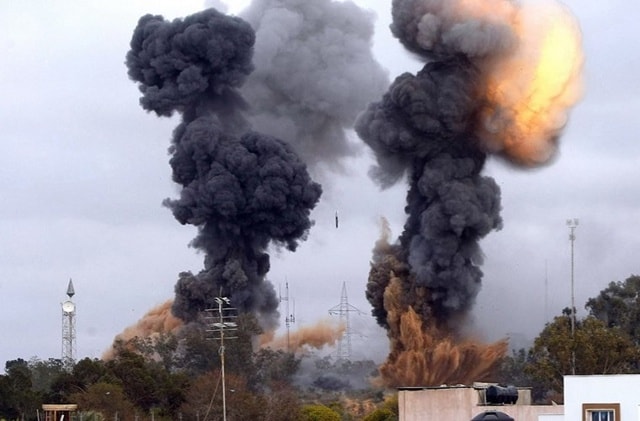 |
| In 2011, taking advantage of the Libyan rebel uprising, the US and NATO deployed air, naval, and marine forces with advanced heavy weaponry to attack Libyan territory. The war ended with the collapse of the Libyan regime and the death of anti-American leader Gaddafi. After the war, Libya, once one of the countries with the highest economies and living standards in Africa, became devastated and engulfed in violence. Photo: Explosions near Tripoli, the capital of Libya, in 2011. |
Kim Ngoc
(Synthetic)

