

What are the unique aspects of university admissions in different countries?
(Baonghean.vn) - Not only in Vietnam, but in many countries around the world, the university entrance exam is an important event that receives public attention. Let's find out what's special about university entrance exams in different countries around the world?
1. France
 |
| French students. Photo: Internet |
In France, students must take a single exam to graduate from high school and apply to university, called the Baccalaureate. Students must achieve a minimum score of 10/20 (average of their subjects); if they score only 8-9/20, they must retake the exam or participate in a subsequent oral examination. If they score below 8/20, they must repeat the course.
The high school graduation exam is divided into three blocks, and students choose one to participate in. Block S (Science) requires candidates to have a high level of proficiency in Mathematics, Physics, Chemistry, and Biology. Block ES (Economics and Social Sciences) focuses on economics and social sciences. Block L (Literature) emphasizes French literature, Philosophy, History, Geography, and Foreign Languages.
The main examination formats are written and oral. Some science exams also include a laboratory section.
2. USA
 |
| The SAT is part of the college admissions process in the United States. (Image source: Wordpress.com) |
In the United States, the standardized test (SAT) is one of the entrance exams used by many universities. Since March 2016, the SAT has changed in format, consisting of three sections: Reading Comprehension and Writing; Mathematics; and Essay Writing. The Reading Comprehension (65 minutes) and Writing (35 minutes) sections assess the test-taker's vocabulary and reasoning abilities. All questions are multiple-choice.
The Math exam (80 minutes) is divided into two parts: a calculator-based section and a non-calculator-based section. Most questions are multiple-choice, but there are also some fill-in-the-blank questions. The exam is based on real-life situations and requires students to use mathematical formulas to solve problems.
The essay writing section is optional and similar to the essays required when applying to university. Although not a mandatory test, some schools still require students to take it.
3. Sweden
 |
| International students in Sweden. Photo: Internet |
The State University Entrance Exam (SweAT) is a standardized test for university admissions. Since 2011, the exam has been divided into two sections: mathematics and writing. There are a total of 160 questions, divided into four smaller tests, with two in the mathematics section and two in the writing section.
The calculation section has 4 topics: Mathematics (24 questions), Quantitative Comparison (20 questions), Charts and Graphs (24 questions), and Data Analysis (12 questions). The writing section also has 4 topics: English Reading Comprehension, Swedish Reading Comprehension, Vocabulary, and Sentence Completion. Each topic has 20 questions.
4. South Korea
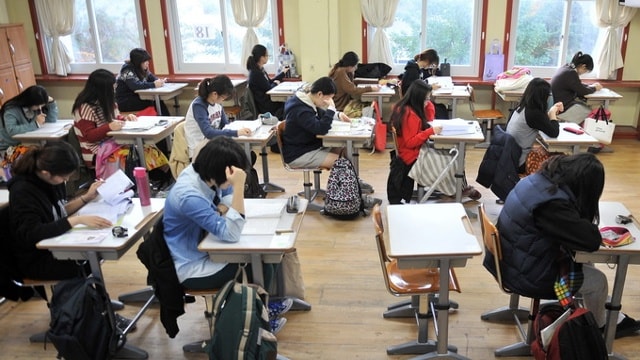 |
| A university entrance exam room in South Korea. Photo: Internet |
The College Proficiency Test (CSAT), established in 1994, is a standardized test accepted by universities in South Korea. Previously, the test consisted of only five subjects, but since 2016, candidates have been required to take a History test.
The Literature, Mathematics, and English exams are graded on a 100-point scale, with the English exam including a listening comprehension section. In addition to English, students must take another foreign language exam, usually Chinese, on a 50-point scale.
Historically, the 50-point grading scale has recently become a compulsory exam in this country. The final exam subject is optional for students, chosen from Social Sciences, Science, and Vocational subjects.
5. China
 |
| A candidate in Jiangsu (China) presents their exam card before entering the examination room. Photo: Internet |
The National College Entrance Examination (NCEE) is held annually and is considered a mandatory requirement for admission to most universities in China. The NCEE format is also known as “3+X,” meaning candidates must take three compulsory exams (Chinese, Mathematics, and a Foreign Language) worth 150 points each, and X elective exams in either Social Sciences (Political Science, History, Geography) or Natural Sciences (Physics, Chemistry, and Biology), accounting for 300 out of a total of 750 points.
6. Japan
 |
The Japanese national university entrance examination takes place in mid-January each year. Photo: Internet |
The results of the national university entrance examination, held over two days in mid-January each year, are accepted by public universities and some private universities. There are 29 exam papers in 6 subjects (Mathematics, Science, Japanese Literature, Foreign Language, Civics, Geography - History).
Candidates will only take the exams required by the university they are applying to. The questions are all multiple-choice and follow the guidelines of the Japanese Ministry of Education, Culture, Sports, Science and Technology.
7. The Russian Federation
 |
| High school students in Russia during their national graduation exams. Photo: Sides.su. |
Previously, Russia had many exams that students had to pass to graduate from high school and enter university. But since 2009, Russia has combined these exams into one. Candidates are required to take exams in Russian and Mathematics. In addition, they can choose to take additional exams in Foreign Languages, Physics, Chemistry, Biology, Literature, History, etc., according to their personal preferences or the specific requirements of each university.
Each test has two parts. Part 1 consists of questions in the form of short answers. Part 2 may have only one or a few questions that require the test-taker to use their creativity to answer.
8. Canada
 |
| International students in Canada. Photo: Internet |
In Canada, there is no common university entrance exam; instead, admissions are based on application review. Each university has different admission standards and reviews applications on a case-by-case basis.
9. Australia
 |
| A view of the La Trobe University campus in Melbourne. Photo: Internet |
In Australia, there are virtually no university entrance exams. Students are admitted to universities or vocational colleges based on their high school academic performance or through the STAT test, which includes multiple-choice questions in Mathematics, Natural Sciences, Social Sciences, and an English essay.
10. India
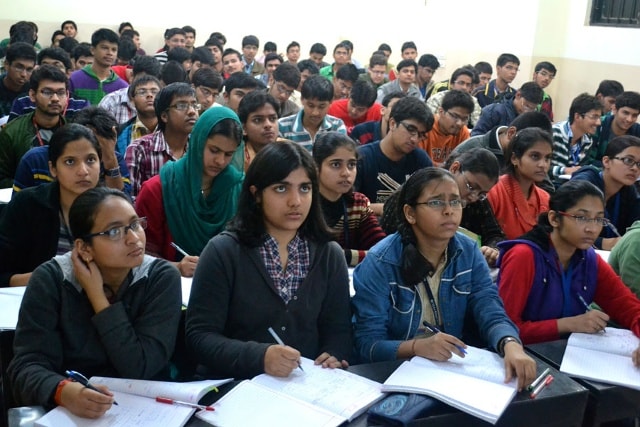 |
| A cram school in India. Photo: Internet |
In India, university admissions are somewhat complicated. High school seniors in India must take two exams: the High School Graduation Exam and the University Entrance Exam. The scores from both the graduation and university entrance exams are used by universities to select students. However, different localities and universities have different scoring methods, grading scales, and admission standards.
11. Norway
 |
| Study abroad for free in Norway. Photo: Internet |
Another country without a university entrance exam is Norway. High school achievements, bonus points for special fields of study, and a student's military service experience are all factors considered in the university admissions process. Each student can submit applications to up to 10 different universities for consideration.
12. Ireland
 |
| Irish university students. Photo: Internet |
In Ireland, after completing secondary school, students must take a national examination to obtain a High School Graduation Certificate. Those wishing to attend university then submit their applications to the Central Admissions Office, and a computer system automatically forwards the list of applicants along with their graduation exam scores to universities based on their preferences. Each university determines its own student quota for each program and notifies successful applicants of the results.
Peace
(Synthetic)