
5 billionaire villages in Nghe An province
(Baonghean.vn) - These millionaire villages all originated from poverty. But thanks to the dynamism and entrepreneurial spirit of the people, these villages are now renowned in Nghe An province for their wealth.
(Baonghean.vn) - These millionaire villages all originated from poverty. But thanks to the dynamism and entrepreneurial spirit of the people, these villages are now renowned in Nghe An province for their wealth.
Visiting the scrap metal village, admiring million-dollar villas.
In Nghe An province, if you ask about Dien Thap commune (Dien Chau district), everyone knows it. It's become famous for its wealth. While Dien Thap used to be known as the "scrap metal village," now, with its rows of multi-million dollar villas, it has become the "villa village."
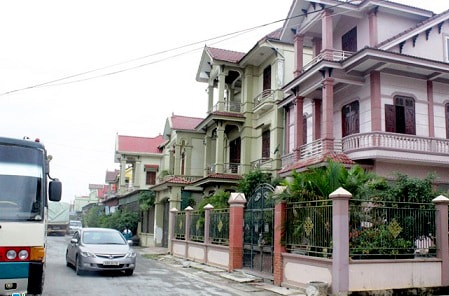 |
| On both sides of the road leading to the center of Dien Thap commune are rows of adjacent villas. |
As a predominantly agricultural commune, each household owns only a few acres of leased farmland, so the people have to struggle to make a living. Most of them collect scrap metal to earn a living and also to support the traditional bronze casting craft in the commune.
Upon learning that scrap metal prices in Laos were low, people from Dien Thap flocked to Laos to buy and resell recycled household products.
After being collected, the scrap metal is transported back to Vietnam for sorting and recycling before being returned to Laos for sale. This cycle of trucks, like shuttles, continues between Laos and Vietnam, providing a significant source of income for the people of Dien Thap.
Once they had a stable source of capital, from the 2000s onwards, the people of Dien Thap competed with each other to build multi-story houses. In just a short time, Dien Thap took on a completely new look, with million-dollar villas lined up side by side, forming a long street along the center of the commune.
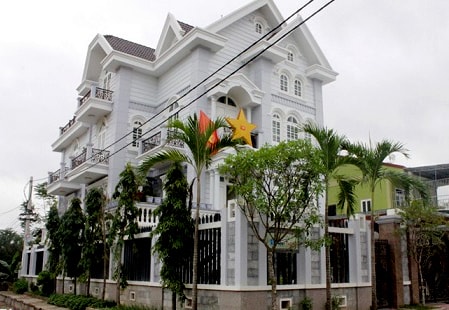 |
| Grand, opulent villas like these are not uncommon in this "scrap metal village". |
According to statistics, the entire commune has over 1,000 people who regularly do business and trade in Laos; there are about 40 households that have established large and small agencies to collect goods to supply to Laos.
From a scrap metal trading business, Dien Thap commune has become one of the richest communes in Nghe An province. Currently, there are hundreds of wealthy households, countless villas, not to mention hundreds of family cars, including dozens worth billions of VND.
Billionaire Villagethanks to going abroad
Do Thanh commune, Yen Thanh district (Nghe An province) was once a poor area where the lives of the people mainly depended on rice cultivation. However, Do Thanh is located in a low-lying area, flooded year-round, resulting in more crop failures than successes.
In the late 1980s and early 1990s, people from Do Thanh commune (Yen Thanh district) began going abroad for work to countries like Germany, Poland, England, and Australia to seek business opportunities. Initially, only a handful of people from the entire commune went, but later, seeing the potential for success, they returned and encouraged their siblings and relatives to go overseas to earn a living. Thus, the number of people "going to the West" (to work abroad) gradually increased.
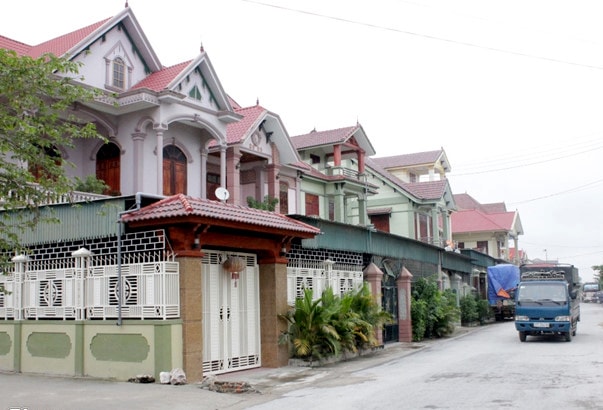 |
| The current appearance of Do Thanh commune (Yen Thanh district). |
After working hard abroad for a period of time, the laborers proudly brought back the money they had earned through sweat and tears to support their families, buy household items, and build spacious houses. Tall buildings began to spring up in increasing numbers. In a short time, the city of Do Thanh transformed rapidly.
In recent years, the Lao market has become more favorable for business, leading a segment of the workforce in Do Thanh commune, especially the younger generation, to seek opportunities for wealth. A village of Lao Vietnamese expatriates, with its numerous companies and businesses, has sprung up, becoming one of the wealthiest neighborhoods in Do Thanh commune.
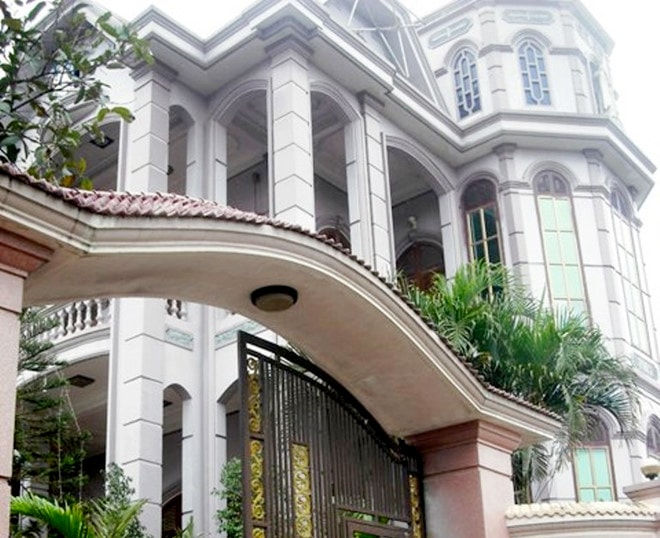 |
| The villa of Mr. Nguyen Duc Hoe's family in Dong Thi hamlet, Do Thanh commune, features a unique, classic Western design. It is considered the most extravagant house in the area, with construction costs reaching billions of dong since 2004. |
Currently, Do Thanh commune has over 300 millionaires, approximately 2,000 houses ranging from 2 to 4 stories, and over 200 cars of various types. If you visit Do Thanh now and are surprised by the million-dollar villas and luxury cars, it's truly "as old as the hills."
Village becomes a billionaire thanks to oranges.
The Quy Hop orange growing area currently has nearly 2,000 hectares of oranges, of which Minh Hop commune has the largest area, accounting for more than 50% of the total area of the entire district with nearly 1,100 hectares.
Currently, with three main orange varieties – Van Du, Valencia, and Xa Doai – nearly 1,300 households in 21 villages of Minh Hop commune have made a significant contribution to preserving and promoting the Vinh orange brand, while also increasing their income.
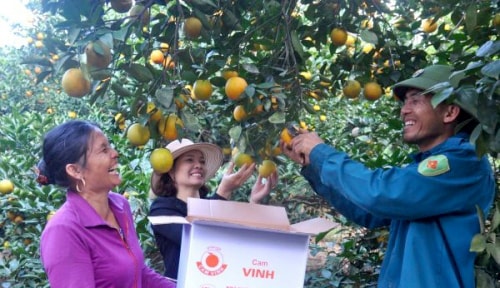 |
| Minh Hop commune has the largest area of orange groves in Quy Hop district, with nearly 1,100 hectares. |
Reportedly, the total area planted with oranges in Minh Ho hamlet is nearly 200 hectares, with an average yield of 20-30 tons/hectare/year.
Accordingly, out of a total of 200 households in the hamlet, over 80% achieved an annual revenue of 500 million VND, with over 10 households earning between 2 and 4 billion VND per year.
Orange growers in Minh Hop have continuously learned new cultivation techniques and introduced many new orange varieties. Besides increasing productivity, yield, and quality, extending the harvesting period and staggering the harvest helps with better preservation and fetches higher prices. Previously, the harvesting period on the trees was only 40-50 days, but now, the orange season almost covers the entire year; as one type of orange is about to be harvested, other oranges and tangerines are already covered in white blossoms.
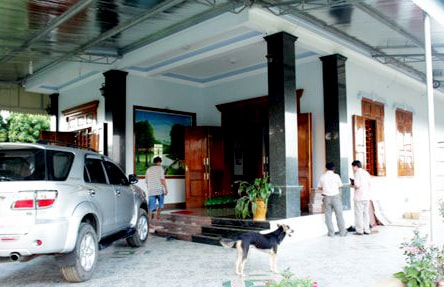 |
| Thanks to orange trees, many households in Minh Hop (Quy Hop) have become millionaires. |
Nowadays, the multi-million dollar orange orchards in Minh Hop are no longer a novelty; orange farmers building multi-story houses and buying luxury cars has become commonplace.
Thanks to the orange trees, mobilizing resources for building new rural areas and constructing social welfare facilities has been very convenient. It can be said that not many farmers like Minh Hop own luxury cars while doing agriculture.
Life-changing success from making banh chung (Vietnamese rice cakes).
No one remembers exactly when the making of banh chung (Vietnamese rice cakes) originated in Vinh Hoa village, Hop Thanh commune, Yen Thanh district. However, according to the elders in the village, since the war, a small number of women in the village would make a few dozen banh chung daily, carrying them to the market to sell...
Nowadays, when people mention Vinh Hoa village, many will remember it as the village famous for its glutinous rice cakes in Nghe An province.
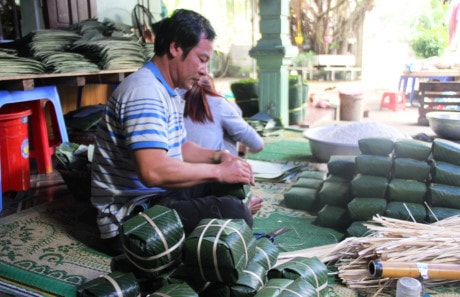 |
| During the Lunar New Year holiday, households make many packages and consume several hundred kilograms of sticky rice each day; on ordinary days, consumption is lower, but still around 30-40 kg of sticky rice. |
For the people of Vinh Hoa, banh chung (Vietnamese sticky rice cake) has become a familiar dish. It's always readily available at home, and whenever guests come to visit, they're treated to banh chung, green tea... and the conversation eventually revolves around where their village's banh chung has traveled to, or how many banh chung their village will make this Tet holiday.
Every day, from 4 or 5 in the afternoon, the whole village gathers to wrap rice cakes until 8 pm when they light the stoves and cook them. At 1 or 2 in the morning, they take the cakes out of the ovens, and around 4 or 5 in the morning, the whole village wakes up, calling out to each other to go sell and deliver the cakes. The atmosphere in the village is always as joyful as Tet (Vietnamese New Year).
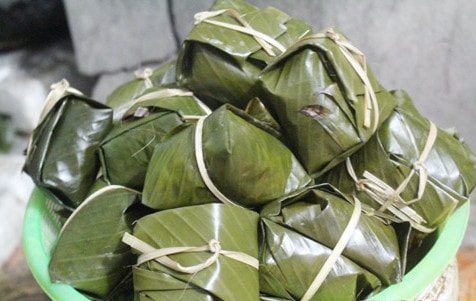 |
| The products of the craft village are also diverse, with many different types of cakes such as banh tet and banh nep. |
Currently, there are 300 households in the village, and almost every household is involved in making banh chung (traditional Vietnamese rice cakes). With the tradition of making banh chung and banh tet (another type of Vietnamese rice cake) for holidays, Tet (Lunar New Year), or even everyday life, and then exporting them domestically and internationally, the people of Vinh Hoa village have become increasingly prosperous. Many people who worked far away have returned to continue the tradition of making banh chung and have become wealthy and well-off.
From selling banh chung (traditional Vietnamese rice cakes), the locals earn about 10 million VND per day. Some families even earn around 40 million VND per day from selling banh chung and banh tet during Tet (Vietnamese Lunar New Year).
In the fishing village, each household earns 40-60 million VND per month.
As its name suggests, Tien Thuy commune (Quynh Luu district), situated in a riverside area, is also mentioned among the wealthiest communes in Nghe An province today.
In recent times, to meet the demands of offshore fishing, fishermen in Tien Thuy commune, Quynh Luu district, have boldly borrowed capital to build new boats, upgrade existing ones, and install modern sonar equipment to improve fishing efficiency.
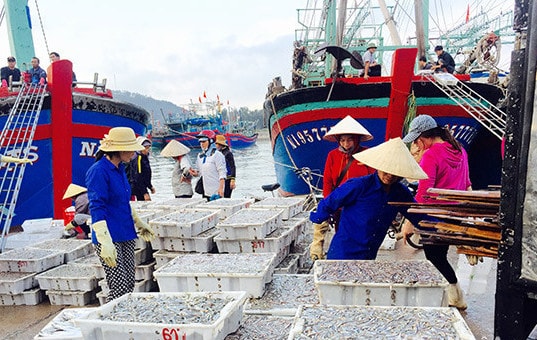 |
| Tien Thuy commune currently has over 324 boats and ships with a total capacity of 85,653 horsepower. |
The entire commune currently has over 324 vessels with a total capacity of 85,653 horsepower (CV). Each year, the locality renovates and builds 10-15 vessels with a capacity of 900-1,100 CV. From the end of 2016 to the present, the locality has invested in building 25 vessels, including 12 vessels built under Decree 67 (4 steel-hulled vessels, 8 wooden-hulled vessels; steel-hulled vessels are valued at 15-18 billion VND/each, wooden-hulled vessels are valued at 7-9 billion VND/each).
The development of the fishing industry also promotes other industries and handicrafts. In particular, it expands services such as: ship repair and construction, mechanical workshops, fuel services, seafood processing, and ice production for preserving seafood.
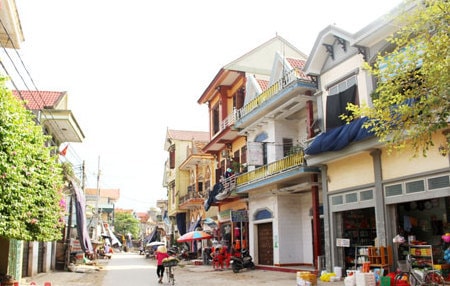 |
| Currently, in Tien Thuy commune, the average income for households engaged in fishing is between 40 and 60 million VND per month. |
With the largest number of boats in the district, it regularly provides employment for over 2,000 local workers. As a result, many households here have escaped poverty and become relatively wealthy; on average, households engaged in fishing earn 40-60 million VND per month.
Thanks to its favorable location near the sea, all the roads in Tien Thuy commune have now been upgraded to concrete roads. Large houses and villas have sprung up over time, and the people have become more prosperous and wealthy through fishing and seafood harvesting.
Ngoc Anh
(Synthetic)
| RELATED NEWS |
|---|