

Secrets to raising crispy carp
(Baonghean.vn) - Recently, crispy carp has become a favorite dish, loved by many people at restaurants and eateries; the fish no longer has a fishy taste but is crispy and appealing.
The secret to raising crispy carp is simple. About 3-5 months before harvesting, regular carp are fed a special feed: broad beans (also known as red broad beans or horse tooth beans). This transforms the fish into crispy carp. The skin and flesh become firm, and when eaten, they have a unique crispness and flavor.
Below are the technical steps for raising crispy carp to achieve the highest efficiency.
Prepare the pond and cages for breeding.
Ponds and cages for aquaculture should be located and designed in areas with clean water sources, free from industrial, agricultural, or domestic wastewater.
- For ponds:The fish ponds have an area of 2,000 - 5,000 m2. The pond bottom is leveled and sloped towards the drainage outlet. The pond depth is greater than 2 m, with a water depth of 1.5 - 2 m. Raising crispy carp in ponds requires auxiliary equipment to create water flow, which can be done using pumps or water fans. This is an important requirement to stimulate the fish to swim and be active, resulting in crispier fish meat.
Before stocking the pond with fish, the water should be drained and the mud dredged. Then, lime should be used to improve the pond bottom and eliminate unwanted organisms; the dosage is 7-10 kg/100 m², and the pond should be left to dry in the sun for 3-5 days. After improvement, the pond should be filled with enough water to a depth of 1.5-1.8 m. The water supplied to the pond must be clean, free from contamination, and turbid.
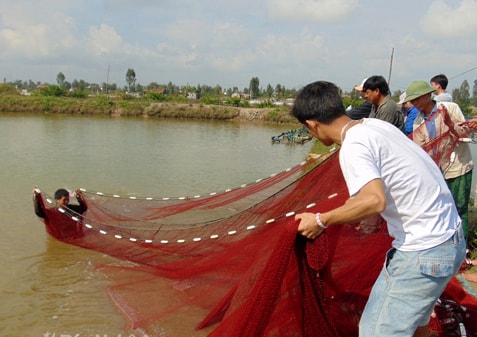 |
| When raising crispy carp, the water source must be clean and free from contamination, and the water supply should be kept free from turbidity. |
- For cages:If the fish cage has a large area, choose locations with a depth of 3.5 - 4 m. The cage should be placed afloat and anchored in a convenient location on the river with a continuous water flow, a relatively stable river water level, and the water level must be 0.3 - 0.5 m higher than the cage's submersion height.
Release method and density
Before carrying out operations such as transporting to new ponds or cages, or thinning out the fish, it is necessary to force-feed them for about one day. Transfer the fish when the weather is cool, in the early morning or late evening.
The fish introduced into the rearing tank have intact fins and scales, are free from abrasions, have not lost their mucus coating, and are of uniform size. They are active, swim quickly and nimbly, and swim submerged in schools; there are no signs of disease.
Crispy carp can be raised for 1-2 seasons per year, each lasting 3-5 months; the fish selected for farming are large, weighing 1.2-1.8 kg. Stocking density in ponds is 0.5-1 fish/m2, while in cages it is 5-7 fish/m3, depending on the care conditions.
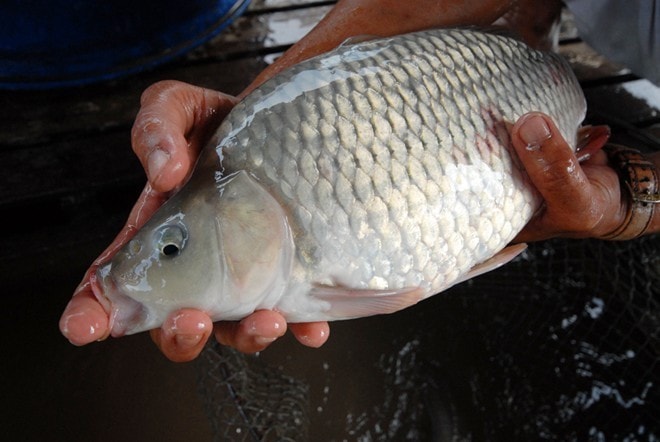 |
| Carp are raised for about 9 months until they reach over 1 kg. At this point, farmers fatten them with silkworm pupae to determine the crispness of the fish meat. |
Methods for feeding fish silkworm pupae.
- Food preparation methods:Before feeding the fish, farmers must soak the fava beans in water for 12-24 hours (depending on the air temperature), and cut larger beans in half. Then, rinse them thoroughly and mix with 1-2% salt, letting them sit for 10-15 minutes before feeding. This is a fairly common method of preparing feed in carp farming..
- Feeding method:Carp should be trained to eat silkworm pupae by starving them for 5 days, then starting to feed them silkworm pupae. For the next 5 days, feed them silkworm pupae at a rate of 0.03% of their body weight at 4 PM, as this is the optimal time for absorption. Then gradually increase the ration to 1.5-3.0% of the total fish weight in the pond.
Fish feed must be closely monitored daily through feeding sieves.
 |
| The broad bean is the key ingredient that gives carp its crispiness and delicious flavor. |
Farming techniques
Initially, do not feed the fish anything other than silkworm pupae. After feeding them the pupae for about 3 hours, check if they have eaten all of it, or if they have eaten too much or too little, so that you can adjust the amount of food accordingly.
Fava bean seeds tend to sink quickly, so when feeding fish, only scatter a small amount at a time to avoid wasting food, and feed the fish according to their daily needs.
The correct way to raise carp is to feed them twice a day, at 8-10 am and 4-6 pm. The feed should be placed in a trough at the bottom of the pond or cage (the trough should be made of an iron frame with a diameter of 6 cm, an area of 4-5 m², and a height of 25-30 cm). The trough should be surrounded by two layers of mesh: one layer of steel mesh and one layer of nylon mesh to prevent the feed from drifting out.
During use, the feeder should be cleaned regularly, at least twice a month, to ensure better disease prevention for the farmed fish.
Disease prevention
Once a month, add Tien Dac I to the fish feed at a dosage of 100g of medicine per 500kg of fish per day, feeding continuously for 3 days. Alternatively, use finely ground garlic at a rate of 3-5g per kg of feed. Vitamin C or a multivitamin supplement can also be used at a dosage of 30mg per kg of feed.
Inspect the fish in the pond or cage; if the fish meat reaches a certain firmness, proceed with harvesting. The fish should be fasted one day before harvesting.
Ngoc Anh
(Synthetic)
| RELATED NEWS |
|---|