

Why is violent behavior considered... normal?
In recent days, the story of a famous architect named Khánh, who lost his temper and slapped a girl, has caused a social media frenzy...
Of course, many people were upset by this behavior, but on the other hand, many also sympathized with and defended Khanh because "everyone gets angry sometimes." Khanh apologized, the girl forgave him, and the story had a peaceful ending.
But what really bothered me was how the phrase "everyone gets angry sometimes" is so easily used to excuse violent behavior. It's so commonplace that most people accept it as a given, viewing moments of losing control as unintentional, external rather than a result of their own immaturity.
Setting a bad example for children.
During their upbringing and maturation, many children fail to learn the crucial lesson of self-control and the importance of not using violence in order to behave in a civilized and noble manner.
Violence stemming from anger is so common that almost every parent has yelled at their child, or even hit them. Many families see parents arguing and fighting constantly, even physically, in front of their children. They may realize their mistake later, but the excuse they always give is that they couldn't calm down in the heat of anger.
 |
| The architect's slap has caused a stir on social media in recent days. Image: Internet |
When children go to school, many also encounter teachers who lose their temper, insult students, spank them, or expel them from the classroom. There are videos posted online showing teachers who couldn't control their anger, grabbing students by the neck and hitting them, only to be hit back by the students. If teachers themselves lack self-control, how can they teach children about self-control?
The fact that some nannies, in a fit of anger, have abused children under 5 years old is often justified with this: "If I hit my own child when I'm angry, how can a nanny look after dozens of children?" It's all too easy to justify anger and violence. Adults have instilled in children the idea that anger can lead to violence against others. They are also more likely to retaliate with violence when they are angry.
When children fight, it's also a great opportunity to teach them about self-control and avoiding violence. But many parents tend to dismiss it as childish behavior, or go looking for the other child to "teach them a lesson" or confront their parents.
Lack of maturity in social and legal behavior.
During a mobile court hearing where a defendant was charged with two counts of "murder" and "intentional infliction of injury," I witnessed many people defending the defendant, arguing that although the defendant had brutally and presumptuously killed his rival, the primary fault lay with the defendant's wife's infidelity.
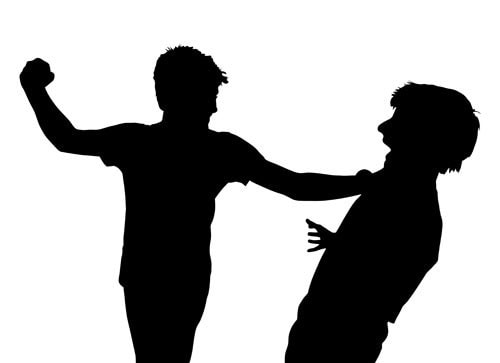 |
| Illustrative image. |
The judges that day were also quite harsh with the defendant's wife. And in some of my colleagues' articles, I read every sentence, every word emphasizing the wife's fault, "sympathizing" with the defendant for losing control due to anger. When discussing this story, many people said to me: "In that situation, I might have killed someone too; who could remain calm?" I asked them in return: "What about your children? Aren't you afraid of going to jail? Do we have the right to punish others with violence?" Many still insisted: "Killing someone and going to jail is acceptable; doing nothing would be shameful."
At a UNICEF workshop on violence prevention, many delegates argued that some media coverage reinforces social prejudices that fuel violence instead of fighting to eliminate it. Justifying violent acts is also a contributing factor.
Recently, there have been many incidents of people brutally beating dog thieves to death or severely injuring people suspected of kidnapping children out of "extreme anger." They resorted to savage violence to vent their rage on an individual, regardless of the legal consequences. I think about the families shattered by imprisonment, about the families who lost loved ones because of these violent mobs. Surely, when they committed these acts, they didn't think so far ahead. Or, even if they did think about it, if they still acted recklessly, then they were truly irresponsible.
Self-control should be the first lesson.
I have a friend who moved to the US with her husband. She said she learned a lot from her husband about raising children. One day, her 4-year-old son got into a fight with a friend, so her husband took him to their room to talk. The boy continued screaming, so her husband went outside and closed the door. The boy was shouting hoarsely, banging on the door, and then crying pitifully. But her husband patiently waited until the boy calmed down before returning to the room to continue the conversation. He repeatedly told his son, "You must not be violent towards others. You must be calm to talk things out."
At school, children will always be taught this lesson: to remain calm and control their emotions. Violence is shameful and illegal. In reality, the police will immediately arrest anyone who commits violence against children or women. The community will despise them, regardless of the reason for their anger.
A foreign friend living in District 7 rushed to intervene when a guy was grabbing his girlfriend's hair and hitting her during an argument, almost resulting in a fight. He told me about it, and I jokingly said, "Oh, maybe she did something wrong yesterday." My friend didn't realize I was joking and seriously told me, "No one has the right to use violence against others. What you're saying is nonsense."
I've realized something: what you do when you're angry accurately reflects your level of maturity, both personally and socially.
According to PLO