

President Ho Chi Minh's affection for the peasant class.
(Baonghean.vn) - During his lifetime, President Ho Chi Minh always paid attention to all social classes, with particular concern for the peasant class. In their journey towards happiness and prosperity, Vietnamese farmers always had Uncle Ho by their side.
Vietnamese farmers were a tremendous force in the revolution. They did not shy away from hardship and sacrifice, actively increasing production and contributing their manpower and resources to the sacred resistance war of the nation. More than anyone else, Uncle Ho understood the hardships and struggles of these people.
At every meal, Uncle Ho always made sure not to let a single grain of rice fall, considering the waste of even a single grain of rice as a waste of the sweat and labor of his compatriots and comrades. In his Last Will and Testament, he proposed "exempting agricultural taxes for one year for agricultural cooperatives so that the people would be happy, relieved, and more enthusiastic, boosting production."
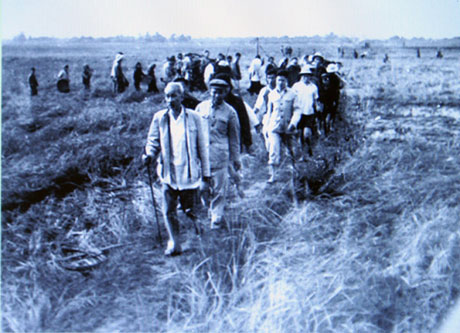 |
| President Ho Chi Minh visits members of Thap Thuong Cooperative in Dan Phuong, Hanoi, during the harvest season. (Archival photo) |
During the fierce bombing campaign by the American invaders in the North, Uncle Ho took the time to visit cooperatives, inquire about and encourage farmers. The image of Uncle Ho rolling up his trousers to wade into the rice fields, helping to bail out water and operate water wheels to combat flooding with the people, remains a beautiful image in the hearts of the people.
Upon hearing the news that the Red River dike in the Hung Yen and Thai Binh areas had broken, President Ho Chi Minh personally went to inspect the damage repair efforts. He inquired in detail about the number of victims, instructing that the first priority should be to ensure food for the people so they wouldn't go hungry, then to provide shelter and stabilize their lives, and to concentrate human and material resources on repairing the broken dike. He promised to visit once the repair was complete.
Keeping his promise, four months later, Uncle Ho came to attend the inauguration of the newly constructed dike section. He inspected the area where the new and old dikes met and reminded everyone that reinforcement was necessary for safety. He praised the speed of construction but noted that the compaction wasn't sufficient, suggesting that more manpower was needed to thoroughly compact the dike to ensure its long-term durability.
 |
| President Ho Chi Minh tries out an improved rice transplanter at the Hanoi Department of Agriculture and Forestry's Rice Cultivation Experimental Farm. (Archival photo) |
In his "Letter to Farmers Competing in Agricultural Production" in February 1951, President Ho Chi Minh wrote: "A well-fed army is a strong army! While soldiers on the front lines compete to kill the enemy and achieve meritorious deeds, our compatriots in the rear must compete to increase production. Fields are the battlefield, hoes and plows are weapons, farmers are soldiers, and the rear competes with the front lines." This letter demonstrated President Ho Chi Minh's special concern for the peasant class and agricultural production.
When visiting the people, Uncle Ho did not use general words but was very specific, clearly stating each issue, pointing out strengths to be promoted, and clearly identifying weaknesses to be overcome. Standing before the people, Uncle Ho did not deliver speeches but instead cordially conversed and inquired about their well-being.
In his final years, Uncle Ho still devoted much time to working with comrades in charge of agriculture. During Politburo meetings or agricultural work sessions, he often mentioned the Cooperative Charter. He said: "Workers have a commemorative day, so farmers should also have one. Therefore, the date of promulgation of the Cooperative Charter should be used as a commemorative day for farmers." He instructed that the Charter be written in a way that even uneducated farmers could understand. After reading the draft, he said that this was the version for cadres; for cooperative members, it should be more concise and easier to understand…
 |
| President Ho Chi Minh visits farmers harvesting rice in the fields of Hung Son commune, Dai Tu district, Thai Nguyen province. (Archival photo) |
Before his passing, he left behind immense love and affection for his comrades and compatriots. In the supplement to his Last Will and Testament, written in May 1968, he dedicated a section to the Vietnamese peasantry. He wrote: “Throughout the years of resistance against French colonialism, and then against American imperialism, our people, especially the peasants, have always been extremely loyal to our Party and Government, contributing resources and manpower, willingly enduring all difficulties and hardships. Now that we have achieved complete victory, I propose exempting agricultural taxes for one year for agricultural cooperatives so that our people may be happy, relieved, and more enthusiastic, boosting production.”
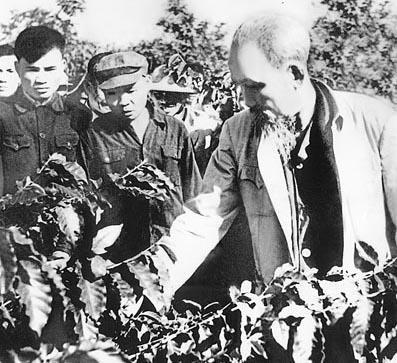 |
| President Ho Chi Minh visits the coffee plantation of Dong Hieu Farm, Nghia Dan district (Nghe An province). (Archival photo) |
Today, our country has become one of the world's leading rice exporters. The lives of farmers have changed dramatically; their children have received education and gained knowledge. In this great joy, we remember our beloved Uncle Ho – the builder of the new Vietnam, the great leader of the Party and the nation, who throughout his life cared for and was close to Vietnamese farmers and rural areas. Uncle Ho will live forever in the hearts of the nation, in the hearts of the hardworking, simple, and loyal farmers.
Peace
(Synthetic)