

Foreign military intervention: A painful failure for the US?
History shows that military support in vulnerable and unstable nations is not the "cure-all" that U.S. security officials had hoped for.
Since the end of World War II, both parties in the U.S. Congress have pursued a foreign policy that has evolved over time: training and equipping military forces abroad to expand American influence.
|
| US soldiers participate in training Iraqi troops in counter-terrorism operations. Photo: US Department of Defense. |
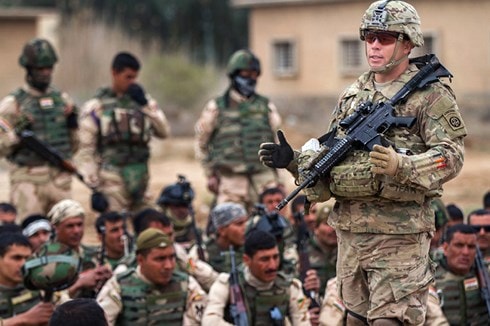
The United States has pursued this policy in most parts of the world for over 70 years, seeking to stabilize unstable countries. Currently, Washington is cooperating with the militaries of more than 100 nations, implementing large-scale programs such as training and arming foreign troops in conflict hotspots like Syria, Afghanistan, Iraq, Jordan, and Pakistan.
Why is the U.S. determined to militarily bolster unstable nations?
The principle behind this approach can be understood as follows: by increasing security in unstable regions, the US will establish itself as the most influential superpower in the world, surpassing both China and Russia, acting as a "peacebuilder," and subsequently preventing potential security threats from spreading to the US.
Providing military support to foreign countries is common and familiar to U.S. policymakers. In a 2010 article in the Journal, then-U.S. Secretary of Defense Robert Gates called unstable nations “the greatest security challenge of all time,” emphasizing the need to help these countries defend themselves, whether through military training, equipment provision, or other forms of security assistance.
For decades, the United States has spent billions of dollars on foreign security forces. If you do the math, that's around $20 billion a year. But what has the U.S. received in return?
Even within the United States, public support for military intervention abroad has declined. And in the countries that the U.S. provides military support, the situation is no better; conflicts persist and divisions remain almost irreparable, leading to increasingly dim prospects for peace and stability. The U.S. policy of support can only be summed up in three words: "more and more"—more funding, more military equipment, more training programs…
When reality doesn't live up to expectations.
Experience throughout history has shown that military support in vulnerable and unstable countries is not the "cure-all" that security officials in these countries hoped for. In fact, the results of this policy have been half-hearted and have not achieved the desired outcomes.
The biggest problem with U.S. efforts to build foreign militaries is setting higher-than-expected goals, failing to adequately assess the realities of the host country and the structure and capabilities of its military.
For example, during the war in Yemen from 2007 to 2011, the US government allocated over $500 million to support the Yemeni military in fighting Al Qaeda and various rebel groups. Primarily focused on counterterrorism, the US failed to understand that security challenges were not the only problems Yemen faced. Another challenge was corruption and abuse of power within the Yemeni government at the time.
Former Yemeni President Ali Abdullah Saleh, since coming to power, has sought to place his relatives in government. UN investigators have accused him of accumulating wealth through embezzlement, extortion, and abuse of power.
According to some sources, Saleh also siphoned off US aid funds to enrich himself and consolidate his power. By 2015, as Yemen was mired in civil war, US Department of Defense officials officially admitted that they had failed to track the movement of millions of dollars worth of military equipment and were unaware of whether these weapons were being misused.
U.S. efforts to support the Malian military also collapsed for similar reasons. General Carter Ham, commander of the U.S. Africa Command from 2011 to 2013, explained that military assistance to Mali "focused almost entirely on tactical or technical issues."
The US approach focused solely on training programs without enhancing the overall capabilities of the Malian military, including its structure, organization, discipline, and mission. As a result, the Malian military was unable to withstand the rebel coup on March 21, 2012, which seized all the military equipment the US had provided. The coup was motivated by the government's failure to provide sufficient weapons and resources for the military to confront the Tuareg rebels and other extremist Islamic groups in the north.
In Afghanistan and Iraq, the situation was different, with the US deploying troops to both countries alongside financial support. In these two nations, the US spent billions of dollars building up armies of hundreds of thousands of soldiers. However, the US overlooked crucial questions about the mission, structure, and leadership of these forces. Consequently, despite the significant efforts to build up the militaries of these countries, their operational effectiveness remained low.
Is the partner dissatisfied?
Despite U.S. efforts, countries receiving military assistance remain dissatisfied with the quality, quantity, and duration of the aid provided. This is understandable, given the constant instability and threats they face, and their desire for immediate and more substantial assistance. Meanwhile, the U.S. has limited financial resources and military capabilities.
A prime example is the conflict in Lebanon. The US announced a $1 billion aid program to help Lebanon build up its army after 2005, following the Syrian army's withdrawal. Washington argued that Lebanon urgently needed assistance to regain control of its territories.
However, it took more than a year for the US to realize this goal, and another year to establish a military training program and provide equipment to Lebanon, including vehicles, light weapons, rifles, and night vision equipment. Frustrated by the delays from its American partners, Lebanon criticized the US and even sought help from Russia.
Another lesson that could be considered a "bitter failure" for the US is the Syrian battlefield, where the US was abandoned by both its Kurdish allies and Türkiye. Despite being a long-standing ally in the North Atlantic Treaty Organization and in the fight against Islamic extremism, Turkey felt that President Trump never seemed to care about Turkey's concerns regarding the decision to arm Kurdish forces in Syria.
The decision to attack Kurdish forces in Afrin was in response to the US decision to establish a border guard force in Syria, primarily composed of Kurds. Meanwhile, the Kurds, feeling cut off from US aid and abandoned on the battlefield, turned to the Syrian government for assistance in resisting Turkish attacks.
According to analysts, the US needs to learn from the aforementioned failures. Instead of focusing solely on training and equipping the host country's military, the US needs to understand the political situation of each nation, set clear goals, and evaluate each stage of its support operations.
Mara Karlin, a political analyst, said the U.S. needs to face reality and try to address the root causes of instability in each country it supports, instead of unnecessarily "throwing money away."