

Will vehicles that evade inspection face harsher penalties?
Minister of Transport Nguyen Van The suggested that if the current penalties for vehicles evading inspection are too lenient, a proposal could be made to increase them to adequately deter violations.
According to information from the Vietnam Registering and Inspection Department, the department has updated and posted a complete list of all vehicles that have reached the end of their service life or have overdue inspections on its website to serve the public and relevant authorities for reference.
The legal sanctions for using vehicles that have exceeded their service life or registration expiration date are quite comprehensive, including fines, license revocation, and confiscation of vehicles that have exceeded their service life; however, violations remain a complex issue.
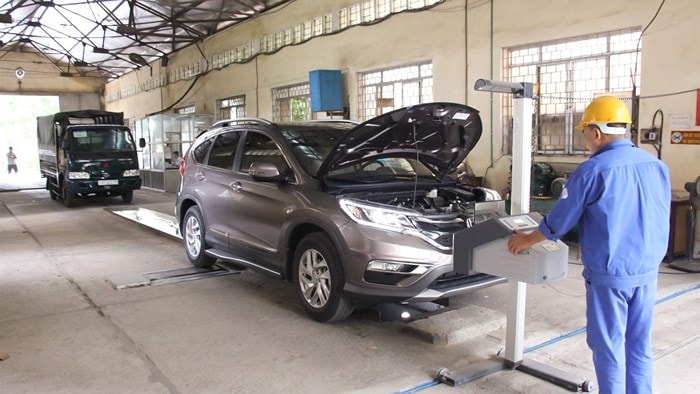 |
| Currently, there are over 200,000 vehicles that have evaded vehicle inspection. |
Currently, localities have 186,000 vehicles that have exceeded their service life, but in reality, many of these vehicles are still participating in traffic, operating illegally and without proper registration. In addition, more than 200,000 vehicles do not comply with periodic vehicle inspections. These are common and serious violations that pose a direct risk of traffic accidents.
“The Vietnam Registering and Inspection Department needs to find new solutions and approaches to address this issue; proactively propose that district-level authorities and equivalent units where vehicles have reached the end of their service life or are overdue for inspection manage them according to their authority. If the penalties are not sufficiently deterrent, a proposal to increase them can be made,” Minister of Transport Nguyen Van The requested.
In particular, the head of the transport sector stated that there is a gap in state management of vehicle quality between inspection periods. After inspection, maintaining quality is the responsibility of the vehicle owner, but there is no mechanism to monitor whether the vehicle maintains its technical safety and environmental protection standards.
The Minister raised the question: if vehicle owners rent standard-compliant parts for inspection, but then remove them after the inspection, how can this be controlled? Or what happens if the vehicle owner neglects to maintain quality after inspection? If the Vietnam Registering and Inspection Department suspects such a thing, can it directly inspect and handle the violations?
Previously, according to a report from the Vehicle Registration Department, as of June 1st, there were 205,058 vehicles nationwide that had expired inspection certificates for 30 days or more. If owners continue to use these vehicles on the road, it poses a very high risk of causing traffic accidents.
To date, the whole country has 186,883 vehicles that have reached the end of their service life, including 138,510 cargo vehicles and 48,373 passenger vehicles (in 2017 alone, there were 24,264 vehicles that reached the end of their service life, including 21,651 cargo vehicles and 2,613 passenger vehicles).