

Turkey invites US intervention: What future awaits Idlib?
(Baonghean) - Despite the worsening Covid-19 pandemic, the Turkish army launched a new offensive against the Syrian army this week. Simultaneously, there were unprecedented large-scale military movements. Amidst escalating tensions that could push Idlib into a “final battle,” Turkish President Tayyip Erdogan held a series of phone calls with both US President Donald Trump and Russian President Vladimir Putin this week. Most notably, there was news of agreements being considered by the two allies, the US and Turkey, for cooperation in the last remaining hotspot in northwestern Syria.
THE US-TURKEY CALCULATIONS
In fact, the phone call between Turkish President Tayyip Erdogan and US President Donald Trump was made at the call of UN Secretary-General Antonio Guterres for countries and armed groups around the world to lay down their arms to fight the common enemy: the increasingly serious Covid-19 pandemic.
However, beyond responding to Secretary-General Guterres' humanitarian call for a ceasefire, there are other motivations driving the two allies, the US and Turkey, to temporarily set aside their differences and conflicts and join forces at this time.
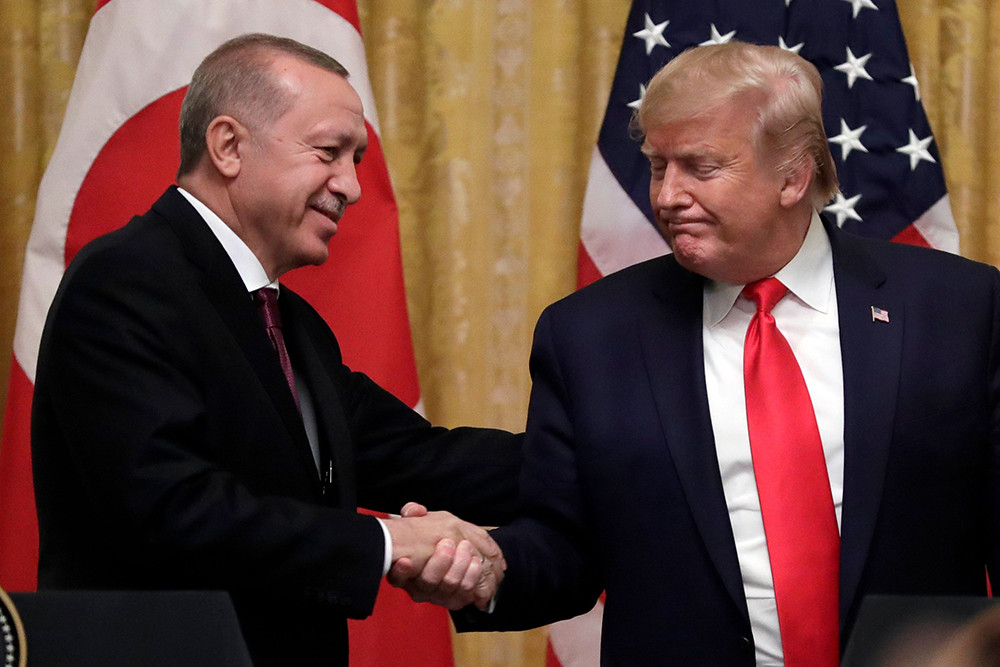 |
| Turkish President Tayyip Erdogan "invites" the US to provide support in the Idlib battlefield. Photo: AP |
Of course, in the context of all countries, including the US and Türkiye, struggling to combat the Covid-19 pandemic, political calculations are perhaps becoming secondary to current priorities. However, on the other hand, both leaders understand the reality that if Idlib, the last remaining opposition stronghold in northwestern Syria, falls under the control of President Bashar al-Assad's government, another wave of violence will ensue, potentially even spreading beyond Syria's borders.
Not to mention the uncontrollable wave of migrants that would put even greater pressure on Türkiye and the entire Middle East region. Clearly, neither the US nor Türkiye are prepared for these scenarios, especially in the context of the current pandemic. Meanwhile, allowing the Assad regime to gain the upper hand would only further solidify Russia's position and influence in Syria in particular and the Middle East in general.
The only condition for US support in Idlib is that Türkiye must abandon its S-400 air defense missile system.
Therefore, in the latest developments, US Secretary of State Mike Pompeo and NATO Secretary General Jens Stoltenberg have both offered support to Turkey in Idlib, although no specific military aid has been promised. The only condition the US has set is that Türkiye must abandon the S-400 air defense missile system purchased from Russia.
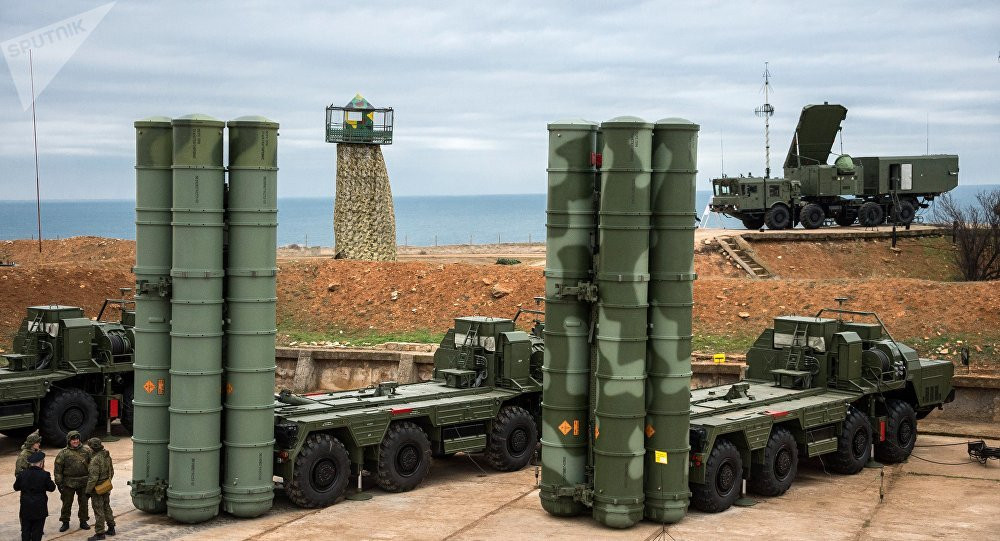 |
| Russia's S-400 Triumf missile defense system. Photo: Sputnik |
Ankara has not yet given an official response to this proposal. However, according to observers, dismantling or returning the S-400s to Russia is certainly not an option for Turkish President Erdogan. But it could be a move to halt further purchases of this system in the near future. This alone could satisfy the US, thereby increasing its support for Türkiye in the Syrian war, however it may be!
STRUGGLE OR RETENTION
The reality is that the Syrian government army has consistently been determined to gain control of the last remaining strategic area, Idlib, which is currently under the control of opposition armed forces. Conversely, Türkiye, through various means such as reinforcing its forces and appealing to allies like the US, is working to maintain the ceasefire reached with Russia in early March.
Türkiye is seeking various ways to acquire more resources to compete with Russia.
On the surface, the goal is to reduce conflict in order to focus resources on combating the pandemic; but in reality, this is a move to secure Ankara's strategic interests in northwestern Syria. At the same time, it's also a way for Ankara to gain more resources to compete with Russia.
Notably, this week, along with the phone call with the US President, Erdogan also had a phone call with Russian President Putin. More than anyone else, Erdogan understands that Russia has a significant advantage in Syria. He understands that Turkey's deliberate troop increase in northwestern Syria at this time is a way to force the Syrian government army and forces backed by Russia and Iran to break the ceasefire. This would provide Türkiye with a legitimate pretext to act.
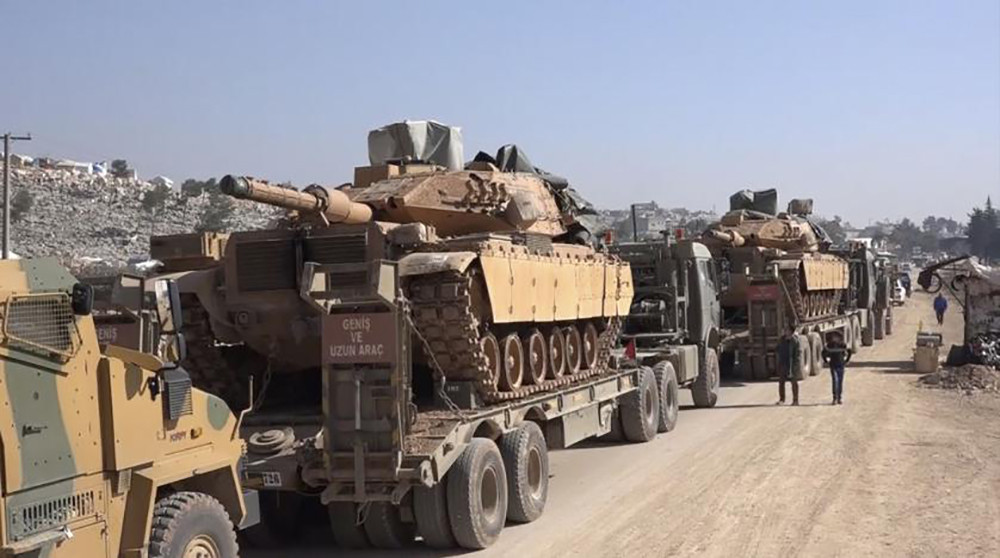 |
| Turkish armed forces in Idlib, northwestern Syria. Photo: AP |
However, in response to the phone call, President Putin only proposed that the Turkish government fulfill its commitments to separate the moderate Syrian opposition from the Hayat Tahir al-Sham terrorists. Putin made absolutely no mention of Turkey's military actions.
Russia's seemingly "indifferent" stance at this time is not difficult to understand. Looking back over the past few days, Russia has made many efforts to cooperate with countries such as the US, China, and even Türkiye... in preventing and repelling the Covid-19 pandemic. These steps can be seen as a spirit of global solidarity, but also as an effective diplomatic investment by Moscow.
Besides that, there's another issue of greater concern to the Russian government: the oil price war and market share conflict with Saudi Arabia. Now, negotiations and bargaining have included the US – another move Russia has been planning for a long time. Therefore, it's understandable that Russia seems unconcerned about Turkey's actions in Syria. And of course, escalating tensions is not an option for President Putin at this time! Meanwhile, Turkey is in a precarious situation, as terrorist elements in northwestern Syria are taking advantage of the pandemic to intensify provocative actions. This is further motivating the Damascus government to accelerate its campaign to eliminate terrorists in Idlib.
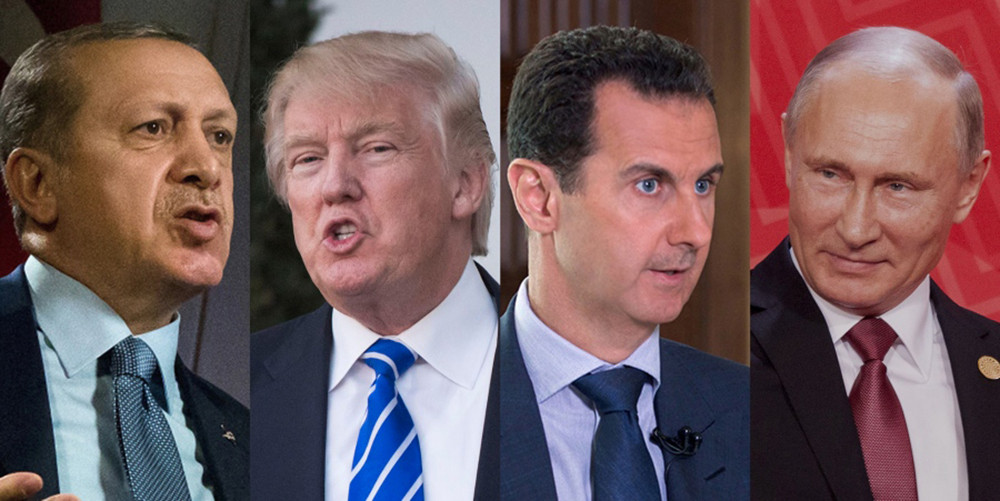 |
| The quartet with a long history of conflict: the US, Russia, Türkiye, and Syria. Photo: Bloomberg, Washington Post, SANA |
For its part, in response to Ankara's offer of assistance, the wise choice for the Washington administration at this time is not military action or conflict, but diplomatic intervention. And that, allowing the war in Syria to truly end is the sensible option, avoiding escalating tensions with Russia and igniting a new war in Idlib. Of course, the US will need to reach an agreement with other countries, including Russia, on pressuring the Syrian government regarding a roadmap for national reunification. This includes limiting casualties and conflict in retaking Idlib, and granting amnesty to political prisoners...
Of course, there is no easy solution for Idlib or for Syria as a whole, especially when the parties are still vying for a fair share of the spoils. But one reality that all parties understand is that if there is no diplomatic and political solution, then there will only be bad or even worse options for Syria!