

Should tutoring and extra classes be banned or not?
The issue of tutoring and extra classes has been debated repeatedly in the press, even in the National Assembly. However, to this day, it remains fundamentally unresolved.
This situation reveals a certain awkwardness in addressing the issue. This is due to differing opinions regarding the various manifestations of tutoring and supplementary classes, and consequently, differing public opinions. Some opinions view tutoring and supplementary classes as something extremely negative and evil that needs to be abolished. In my opinion, these opinions are biased, stemming from two possibilities: Firstly, the judges have not yet considered and evaluated the issue comprehensively and holistically, with a multifaceted perspective; secondly, the judges only focus on the negative aspects of the issue, lacking a benevolent, tolerant, and humane viewpoint. Of course, this perspective arises because the education sector has long had many issues that cause concern, including the issue of tutoring and supplementary classes.

Personally, I believe there's no reason to ban tutoring and extra classes, because it's both a need and a right. Tutoring is, first and foremost, the desire of parents and students. Without demand, how can there be supply? No one would think of opening classes without understanding the needs of the learners, nor would anyone arbitrarily create classes and then force students into them. The proof is that while we ban tutoring and extra classes within schools, tutoring centers outside of schools are still bustling with students. Here, I'm talking about the origins of the story. And of course, we should never completely deny the significance of tutoring and extra classes in the process of forming and perfecting students' knowledge, abilities, and qualities.
In our time, cram schools sprung up like mushrooms, sometimes with hundreds of students in a single classroom. And these cram schools played a crucial role in opening the doors to university for many people. Even those who are now protesting against tutoring and extra classes may have entered university thanks to the support of these cram schools. We once accepted and welcomed this, so why can't we continue?
Someone opens a class, someone gives extra lessons, primarily to meet the needs of the students. And the teachers, while it may sound pragmatic, still need to be said, do it to earn extra income to cover their countless expenses. This is normal, and even very good, when salary alone is insufficient to ensure even a minimum standard of living. From a more positive and humane perspective, I believe that extra lessons also create opportunities and pressure for teachers to continuously learn and hone their expertise. This benefits both the teachers, the students, and the profession. If extra lessons are banned, teachers can certainly improve their income through other jobs. But I truly cannot bear to see our teachers having to work as delivery drivers, online sellers, life insurance salespeople, multi-level marketing salespeople, or Grab taxi drivers... I know quite a few teachers who are in such a predicament.
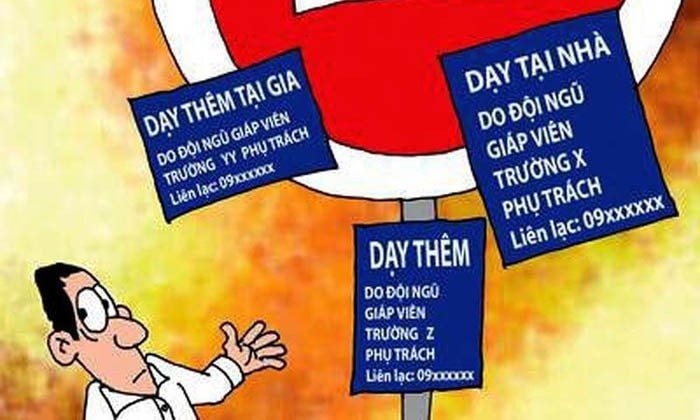
Furthermore, tutoring also creates an additional channel of communication between schools, teachers, and parents, aiming to better monitor children and prevent them from engaging in uncontrolled behavior that could lead to academic neglect or even social problems. Another question arises: while we prohibit schools from organizing tutoring, we license external centers? This easily creates the misunderstanding that we have lost faith in our own educational institutions and in our teachers. Moreover, since it's a "noble profession," why can medical professionals—doctors, nurses, and orderlies—do extra work while teachers cannot? Why can public healthcare facilities offer on-demand medical services while the education sector cannot offer on-demand tutoring? Above, we talk about needs; now we talk about rights. It should be noted that restricting extracurricular tutoring at public educational institutions not only undermines the right to education for teachers but also for students. Furthermore, it somewhat limits teachers' right to self-training and self-development.
I don't want to generalize, but consider the licensed tutoring centers. Who can guarantee that all of them meet quality standards, at least compared to educational institutions managed by the government? The reality is that many tutors at these centers are recent graduates, or graduates who graduated several years ago but couldn't find a position in schools, so they join these centers. These centers obviously prefer recruiting these "teachers" because their demands for compensation are likely not too high. Their knowledge, skills, and experience, especially their teaching experience, will inevitably be inferior to that of teachers at established schools. When we ban tutoring at official educational institutions, we are essentially sending students to places where the quality of teaching and learning isn't necessarily the best.
Of course, it's also important to note this: In fact, those who oppose tutoring have some valid points. They are looking at the ethics and conscience of teachers as revealed through this practice. Public opinion has repeatedly discussed teachers forcing students to take extra classes using familiar and inhumane tactics. This needs to be condemned. But the question is, why don't we consider a management approach to prevent these phenomena? Why can't we find a way to ensure that teachers always prioritize professional ethics and love for their students? Of course, this is not easy when we are witnessing a chaotic state of values. Furthermore, let's ensure that teachers have a reasonably stable livelihood based on their own salaries.