

11th Party Congress: Comprehensively accelerating the reform process
The 11th Party Congress adopted decisions on all fundamental and crucial areas of national development, construction, and defense; creating a foundation for Vietnam to basically become a modern industrialized country by 2020.
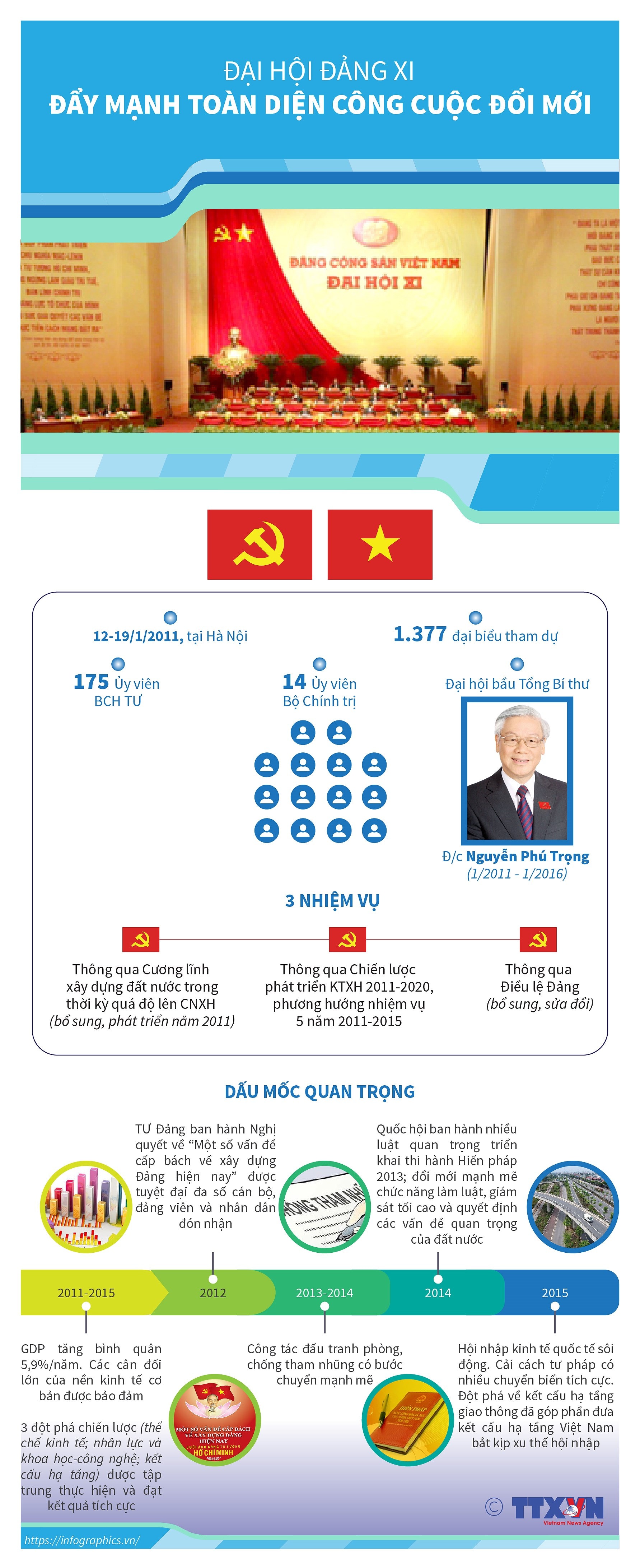
11TH PARTY CONGRESS
Time:12-19/1/2011
Location:Hanoi, the capital city
Number of delegates attending the Congress:1,377
Number of party members in the country:3.6 million
The congress elected:
- General Secretary: Comrade Nguyen Phu Trong
- Central Executive Committee: 175 full members and 25 alternate members
- Politburo: 14 members
GENERAL CONTEXT
- As the first decade of the 21st century drew to a close, the global situation was complex and unpredictable.
Although peace, cooperation, and development remain the dominant trends, local wars, armed conflicts, terrorism, socio-political instability, and disputes over sovereignty and territory, especially in the South China Sea, continue to unfold in a complex manner.
Natural disasters, epidemics, energy crises, environmental pollution, and climate change have become serious problems on a global scale.
The financial crisis, which originated in the US, spread and became a global financial crisis and economic recession.
- After 25 years of reform, 20 years of implementing the Platform for building the country during the transitional period to socialism, and 10 years of implementing the Socio-Economic Development Strategy 2001-2010, the country has emerged from underdevelopment, national strength in all aspects has been enhanced, independence, self-reliance and the socialist system have been maintained, and Vietnam's position and prestige in the international arena have been improved.
Vietnam became a member of the World Trade Organization (WTO) in 2006.
However, hostile forces continue to sabotage, incite riots, and intensify their "peaceful evolution" activities.
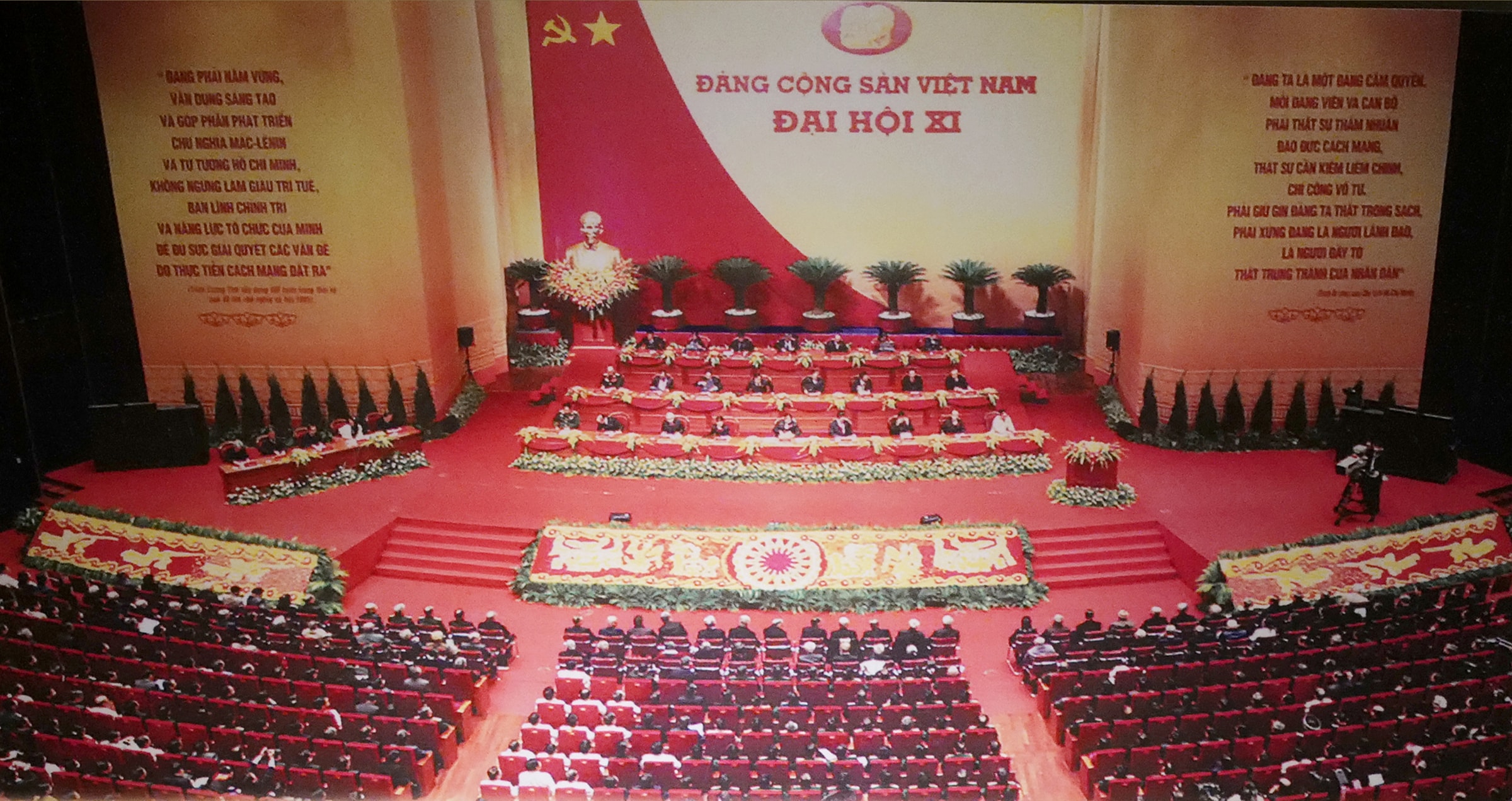
BOOSTING THE NATIONAL RENOVATION PROCESS COMPLETELY
The Congress assessed and drew lessons from the implementation of the Party's Resolution of the 10th National Congress, the five-year socio-economic development plan (2006-2010), the ten-year socio-economic development strategy (2001-2010), and the 20 years of implementing the Platform for building the country during the transitional period to socialism. Based on this, the Congress decided to supplement and develop the 1991 Platform; determine the ten-year socio-economic development strategy (2011-2020); set forth directions, objectives, and tasks for the five-year period (2011-2015); and approve the Party Charter (amended and supplemented) and many other important documents.
Regarding the implementation of the goals and tasks of the 10th National Congress, the Congress assessed that the entire Party and people have strived to achieve important accomplishments. They have responded effectively to the complex developments in the global and domestic economies. Macroeconomic stability has been fundamentally maintained. A relatively high economic growth rate has been sustained, with all sectors developing and the size of the economy increasing; people's living standards continue to improve; political and social stability has been maintained; national defense and security have been strengthened; independence, sovereignty, unity, and territorial integrity have been upheld; foreign relations and international integration have expanded, and our country's international standing and prestige have been enhanced; progress has been made in promoting democracy, and the great national unity has continued to be consolidated; and the work of Party building and the political system has achieved some positive results.
The overall five-year goal (2011-2015) set by the Congress was: To continue to enhance the leadership capacity and fighting strength of the Party; to comprehensively accelerate the reform process; to build a clean and strong political system; to promote democracy and the strength of national unity; to develop the economy rapidly and sustainably; to improve the material and spiritual lives of the people; to maintain political and social stability; to strengthen foreign relations; to firmly protect independence, sovereignty, unity, and territorial integrity; and to create a foundation for Vietnam to basically become a modern industrialized country by 2020.
The Platform for Building the Country during the Transition Period to Socialism (supplemented and developed in 2011), adopted by the Congress, affirms: Advancing towards socialism is the aspiration of our people, the correct choice of the Communist Party of Vietnam and President Ho Chi Minh, and in line with the historical development trend.
The socialist society that our people are building is a society that is prosperous, strong, democratic, just, and civilized; where the people are the masters; where the economy is highly developed based on modern productive forces and progressive production relations; where the culture is advanced and rich in national identity; where people have a comfortable, free, and happy life with conditions for comprehensive development; where all ethnic groups in the Vietnamese community are equal, united, respect and help each other to develop together; where there is a socialist rule of law state of the people, by the people, and for the people, led by the Communist Party; and where there are friendly and cooperative relations with countries around the world.
The Congress elected the 11th Central Committee of the Party, consisting of 175 full members and 25 alternate members. At its first meeting, the 11th Central Committee elected the Politburo, comprising 14 members, and the Secretariat, comprising four members. Comrade Nguyen Phu Trong was elected General Secretary of the Party.
At the 7th Central Committee meeting of the 11th Party Congress, held from May 2 to 11, 2013, two comrades were elected to the Politburo; and one comrade was elected to the Secretariat.
DOMESTIC EVENTS
- September 2010: The United Nations recognized Vietnam as a leader in implementing the Millennium Development Goals (MDGs), with the two most successful goals being poverty reduction and universal education.
- December 31, 2010: Vietnam successfully concludes its ASEAN Chairmanship Year.
- December 17, 2010: Unit 1 of the Son La Hydropower Plant was connected to the national power grid. This is one of the key national projects.
- 2010: 4 Vietnamese heritage sites were recognized by UNESCO:
+ 82 Doctoral Examination Steles at Van Mieu-Quoc Tu Giam (World Documentary Heritage, March 2010);
+ Thang Long Imperial Citadel (World Cultural Heritage Site, August 2010);
+ Dong Van Karst Plateau (Global Geopark, October 2010)
+ Giong Festival in Phu Dong and Soc Son (Representative Intangible Cultural Heritage of Humanity, November 2010).
- January 2011: Inauguration of Can Tho International Airport (January 1, 2011) and Dung Quat Oil Refinery (January 6, 2011).
- May 22, 2011: For the first time, Vietnam held elections for National Assembly representatives and People's Council representatives at all levels on the same day.
- May 26, 2011: A Chinese coast guard vessel cut the survey cable of the Binh Minh 02 ship while it was 120 nautical miles from Dai Lanh Cape (Phu Yen), entirely within Vietnam's sovereign waters.
On November 30, 2012, the Bình Minh 02 vessel was again attacked by a Chinese ship, which cut its cables while it was moving in the area outside the Gulf of Tonkin preparing for a survey.
- November 20, 2011: The Thu Thiem tunnel and the entire East-West Boulevard were opened to traffic.
This is the country's first river crossing tunnel and the most modern in Southeast Asia at this time.
- UNESCO recognized the Ho Dynasty Citadel (Vinh Loc district, Thanh Hoa province) as a World Cultural Heritage site (June 27, 2011); and Xoan singing (Phu Tho province) as a World Intangible Cultural Heritage site in need of urgent protection (November 24, 2016).
INTERNATIONAL EVENT
- January 12, 2010: Haiti experiences its strongest earthquake in 200 years, killing approximately 230,000 people.
- From July to November 2010: WikiLeaks revealed a wealth of data about the US wars in Afghanistan and Iraq, as well as internal US diplomatic cables, shocking the world.
- August 19, 2010: The United States withdrew all combat forces from Iraq after more than seven years of waging war to overthrow Saddam Hussein's regime.
More than a year later, on December 14, 2011, the United States officially declared the end of the war in Iraq.
- October 13, 2010: After being trapped for 70 days 700 meters underground in the San Jose mine, 33 Chilean miners were successfully rescued.
- 2010: The sovereign debt crisis erupted in Greece and spread across Europe.
- March 11, 2011: A double disaster of earthquake and tsunami struck Japan, killing and leaving nearly 30,000 people missing, and causing a radioactive leak at the Fukushima nuclear power plant.
- April 2011: Cuba adopted the policy of "updating the economic model," mobilizing the potential of non-state economic sectors to participate in socio-economic development (at the Sixth Congress of the Cuban Communist Party).
- May 1, 2011: Terrorist leader Osama Bin Laden, head of the Al-Qaeda network, was killed by US special forces in Pakistan.
- October 31, 2011: The world population reached 7 billion.
- November 2011: ASEAN and China reached an agreement to continue fully implementing the Declaration on the Conduct of Parties in the South China Sea (DOC) and to work towards building a Code of Conduct in the South China Sea (COC), aiming to resolve disputes in the South China Sea peacefully and in accordance with international law (within the framework of the 19th ASEAN Summit).
- December 17, 2011: North Korean leader Kim Jong-il passed away.