
Final article: From smart governance to pioneering policies
It is clear that, as science, technology, innovation, and digital transformation have proven effective in practice, the requirement is no longer to remove immediate obstacles, but to create an institution capable of opening up development space for new drivers. This is not only a requirement for the restructuring of Nghe An's health sector, but also a significant issue for legislative activities, supervision, and policy improvement in the new development phase of the country.

Greater decentralization, higher governance capacity.
The operation of a two-tiered local government model is creating a significant shift in the method of state management, with a spirit of stronger decentralization and delegation of power, emphasizing the initiative and responsibility of local governments. However, decentralization will only be truly effective when accompanied by commensurate governance capacity.
For the healthcare sector, this is not just a requirement for organizational restructuring, but more fundamentally, a need to innovate management methods to adapt to the demands of development in the digital age. Unlike in the past, when many management decisions were primarily made through administrative procedures and periodic reporting systems, modern governance models require leaders to be able to make quick, accurate, and data-driven decisions.
In the healthcare sector, this becomes even more crucial because every decision regarding resource allocation, organization of the healthcare network, disease prevention and control, or investment in technology directly impacts the quality of healthcare for the people.
Looking at the situation in Nghe An, it is clear that this transformation process has begun to lay positive foundations. As a locality aiming to build a high-tech medical center for the North Central region, Nghe An is orienting itself towards developing smart governance, smart prevention, and smart medical examination and treatment. At Nghe An Oncology Hospital – the region's leading specialized oncology hospital – the successful implementation of electronic medical records, online appointment registration, eHeal software, PACS systems replacing film printing, and many other digital platforms not only standardize professional processes but also create data sources to support management and operation.
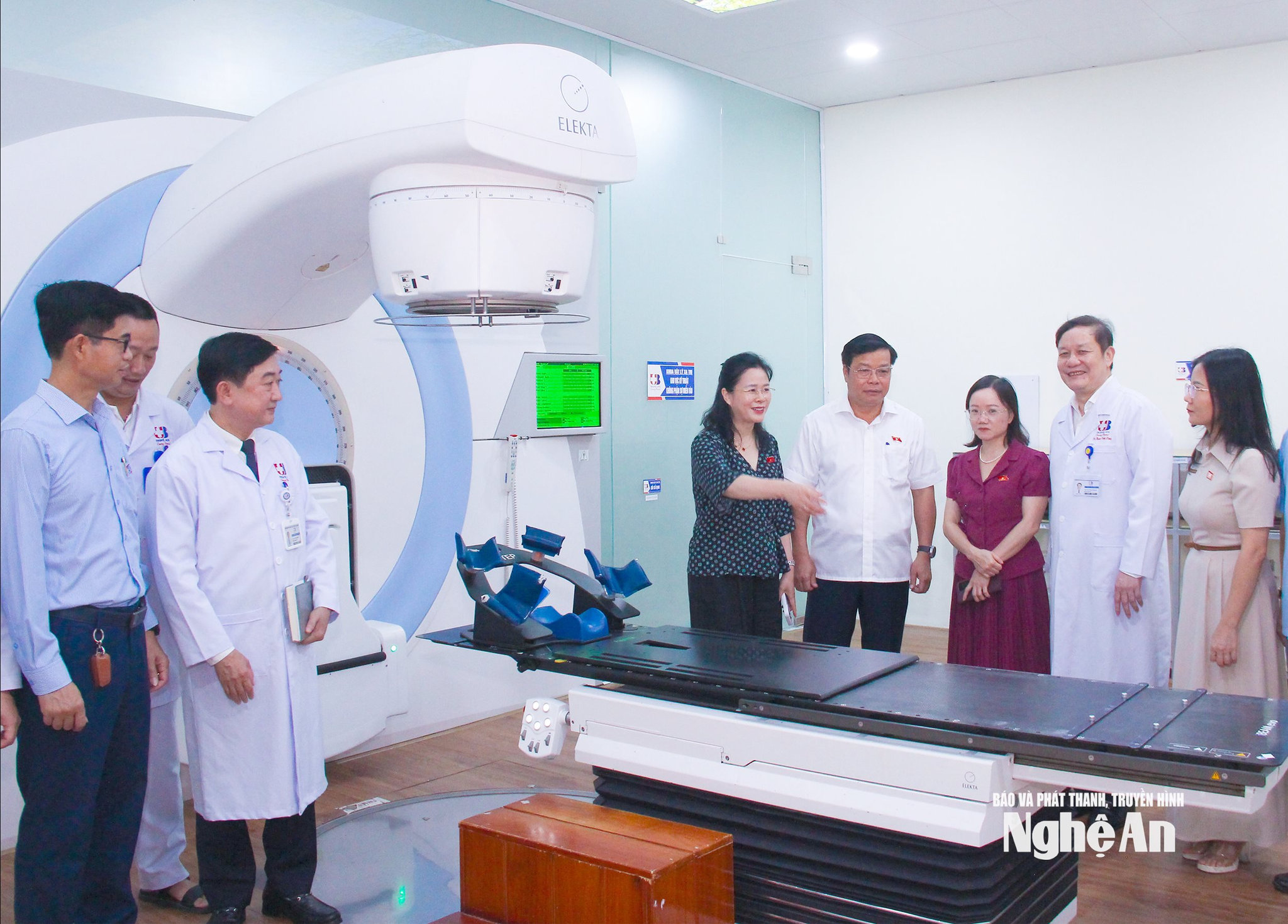
According to Dr. Le Thi Hoai Chung, a member of the Provincial Party Committee and Director of the Nghe An Department of Health, when the two-tiered local government model comes into operation, the requirement is not only to more clearly define responsibilities between management levels, but more importantly, to improve management capacity based on digital data and scientific evidence. At the same time, digital transformation is only truly meaningful when it helps managers make more accurate decisions, use resources more effectively, and improve the quality of service to the people.
This practice shows that modern governance is no longer measured by the number of directives or the frequency of inspections, but by the ability to predict, coordinate, and respond policy to emerging issues. With real-time data updates, managers can monitor the development of epidemics, hospital bed occupancy, drug and medical supply needs, and the effectiveness of individual healthcare programs to make timely adjustments to operational plans. This also forms the foundation for enhancing transparency, accountability, and transparency in state management of healthcare.
Ultimately, the value of governance innovation lies not in how many software programs or digital platforms are added to the system, but in whether leaders have sufficient information to make sound decisions, healthcare facilities have the tools to operate efficiently, and citizens have faster and more convenient access to healthcare services. When governance capacity is enhanced, decentralization truly becomes a driving force for development, rather than just a change in organizational structure.
Data interoperability - from digitalization to intelligent governance
Digital transformation only truly creates value when data is no longer fragmented within individual healthcare facilities but is connected, shared, and effectively utilized across the entire system. If digitalization is the starting point of innovation, then data interconnection is the condition for forming a smart governance model – where every operational decision is supported by complete, accurate, and up-to-date information.
In the healthcare sector, data is not simply medical records or professional indicators. When standardized and interconnected, data becomes the foundation that helps management agencies monitor epidemiological trends, assess the capacity of each level of treatment, allocate resources rationally, and forecast the healthcare needs of the population. For healthcare facilities, interconnected data helps reduce administrative procedures, limit duplicate test orders, improve the quality of consultations, and ensure continuity in the treatment process. For the public, it provides conditions for more convenient, transparent, and safe access to healthcare services.
.jpg)
The direction for building a smart healthcare governance model that Nghe An is implementing also stems from that mindset. The goal is not only to apply more digital platforms, but to form a unified data system, connecting preventive medicine to examination and treatment, from the grassroots level to specialized levels, creating a foundation for guidance and management in the context of increasingly strong decentralization and delegation of authority.
In discussions with the monitoring delegation, Dr. Le Thi Hoai Chung emphasized that digital transformation will only truly succeed when data is effectively utilized to serve management, operations, and improve the quality of patient care.
This perspective shows that the ultimate goal of digital transformation is not to change working tools, but to innovate governance methods, using data as the basis for all decisions and placing the people at the center of the reform process. It can be seen that, in a two-tiered local government model, the governance capacity of the health sector will increasingly be determined by its ability to connect with and utilize data.
Policies that pave the way and shape the future.
In the process of developing and refining legislation, practice is always the most important measure of policy. Each new, effectively operating model not only brings value to the implementing unit but also suggests issues that need to be researched and institutionalized to create momentum for development on a broader scale. From that perspective, the changes at Nghe An Oncology Hospital are not simply the result of a medical examination and treatment facility, but also reflect the emerging trend of innovation in the healthcare sector as science, technology, innovation, and digital transformation increasingly become the foundation of modern governance.
With over 1,250 inpatient beds and a comprehensive investment in modern equipment such as the Synergy Platform radiotherapy system, SPECT/CT machine, molecular biology testing system, interventional robots, 128-slice computed tomography scanner, etc., Nghe An Oncology Hospital is not only a treatment facility but is also gradually becoming a center for research, application, and transfer of advanced techniques to the North Central region. This development is even more significant when considered within the goal of building Nghe An into a high-tech medical center in the region, where science, technology, innovation, and digital transformation are identified as the foundation for a new management model.
However, for these innovative elements to develop into the strength of the entire system, a prerequisite is to create a favorable environment for all stakeholders to participate. The State plays a role in creating and perfecting policies; hospitals are centers for technology application and transfer; universities and research institutes provide knowledge and human resources; businesses collaborate in developing technological solutions; and medical data becomes a strategic resource connecting the entire system. When these links operate synchronously, science and technology not only create technical advancements but also generate new management methods, new service models, and new value for the people.

From that perspective, institutional reform is not simply about amending certain regulations on investment, finance, or public procurement. More importantly, it's about creating a sufficiently broad development space to encourage innovation, accept controlled experimentation, and promote cooperation between the State, healthcare facilities, businesses, and research organizations. When all resources are connected within the same ecosystem, scientific and technological achievements will be transformed more quickly into products, services, and solutions to serve patients, while simultaneously creating a sustainable development impetus for the healthcare sector.
For the National Assembly's activities, the significance of this process extends beyond simply enacting or amending legal regulations. More importantly, through oversight and reflection from practice, the National Assembly has the opportunity to identify mechanisms that have proven effective in order to further improve them, while simultaneously removing obstacles hindering the development of new models. National Assembly representative Tran Nhat Minh stated: “What we aim for after oversight activities is not just to resolve the problems of a particular sector or locality, but to draw from practice issues of universal value to propose improvements to policies. Each effective model should be considered a legislative and governance experience, so that when policies are enacted, they will create conditions for shared development, rather than just addressing difficulties for specific cases.”
Based on the experience of Nghe An, the issue is not only identifying "bottlenecks," but more importantly, transforming the monitoring results into policy recommendations, paving the way for the rapid and sustainable development of the health sector in the new phase.
The top priority should be to continue improving the legal system to align with the development of science, technology, innovation, and digital transformation. Practical changes are happening much faster than the process of amending existing regulations; therefore, many mechanisms related to investment, procurement, scientific research, technology transfer, data governance, and public-private partnerships have revealed gaps that need to be addressed.
As the legislative body, the National Assembly needs to strengthen its oversight of the implementation of the Law on Science, Technology and Innovation 2025, as well as related laws, promptly summarize practical experiences to amend and improve legislation, and ensure that the institutional system truly becomes a driving force for development rather than a barrier to innovation.
Furthermore, the government is required to accelerate the institutionalization of the Party's policies through specific, unified, and highly feasible operational mechanisms. The early issuance of guiding decrees and circulars; the completion of financial mechanisms for digital transformation; the reform of investment policies for scientific research; and the encouragement of public-private partnerships and the mobilization of social resources will determine the speed at which scientific and technological achievements are applied in medical examination and treatment.
From a sector management perspective, the urgent need today is not only to promote digital transformation, but also to establish a data-driven healthcare governance system. This requires the Ministry of Health to quickly finalize national standards for healthcare data, accelerate the implementation of a unified electronic medical record system, build a mechanism for secure data connection and sharing between different levels of treatment, and develop artificial intelligence platforms for management, forecasting, and professional support. Along with infrastructure investment, a long-term strategy is needed to develop high-quality human resources in the fields of healthcare data, artificial intelligence, biotechnology, medical informatics, and modern hospital management. Investing in people today is building the competitiveness of the healthcare system in the future.

For Nghe An province, the operation of a two-tiered local government model is opening up new opportunities to promote proactiveness in policy implementation. The Provincial People's Council needs to continue to play its supervisory role in the implementation of high-tech medical development goals; the Provincial People's Committee should focus on directing the construction of shared data infrastructure, prioritizing investment in high-tech fields, developing human resources, and creating mechanisms to encourage research and technology transfer.
The healthcare sector needs to be more proactive in collaborating with universities, research institutes, and technology companies to form an innovation ecosystem, transforming healthcare facilities from mere treatment centers into research, training, and technology transfer hubs.
The experience of Nghe An Oncology Hospital has proven that, when given autonomy and appropriate mechanisms, a provincial-level hospital can fully master many specialized techniques, becoming the first oncology specialist unit in the country to successfully implement electronic medical records, effectively apply artificial intelligence in diagnostic support, build smart examination and treatment processes, and gradually approach the level of major medical centers. This shows that the gap between central and local levels no longer depends primarily on geographical conditions or investment scale, but increasingly on the quality of governance, the ability to innovate, and the effectiveness of policies.
Concluding this monitoring journey, what remains is not just the numbers on scientific research, the new technologies applied, or the pioneering governance models that have been formed. The greater value lies in the belief that, when institutions truly pave the way, governance is constantly innovated, resources are unlocked, and all policies are geared towards the people, then science, technology, innovation, and digital transformation will become powerful driving forces for the development of the health sector in Nghe An province in particular and the whole country in general.
This is also the path to realizing the aspiration of building a modern, intelligent, humane, and sustainable healthcare system that meets the expectations of the people and the development requirements of the country in the new era.
Major General Ngo Nam Cuong