
An iPhone can be hacked simply by accessing a website infected with malware.
Hackers are exploiting thousands of legitimate websites and online advertisements to spread spyware, targeting iPhones that haven't received security patches.
Users don't necessarily have to click on suspicious links or download questionable apps to be at risk of attack. Some new campaigns discovered by cybersecurity experts can exploit vulnerabilities on iPhones through compromised websites or advertisements.
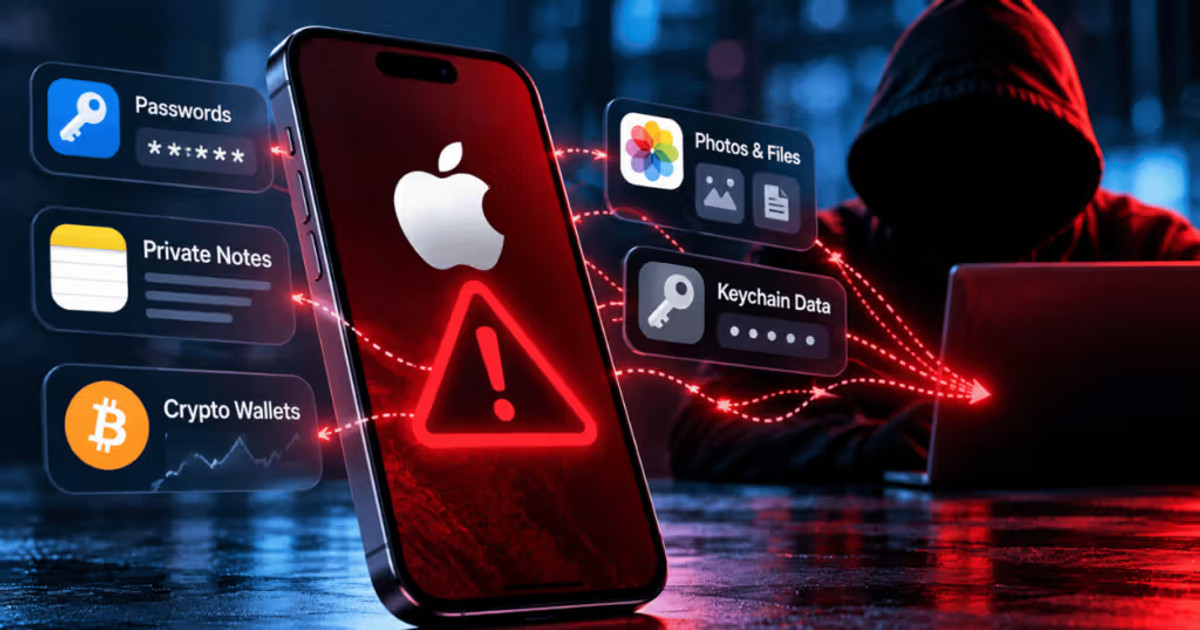
Researchers have warned that thousands of legitimate websites are being exploited as channels to spread malware targeting Apple devices. Notably, in some cases, users can become targets simply by accessing the website or browsing malicious advertisements.
Thousands of legitimate websites are being exploited to spread malware.
According to Forbes, the attack campaign was discovered after cybersecurity expert Scott Helme, founder of Report URI, found malware appearing on numerous websites. Report URI then collaborated with security company iVerify to investigate the activity.
The results showed that at least 6,600 legitimate websites were exploited, with a total of approximately 49 million visits per month. Of these, 248 websites directly distributed spyware targeting iPhones, with about 8 million visits per month.
What's concerning is that most of these websites didn't actively participate in spreading malware. The hackers simply hijacked old domain names previously used by advertising services, data analytics companies, or website support tools.
Typically, websites integrate third-party services by inserting a small piece of code into the page. When the service provider ceases operations and abandons the domain name, this code may still remain on the website. Hackers buy these expired domains and inject malicious code, causing websites that still load content from the old domain to inadvertently become redirected to other sites.
Report URI has dubbed this activity DeadTag. According to the research team's analysis, those behind the campaign may be selectively targeting visitors and redirecting them to malicious content, rather than attacking everyone.
Hackers can steal passwords and cryptocurrency wallet data.
One of the campaign's goals was to distribute exploit kits for iPhones, including Coruna and DarkSword.
These are toolkits that exploit numerous security vulnerabilities in the iOS operating system and browsers, allowing hackers to execute malicious code on devices if the corresponding software version has not been patched.
According to research by Report URI and iVerify, these toolkits can be distributed through compromised websites or malicious advertisements. When users access a website containing the exploit code, or browse through malicious ads in some cases, the attack can occur automatically without them clicking on a link or downloading an application.
Researchers documented a case where an employee's device at a client organization was compromised after the employee scrolled through a soccer advertisement on Instagram. The advertisement was designed to trigger an exploit on the device.
After successfully gaining access, the spyware can attempt to steal passwords and confidential information stored in the iPhone's Keychain. This is Apple's authentication information management system, used to securely store passwords and other sensitive data.
The primary goal, according to researchers, is financial gain, particularly through the misappropriation of cryptocurrency assets. However, the ability to collect various types of data on phones also raises concerns about the risk of personal and account information leaks.
iPhones that haven't been updated to iOS are at risk of being attacked.
Not every iPhone accessing the website was infected with malware. The exploit kits described in the study primarily targeted devices running iOS versions with corresponding vulnerabilities.
According to Report URI, Coruna was used to target iOS versions 13 through 17.2.1, while DarkSword targeted some iOS versions in the 18.4 to 18.7 branch.

Apple has released updates to fix the vulnerabilities that these toolkits exploit. Therefore, devices with the corresponding patched iOS version installed will be protected against these known attack methods.
However, the fact that hacker groups are finding ways to adapt their tools to exploit new vulnerabilities remains a risk to be aware of. Research by iVerify and Report URI also notes signs that these groups are preparing the infrastructure to distribute new exploit toolkits in the future.
What can users do to protect their iPhones?
The most important measure is to update iOS to the latest version supported by your device. Updates not only add features but also fix vulnerabilities that hackers could exploit.
Users can check for and update by opening Settings > General > Software Update. If a new update is available, it should be downloaded and installed according to the instructions.
In addition, users should:
Enable automatic updates:This helps your device receive security patches sooner when Apple releases them.
Be cautious with websites and advertisements:Do not install applications, configure settings, or manage device profiles at the request of unreliable websites.
Protect your important accounts:Use two-factor authentication, separate passwords, and do not store cryptocurrency wallet recovery information in easily accessible locations.
Don't underestimate familiar websites:A legitimate website can still be compromised or receive malware from a third-party service.
If you suspect your device has been compromised, you should update iOS, check important accounts from another trusted device, and change any potentially compromised passwords. For cryptocurrency wallets, prioritizing asset protection and wallet recovery information is crucial.
The campaign mentioned by Forbes shows that hackers are exploiting even the least-noticed elements of the advertising and website ecosystem to spread malware. Therefore, in addition to being vigilant when accessing the Internet, maintaining an updated operating system is one of the most practical ways to reduce the risk of being exploited through known vulnerabilities.
Phan Van Hoa