Assoc. Prof. Ninh Viet Giao•October 30, 2024 20:21
Folk verses (vè) are a form of folk literature, a narrative form in rhyming verse. During the Nghệ Tĩnh Soviet Uprising, folk verses contributed to spreading the spirit and courage of the Soviets by exposing the true face of the ruling clique and the reactionary policies of the enemy, urging the masses to rise up and fight, and recording the events of the revolution. Even now, folk verses have become invaluable historical documents.
Nghe An Newspaper would like to summarize the research paper "Soviet Nghe Tinh through folk verses" by Associate Professor Ninh Viet Giao - who is considered a "Nghe An scholar" and has been recognized by the Vietnam Book of Records Center as "the person with the most research works on folk culture of Nghe An province".
"
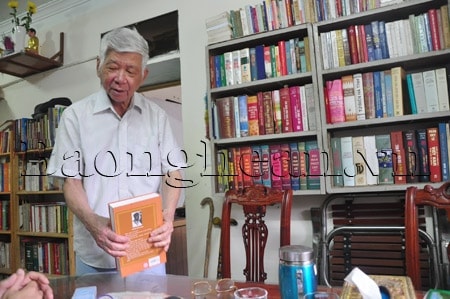
A portrait of Associate Professor Ninh Viet Giao and the books he has dedicated decades to writing.
Photo credit: Nghe An Newspaper
...Folk verses not only possess a fighting spirit, satire, and topicality, but they are also rich and profound in lyricism. Folk verses fully reflect the worldview and philosophy of our people. Although the language may not be polished, and the psychology and personalities of the characters may not be clearly depicted, they are accurate in terms of social research and understanding.
Folk songs in Nghe An province are incredibly rich. It can be said that folk songs...Nghe Tinh SovietThese appeared in Nghe Tinh before the Nghe Tinh Soviet movement broke out. These were revolutionary call-and-response verses and propaganda songs, such as: "The Call to Arms of the Indochinese Communist Party," "Quickly Reclaim Your Rights," "Break Out, Let Us Rise Up," "Let's Reconsider Our Fellow Farmers," "Introducing the Soviet Union," "Talking to My Father," "Our Soldiers," "Come On, Green and Red Uniformed Soldiers"...
These songs are all written in the style of folk songs and rhymes, and their content usually analyzes the social situation, highlights the humiliation of losing the country and freedom, explains the Party's policies, and calls on the people to rise up and make revolution.
The verse speaks about the social situation:
"The Southern Dynasty officials"
With an empire of one district
It drills through the marrow, carves through the bone.
They also acted brutally.
The more brutal the act
During the holiday season
When sentencing someone to death
When the family estate
Let the officials plunder at will.
The people suffer because of the plundering.
(Excerpt from the rhyme: "Breaking out, we stand up").
A folk song urging the people to rise up and make revolution:
"The Communist Party propagates
Marxist-Leninist theory
Let's cheer on the youth!
Let's rally the women!
Workers, peasants, and soldiers are one faction.
Brothers must agree.
With unwavering determination,
To fight together,
"The final battle."
(Excerpt from the folk poem: "The Call to Arms of the Indochinese Communist Party")
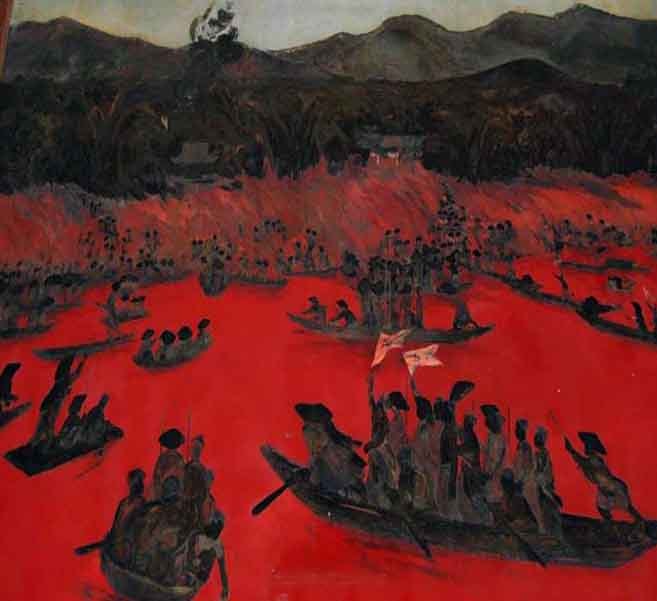
People of Thanh Chuong crossed the river to besiege the district headquarters on September 1, 1930. (Photo credit: Nghe Tinh Soviet Museum)
The folk songs with revolutionary propaganda content, as mentioned above, are more valuable than those with a narrative nature. Some were composed during the years 1930-1931, while others were written shortly afterwards. Articles such as "The People of Hanh Lam Destroyed Ky Vien's House," "Stories of the Struggle in Nam Dan," "Stories of the Struggle in Thanh Chuong," "The Years 1930–1931 in Yen Thanh," "The Years 1930–1931 in Dien Chau," "The September 12 Demonstration in Hung Nguyen," "Do Gang in the Years 1930–1931," "The Last Days in Dong Son Village in 1930–1931," "The Revolution in the State," "Burning Houses," "The French Burning Two Villages of Phu and Tho," "Vinh Prison"... have helped us to see the content and nature of the movement, the developments of a struggle, the revolutionary awakening of the people, the role of the masses, the leadership of the Party, the conspiracies and countermeasures of the imperialists and the feudal Southern Dynasty, the brutal terror of the enemy... in a clear, complete, and vivid way.
The authors of these folk poems were mostly farmers, some were revolutionary fighters. Because the majority of the authors of these narrative poems about the Nghe Tinh Soviet movement were farmers, the content is based on real events and real people, and the way they are reflected is very naive. Because it is naive, it avoids naturalism; it helps us see the true nature of the struggle, including its atmosphere and its strengths and weaknesses.
The folk song reflects the revolutionary atmosphere in Nam Dan during the two years of 1930-1931:
"Throughout my homeland"
The villages are well-developed, the streets are familiar.
Leaflets were scattered day and night.
The drums beat, the bells ring, and the wooden clappers shake a couple of times.
Each person has a long ruler.
People poured out like a raging sea, the sky pouring down rain.
The three armies lead the way, raising the flag.
"Draged all the way to the district governor's residence."
(Excerpt from the folk poem: "Telling the story of the struggle in Nam Dan")
That isthe protest of August 30, 1930During that protest, 3,000 farmers from Nam Dan marched to the district headquarters, broke into the prison, released political prisoners, and forced District Chief Le Khac Tuong to sign a petition with the promise: "From now on, the District Chief of Nam Dan must not harass the people."
And this is in Thanh Chuong:
"Xuan Lam, Cat Ngan, Dai Dong"
Bich Hao, Vo Liet, council of struggle
The hammer and sickle, the red flag, reigns supreme.
The sound of drums and gongs echoed along the river.
Release prisoners, burn down district office.
People are flowing in like the East Sea.
Rushing across the country roads
Shout slogans, what do we care about obstacles?
What does it matter whether we live or die tomorrow?
What's the point of guns and bullets against the colonialists?
Demanding independence, demanding rights.
Demand the abolition of taxes and the establishment of an industrial and agricultural economy.
(Telling the story of the struggle in Thanh Chuong)
On September 1, 1930, twenty thousand farmers from Thanh Chuong district staged a massive demonstration at the district headquarters, breaking into the prison, freeing political prisoners, and then burning down the district office. District chief Phan Sy Phang and all his officials and soldiers had to flee.
We notice in the following passage not only the spirit but also the slogans and demands of the struggle.
And here is the demonstration on September 12, 1930, in Hung Nguyen. Following the demonstrations in Nam Dan, Thanh Chuong, Anh Son, Nghi Loc, Can Loc, Duc Tho, Dien Chau, etc., the revolutionary movement surged like a flood. The enemy feared the movement would spread further and intensify, so they repressed and terrorized it. But the more they repressed, the more ferocious and violent the movement became.
"What a terrible haul, the net is torn to shreds!"
Stop the red wave that has already risen high.
Push them out of the way.
The group parted the earth and pushed through the sky as they advanced.
The rear of the convoy is still at the train station.
The lead group was about to head out to the government office.
Leaflets covered the village roads.
As the bamboo grows taller, the flag flies even higher.
The palace hall was filled with terrified souls and spirits.
"Let me tell you, death is just around the corner..."
(Excerpt from the folk poem: "The September 12th Protest in Hung Nguyen")
Three of the many verses that express the fervor and powerful spirit of the protesting crowds mentioned above, with their fluent language, vivid imagery, and somewhat epic resonance, reflect the concrete yet magnificent reality of history, of the human spirit, and the atmosphere of Nghe An and Ha Tinh, and indeed of Vietnam, not just during the two years of 1930-1931.
In the verse "For months on end, the hammer and sickle flag was raised high, drums and gongs resounded, the Southern Dynasty lost their nerve, the Western garrisons lost their nerve" (verse "Listen to the words of the officials"), "Seeing tattered hats and ragged clothes, they shouted protests loudly, the sky shook violently, we saw airplanes and bombs. Our people regarded the sky like their mother's leaf, cutting their hands indiscriminately, many died, and many were wounded" (verse "The sky shook on all sides"). The verses show us the days when the peasant villages and hamlets took control of the countryside, and the new, healthy activities of the Soviet government.
For example, in Thanh Chuong:
"Western fortifications, feudalism gone."
The village fields, the fields and everything else, belong to us.
Thanh Lam descended to Lieu Nha.
Van Giai and Xuan Bong let Tri Tuong pass.
Distribute leaflets, give proper speeches.
Protests, reading newspapers, village meetings for struggle.
Many lively rallies
The Self-Defense training session is in full swing tomorrow.
Everyone's the same this time.
What's mine, I'll enjoy; I'll kill those heartless creatures.
This time, there are no saints or gods.
Neither God nor Buddha can enforce the people's authority."
(Excerpt from the folk poem "Telling the story of the struggle in Thanh Chuong")
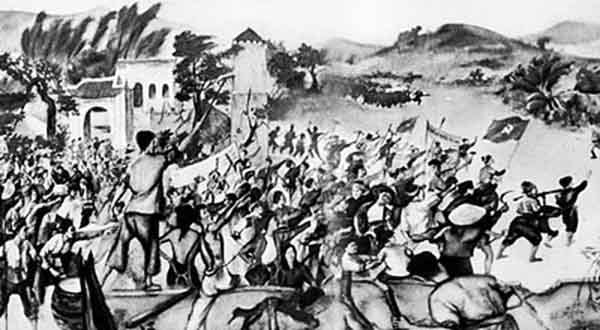
The Red Self-Defense Force in Hoa Quan - Dong So - Nghe An during the Nghe-Tinh Soviet Uprising of 1930-1931. (Photo credit: Nghe-Tinh Soviet Museum)
From this, we can draw the following conclusions:
Among the many key characteristics of folk verses are their social and historical relevance. Folk verses about the Nghe Tinh Soviet possess both of these qualities. They were strong at the time, and they have become even stronger over time. This is because the composers, the authors of these verses, had directly participated in the movement, been deeply involved with it, or witnessed it firsthand.
Folk verse is a form of folk literature. Authors in the Nghe Tinh Soviet movement used this form, a form very close to the people of Nghe Tinh, making great efforts to learn from folk cultural heritage in terms of expression to create their works. Their works were widely disseminated, easily understood and remembered by the working class and peasants. With the remaining two types of folk verse about the Nghe Tinh Soviet movement—political commentary and narrative—we can conclude that folk verse was a revolutionary advantage.
Folk verses exposed the true face of the ruling clique, attacked the reactionary policies of the enemy, called on the masses to rise up and fight, recorded the events and developments of the revolution, and have now become historical documents. Indeed, folk verses, originally a genre with simple language often describing ordinary events in villages, have, through the course of history, elevated themselves into a tool of struggle, participating in the large-scale national movements.
Folk songs from 1930-1931 served to educate the people about patriotism, the revolutionary path, and the resolute fighting spirit. For farmers in particular, amidst the patriotic fervor of that period, folk songs, with their direct reflection of the people, showcased both their strengths and weaknesses.
Now, in the process of industrialization and modernization of the country with an open market mechanism, those folk songs about the Nghe Tinh Soviet, along with patriotic songs in general, still help us understand the good qualities of farmers to promote and the weaknesses to overcome.