(Baonghean.vn) - Summer is the time when children can freely play with their friends. Participating in folk games, children not only improve their health but also develop life skills, and most importantly, experience refreshing laughter. These games leave behind countless unforgettable impressions of a "wild childhood."
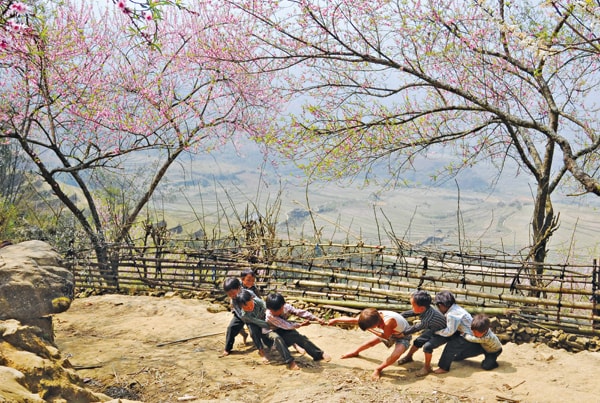 |
| Tug of war:The children are divided into two teams of equal size. The two children at the front of each line hold hands or a rope, connecting them to the children behind them. The children behind then grab the waist of the child in front or the rope and pull back towards themselves. The team that is pulled to the other side of the dividing line loses. Emphasizing teamwork, tug-of-war rightfully deserves the top spot for solidarity. |
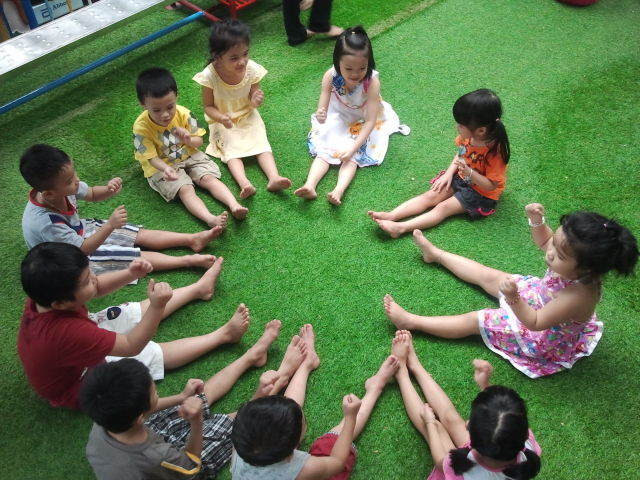 |
| Nu na nu nong:The players sit in a line, legs outstretched. One person in the line gently taps each leg to the rhythm of the song "Nu na nu nong," in order from leg to leg. When the last word of the song is sung, the children in the line must quickly retract their legs to prevent the tapping person's hand from touching them. Anyone whose leg is touched is eliminated or penalized according to the rules set by the players. There are several variations of the nursery rhyme used. To win, the child must concentrate on listening to the rhyme and react quickly when given the opportunity to retract their leg. |
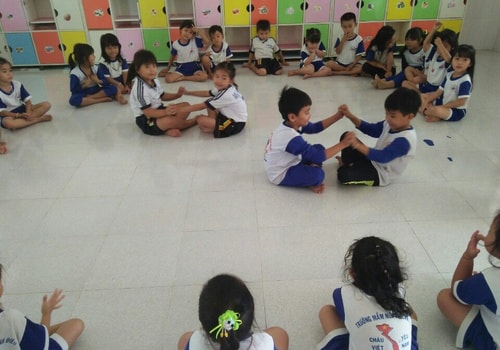 |
| Sawing wood together:This traditional game for preschoolers provides gentle exercise, like a daily workout for your child. Two children can play together, or a mother can play with her child. The mother and child sit facing each other, legs apart, feet touching, hands clasped together. While singing, they pull and push each other back and forth, mimicking the movements of two carpenters working together to saw wood. "Pulling the saw, sawing the wood / Which carpenter is strong / Goes home to eat the king's meal / Which carpenter is weak / Goes home to breastfeed." At this age, children's language and motor skills are quite good enough to understand the rhythm, rhyme, and how to play. |
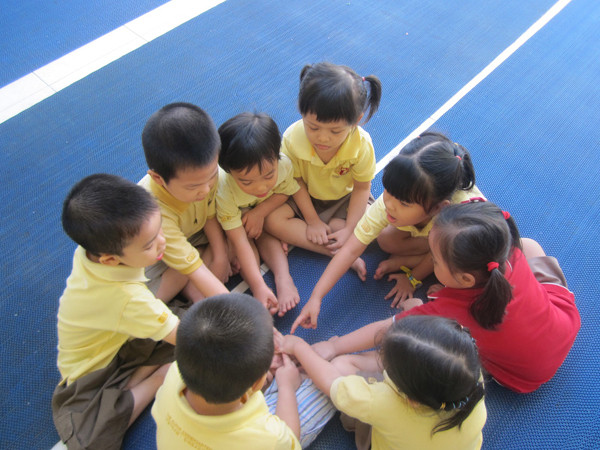 |
| Chi chi chanh chanh:This game helps children develop quick reflexes. One child sits with their hand outstretched, while the other children stand around and each place a finger in the palm of that child's hand. They all simultaneously recite the folk rhyme "Chi-chi-chanh-chanh": "Chi chi chanh chanh, the nail blows fire, the horse dies and swells up, the king sleeps, the emperor catches crickets to find him, u a u... ap." When they reach "ap," the child clenchs their hand tightly, and the other children must quickly withdraw their fingers, otherwise they will be caught. |
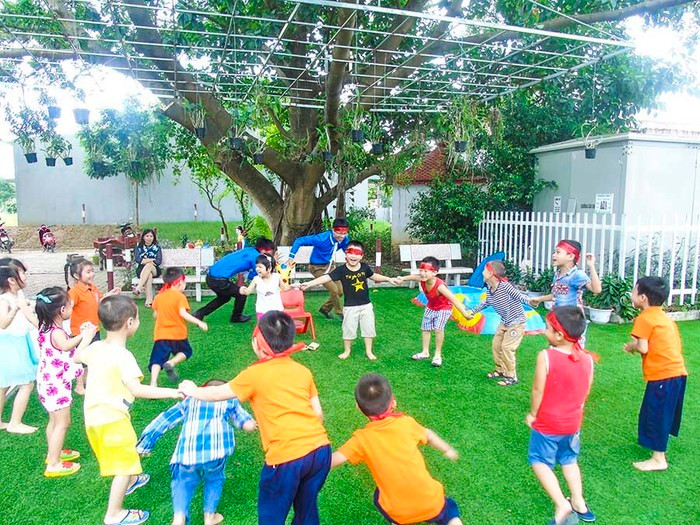 |
| Cat chasing mouse:This is a game that helps children exercise their whole body. Everyone stands in a circle, holding hands and raising their hands above their heads. Then they start singing the song "Cat and Mouse." One person is chosen to be the cat and another to be the mouse. These two people stand in the middle of the circle, back to back. When everyone sings the last line, the mouse starts running, and the cat must run after it. However, the cat must run exactly where the mouse ran. The cat wins when it catches the mouse. Then the two people switch roles, becoming cat and mouse. |
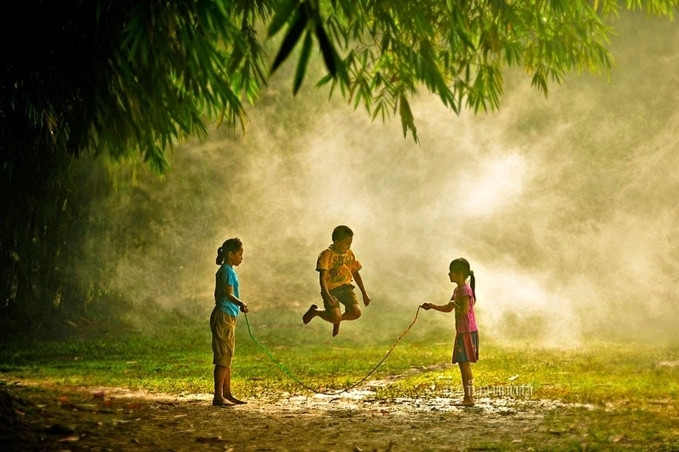 |
| Rope skipping:Both boys and girls enjoy jump rope, a great way to improve their jumping ability and body flexibility. Two people hold the rope taut, and the rest take turns jumping over it, from low to high tension. If someone tripps the rope, they take over from one of the two people holding the rope. Simple and fun! |
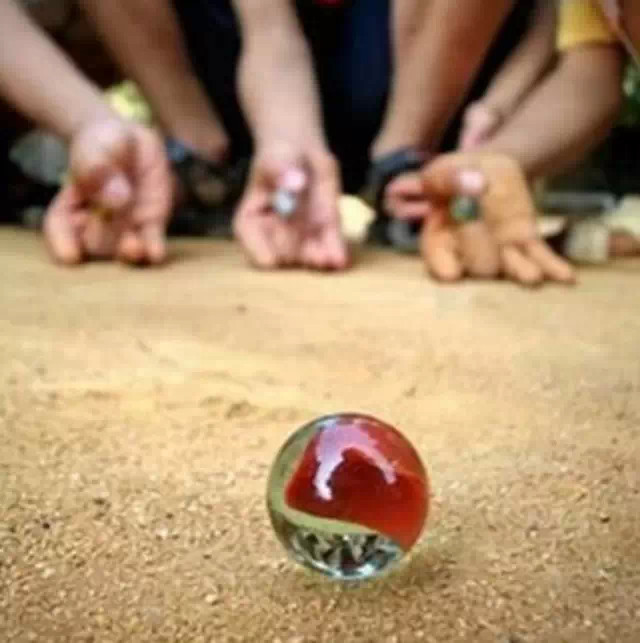 |
| Shoot marbles:Boys love playing this game. Simply draw a small circle or square called a hole, and about 2-3 meters away, draw a straight line (called a mark). Each player contributes an equal number of marbles and puts them into the hole. Players take turns shooting their cue ball from the line towards the hole. The player whose marble lands closest to the hole but not inside gets to play first, and so on until the last player. |
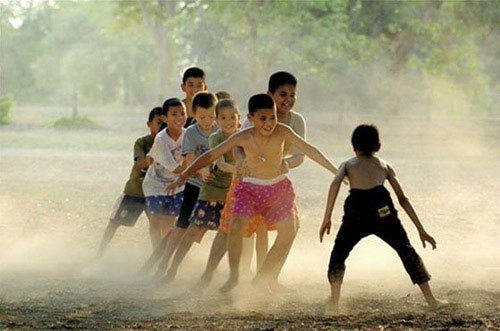 |
| Dragon and snake ascending to the clouds:There's no limit to the number of players. One child acts as the doctor, standing opposite the others who form the "dragon" (or "snake"). The other children hold onto each other's shirt tails (or hug each other's backs) to form a dragon. The leader is usually the biggest and strongest in the group. The dragon weaves around, and the leader recites a nursery rhyme as they go: "The dragon goes up to the clouds, there's a swaying tree, there's a house where soldiers are stationed, is the master at home?" The doctor chases the dragon. The child at the front extends their arms to block the doctor, who tries to catch the tail (the last child). If the doctor catches the tail, the child who caught it is eliminated. The game restarts from the beginning until the dragon gets shorter due to the loss of players. If the dragon breaks or falls, the player loses. |
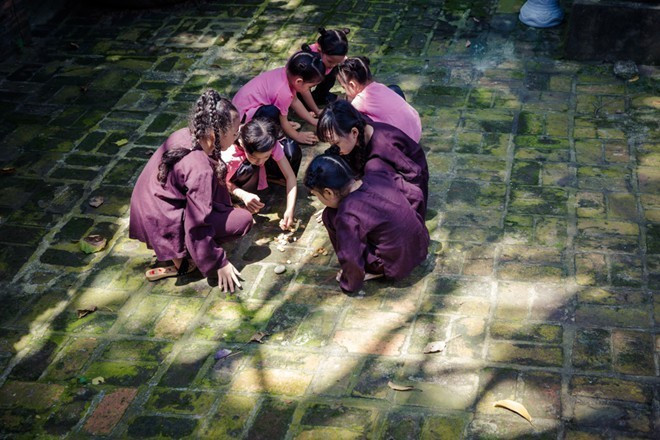 |
| O An Quan (a traditional Vietnamese board game):The game board is drawn as a rectangle, then divided into ten squares, five on each side, symmetrically arranged. At each end of the rectangle, two semicircles or arcs are drawn facing outwards. The squares are called "citizen" squares, while the two semicircles or arcs are called "official" squares. Each player, when it's their turn, moves their "citizens" in a way that allows them to capture as many more "citizens" and "officials" as possible from their opponent. |
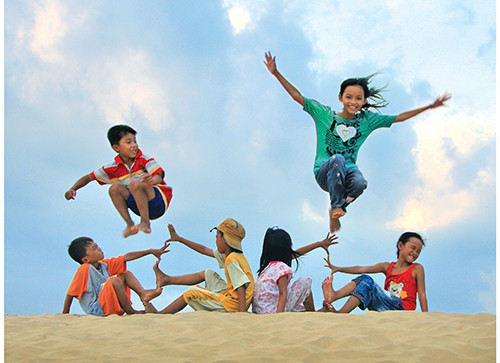 |
| Planting buds and flowers:The rules of the game are: Two children sit facing each other with their legs extended, touching each other's feet, one foot overlapping the other's (feet standing upright). Two other children jump over and then back. Then one child places a fist on the other child's toes to make a bud. The two children jump over and back again. Then the child opposite the bud will place a hand on top of the bud to make a flower. The two children jump over again; if they touch the bud or the flower, they lose their turn and have to sit in place of one of the two children. |
Hoa Le
(Synthetic)



