
Twelve laws will officially come into effect from July 1, 2020.
At its 6th, 7th, and 8th sessions, the 14th National Assembly passed resolutions approving 12 laws that will officially take effect from July 1, 2020.
1. Tax Administration Law 2019
- Taxpayers must register for tax and be issued a tax identification number by the tax authorities before commencing production, business activities, or incurring any obligations to the State budget.
|
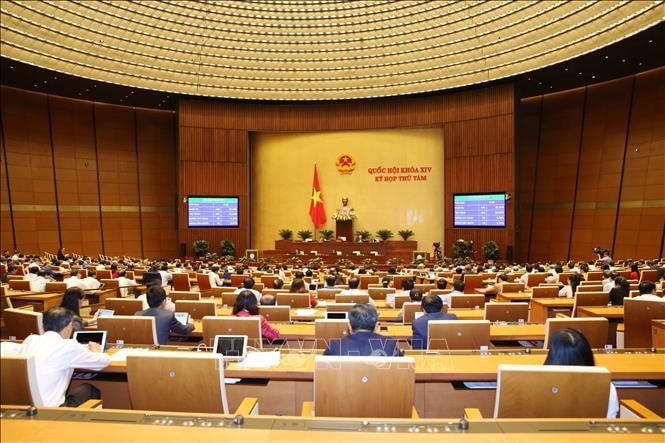
| On the afternoon of December 25, 2019, the National Assembly passed the full text of the Law amending and supplementing a number of articles of the Law on Entry, Exit, Transit, and Residence of Foreigners in Vietnam. Photo: Phuong Hoa/TTXVN. |
Therefore, the current regulation requiring taxpayers to register for tax within 10 working days will no longer be in effect.
- The time limit for issuing a tax registration certificate is 3 working days from the date of receiving a complete tax registration application from the taxpayer (currently 10 working days).
In cases of reissue due to loss, tearing, damage, or burning, the reissue period is 2 working days from the date of receiving complete documents (currently 5 working days).
- Extend the deadline for filing personal income tax returns.
- Legalize regulations regarding electronic invoices.
- Additional cases eligible for tax payment extension.
2. Amended Law on State Audit 2019
- The concept of agencies, organizations, and individuals involved in auditing activities should be added as follows:
Agencies, organizations, and individuals identified during the audit process at the audited entity are those involved in the management and use of public finances and public assets of the audited entity.
- Supplementing the duties and powers of the State Audit Office:
+ Carry out anti-corruption tasks in accordance with the Law on Prevention and Combat of Corruption.
+ Imposing administrative penalties for violations in the field of State auditing in accordance with the Law on Handling Administrative Violations.
- To supplement regulations on audit quality control to ensure that all audit activities are checked and reviewed for quality, the State Auditor General shall specify the organization and implementation of audit quality control.
- The audited entity has the right to file a lawsuit against the decision resolving the complaint in the State audit activities in accordance with the provisions of the 2015 Administrative Procedure Law.
3. Law on Protection of State Secrets 2018
- Clearly define the scope of state secret information (BSN) in each specific field, for example:
+ Information on education and training includes exam questions, answers, and information related to the organization of national-level examinations.
+ Information on health and population includes information on protecting the health of high-ranking Party and State leaders; information, documents, and survey data on population.
- The regulation on the protection period for state secrets is the period calculated from the date the level of secrecy of the state secret is determined until the end of the following period:
+ 30 years for top-secret state secrets.
+ 20 years for top-secret state secrets.
+ 10 years for classified information.
- Cases where classified information is declassified in whole or in part include:
+ The period of protection for state secrets stipulated in Article 19 and the extension period stipulated in Article 20 of the 2018 Law on Protection of State Secrets have expired.
+ Meeting the practical requirements of protecting national and ethnic interests; promoting socio-economic development; and integrating and cooperating internationally.
No longer listed as a state-owned enterprise.
4. Militia and Self-Defense Law 2019
- Regarding the composition of the militia:
+ The militia is no longer divided into core militia and general militia as in the 2009 Militia Law.
+ The composition should be supplemented with permanent militia and maritime militia.
- More cases have been added where the obligation to participate in the militia and self-defense forces can be temporarily postponed, for example:
+ Men who are raising children under 36 months old alone.
+ The spouse or one child of a war invalid, sick soldier, or person exposed to Agent Orange with a reduced working capacity of 61% to 80%.
+ People who are working, studying, or residing abroad.
5. The amended Law on Cadres and Civil Servants and the Law on Public Employees 2019
- Indefinite-term employment contracts are only applicable to the following three categories of individuals:
+ Officials recruited before July 1, 2020.
+ Officials and civil servants who transfer to become public employees as stipulated in Point b, Clause 1, Article 58 of the 2010 Law on Public Employees.
+ Individuals recruited as civil servants to work in areas with particularly difficult socio-economic conditions. In addition, the term of fixed-term employment contracts will be extended to 60 months (currently a maximum of only 36 months).
- Two additional categories of individuals are eligible for recruitment as civil servants through selection:
Students who study under the scholarship program as stipulated by the Education Law will return to work in the locality that sponsored their studies after graduation.
+ Outstanding graduates, talented young scientists.
- The disciplinary measure of salary reduction only applies to civil servants who do not hold leadership or management positions.
6. Education Law 2019
- New regulations regarding the required training qualifications for teachers:
+ Preschool: Must have a college diploma in pedagogy or higher (currently only a vocational college diploma in pedagogy is required).
+ Primary, lower secondary, and upper secondary schools: Must have a bachelor's degree or higher in a teacher training field. If there are not enough teachers meeting this requirement for a particular subject, the teacher must have a bachelor's degree in a relevant field and a certificate of pedagogical training.
- Students studying to become teachers receive financial support for tuition fees and living expenses throughout their course of study; however, they must repay the money if, after two years from graduation:
Not working in the education sector.
+ The required working hours were not met.
7. The Law on Entry, Exit, Transit, and Residence of Foreigners in Vietnam, amended in 2019.
- Visas cannot be converted to a different purpose, except in the following four cases:
+ Possess documents proving that they are an investor or a representative of a foreign organization investing in Vietnam as required by regulations.
+ Provide documents proving the relationship as father, mother, wife, husband, or child with the inviting or sponsoring individual.
+ Invited or sponsored to work by an agency or organization, and possessing a work permit or confirmation that they are not subject to work permit requirements according to regulations.
+ Entry with an e-visa and a work permit or confirmation that the applicant is not subject to the work permit requirement. - Amendments and additions to visa symbols such as: LS, DT1, DT2, DT3, DT4, DN1, DN2, LD1, LD2 (currently only DT, DN, LD symbols are available).
- Legislating regulations on electronic visas:
+ The EV symbol indicates a one-time validity period of no more than 30 days.
Foreign nationals using e-visas for entry and exit must meet the prescribed conditions and must enter and exit through international border gates designated by the Government.
8. The Law on Government Organization and the Law on Local Government Organization, amended in 2019.
- The concept of extraordinary meetings will no longer exist in the activities of the Government, People's Councils, and People's Committees; instead, there will be thematic meetings or meetings to address unforeseen issues.
- An additional criterion for members of the People's Council is added: Must possess only Vietnamese citizenship.
- The number of Deputy Chairpersons of Type II Commune People's Committees will not exceed 2, an increase of 1 compared to the current regulations.
- The total number of elected representatives to the People's Councils of Hanoi and Ho Chi Minh City is 95 (currently 105 representatives).
In addition, the new law also stipulates adjustments to reduce the number of People's Council representatives and changes to the number of standing members of the People's Councils at the provincial, district, and commune levels.
9. Law on Reserve Mobilization Forces 2019
- The regulations stipulate four cases for mobilizing reserve forces, including:
+ When implementing a general mobilization order or a partial mobilization order.
+ When martial law is implemented.
+ When there is a threat to national security, public order, or social safety, but not to the extent that a state of emergency must be declared.
+ To prevent, combat, and mitigate the consequences of disasters, natural calamities, and dangerous epidemics.
- Regulations on the organization and staffing of reserve mobilization units:
+ Reserve military personnel and reserve technical equipment, already included in the plan to supplement the regular forces of the People's Army, are organized into reserve mobilization units.
+ Reserve mobilization units must maintain a reserve of military personnel and technical equipment, with a reserve quantity of 10% to 15%, and stockpile weapons and technical equipment according to their assigned levels.
10. Law on Exit and Entry of Vietnamese Citizens 2019
From July 1st, 2020, many types of passports will be equipped with electronic chips: The law stipulates that a passport with an electronic chip is a passport that contains an electronic device storing encrypted information of the passport holder and the digital signature of the issuer. It is issued to Vietnamese citizens aged 14 and above.
Individuals aged 14 and above have the right to choose between a passport with an electronic chip or a passport without an electronic chip. Passports that will be equipped with an electronic chip include:
- Diplomatic passport.
- Official passport.
- Ordinary passport.
11. Library Law 2019
The 2019 Library Law has expanded the scope of entities eligible to establish libraries, specifically: Vietnamese organizations and individuals, foreign organizations and individuals, and community investors all have the right to establish non-public libraries when they meet the following conditions:
- The objectives and target audience are clearly defined.
- Information resources that are appropriate to the library's functions, tasks, and target audience.
- Facilities and equipment are in place to support library operations.
- Librarians must possess the expertise and professional skills appropriate for library work.
- The legal representative of the library must have full civil capacity. (According to current regulations, only Vietnamese organizations have the right to establish libraries).
12. Architecture Law 2019
Regulations regarding the requirements for obtaining an architectural practice certificate:
- Possess a university degree or higher in the field of architecture.
- Must have at least 3 years of experience providing architectural services at an architectural practice organization or collaborating with practicing architects as an individual.
Individuals who have won a national or international architectural award will be exempt from this requirement.
- Meeting the requirements for the architectural practice certificate examination. Individuals with 10 years or more of continuous experience directly involved in state management of architecture, holding a university degree or higher in architecture, or practicing architecture are exempt from this requirement.


