
13 car habits that can save you 25% on fuel costs.
By applying environmentally friendly driving techniques, drivers can reduce fuel consumption and emissions by up to 25%.
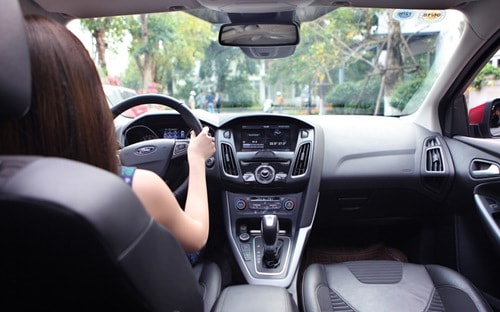 |
| Driving habits such as speeding and sudden braking can lead to higher fuel consumption. |
Many car consumers still believe that whether a car is fuel-efficient or not depends entirely on the manufacturer. However, reality proves that proper driving is the best way to effectively reduce fuel costs.
Ford Motor Company has conducted research on the impact of driving skills on fuel consumption and CO2 emissions per kilometer. The studies show that by adopting environmentally friendly driving techniques, drivers can reduce fuel consumption and emissions by up to 25% compared to conventional driving methods. Even small changes in driving habits can have a significant impact on fuel efficiency.
According to Adam Smith, Ford's Director of Fuel Efficiency Engineering and one of Ford's leading fuel efficiency experts in Asia Pacific, people are willing to go the extra mile to buy cheaper items without realizing that even more fuel is being wasted while they drive.
"Smart driving not only saves you fuel and money, but also helps protect the environment and makes the roads safer for everyone," shared expert Adam Smith.
Based on this reality, Ford experts have pointed out some simple tips to help car users drive more fuel-efficiently and in a more environmentally friendly way.
Drive slowly.
Driving habits like speeding and sudden braking can increase fuel consumption. Therefore, unless it's an emergency, accelerate gently, brake early and smoothly. If it's safe, avoid changing lanes while driving. This will not only save fuel but also extend the lifespan of your brakes and tires.
Slow down.
Driving at high speeds wastes a lot of fuel. Driving at 90 km/h instead of 100 km/h saves you 10-15% on fuel. At the same time, you should maintain a steady speed. Every time you press the accelerator, more fuel is pumped into the engine, sometimes more than necessary. Using cruise control whenever possible on the highway will help maintain a steady speed and save fuel.
Turn off the engine when waiting.
Modern car engines don't require a warm-up period. You should drive your car immediately after starting it, avoiding idling. Idling while stopped increases emissions and wastes fuel. If unnecessary, turn off the engine if the car is stationary for more than 30 seconds to avoid wasting fuel.
Cut back on unnecessary items.
The lighter the cargo in the truck bed or inside the vehicle, the less fuel is needed to accelerate. Try to travel with as few items as possible, keeping only essentials such as first aid supplies, jumper cables, a compact tool kit, and a small jack in the car.
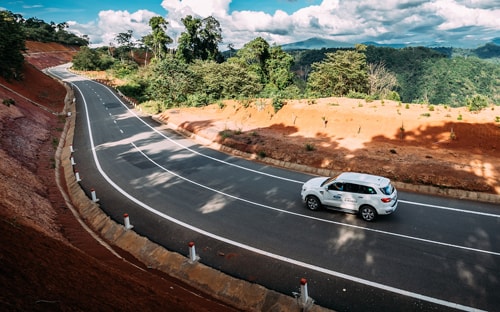 |
| Removing unnecessary items and reducing wind resistance while driving will significantly save on fuel costs. |
Reduce wind resistance
Your vehicle is designed to minimize wind resistance. Therefore, carrying a large object or a bicycle on the roof will significantly increase wind resistance. If you're traveling a long distance, try to arrange items inside the vehicle or secure them to the rear. Additionally, closing the side windows and sunroof will also reduce wind resistance. The less resistance, the more fuel you'll save.
When the weather is cool, only turn on the air conditioning on the highway.
Setting the air conditioner to a low temperature consumes about 15% more fuel. Therefore, if it's not too hot, roll down the windows and turn off the air conditioner when driving around the city. However, when driving at speeds above 90 km/h, closing the windows and turning on the air conditioner is a more sensible decision for two reasons: firstly, it improves the car's aerodynamics; and secondly, at high engine speeds, the engine produces enough power for the air conditioning system to operate efficiently.
Use the automatic transmission system.
Activating the cruise control system not only frees up your feet when driving at high speeds but also improves fuel efficiency, maintaining a stable speed and preventing fuel waste during acceleration. Set the system to the speed that best optimizes your vehicle's fuel economy, as long as you don't exceed the speed limit.
Multitasking on a single trip.
Traveling multiple short distances will consume more fuel than traveling a single long distance. Therefore, when you're going somewhere, you can combine other errands you need to run along the same route to use fuel more efficiently.
Vehicle maintenance
The way you maintain your vehicle also significantly affects fuel consumption. When your vehicle is always running at its best, energy consumption will be minimized.
Keep your car engine in good condition.
When a vehicle malfunctions or fails emissions tests, thorough repairs can save an average of 4% on fuel. Specifically, replacing a faulty oxygen sensor in the engine can increase fuel efficiency by up to 40%.
Maintain standard tire pressure.
Properly inflated tires contribute to safer driving, more precise steering, longer vehicle lifespan, and better fuel efficiency. The correct tire pressure is indicated in the owner's manual or located on the driver's side door, door pillar, or glove compartment. Avoid over-inflating your tires, as excessive pressure reduces traction and shortens tire life.
Use the recommended type of engine oil.
Using the type of engine oil recommended by the manufacturer (clearly stated in the owner's manual) will help the lubrication system operate at maximum efficiency. Using the wrong type of oil can reduce fuel efficiency by up to 2%.
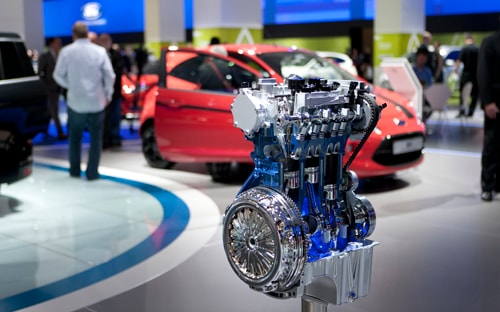 |
| The EcoBoost engine generation represents a breakthrough for Ford in its goal of increasing performance while reducing fuel consumption and being environmentally friendly. |
Other minor notes
Ford dealership technicians are trained to help optimize your vehicle's fuel efficiency. In addition to the aforementioned routine vehicle maintenance, technicians can replace old fuel filters or spark plugs, and perform wheel alignment and exhaust system checks. Proper vehicle maintenance and driving habits can increase fuel economy by up to 25%.
Of course, the car's design also makes a big difference. Ford is one of the automakers constantly moving forward in its journey to provide consumers with different fuel options, increasing fuel efficiency for current models or electric vehicles under research, alternative fuels, and advanced technologies that are changing the way millions of people travel.
For example, Ford currently owns the award-winning EcoBoost engine generation, which is being used in its vehicles to deliver superior performance with high fuel efficiency.
At the Vietnam Motor Show 2017, scheduled to take place from August 1-5 in Ho Chi Minh City, Ford Vietnam will also showcase leading smart technologies currently available on its vehicle lines in Vietnam.
In particular, the compact duo Fiesta and EcoSport boast the most advanced technologies in their segment, such as the SYNC infotainment and voice control system, automatic headlights, automatic rain-sensing wipers, and electronic stability control.
Slightly higher up the range is the Focus model, with notable features such as active city braking and active parking assist. As an icon of the "Built Ford Tough" spirit, the Ranger pickup truck has proven itself with impressive load-carrying and off-road capabilities, ready to tackle any terrain and serve diverse practical driving needs.
The two mid-to-high-end SUV models, the Everest and Explorer, offer drivers exciting experiences thanks to the integration of a range of advanced and modern technologies. These include Cruise Control, the SYNC 3 voice-controlled infotainment system with GPS navigation, lane-keeping function, and blind-spot warning system…
These can be considered typical Ford products in terms of automotive technology, meeting criteria of quality, environmental friendliness, safety, and intelligence.
According to VnEconomy
| RELATED NEWS |
|---|


