
20-minute shootout kills assassin of Russian ambassador in Türkiye
Turkish special forces killed the assassin after a 20-minute shootout, despite having several good opportunities to capture him alive.
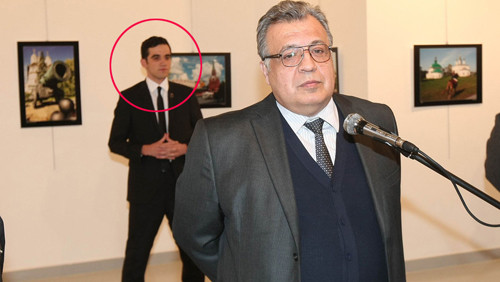 |
The assassin (circled in red) stood directly behind Ambassador Karlov before carrying out the attack. Photo: Haberturk |
The assassination of Russian ambassador to Türkiye Andrei Karlov has been the focus of Turkish media attention in recent days, but information about the killer's motive remains unclear, as the assassin was killed immediately after committing the crime rather than captured alive, according to RBTH.
At 7:30 PM on December 19th, Ambassador Karlov arrived at the Contemporary Art Center in Ankara, Türkiye, to attend the opening of a photo exhibition. He had barely stood up to speak when an assassin standing directly behind him pulled out a gun and coldly fired multiple shots into the ambassador's back.
Ambassador Karlov was hit by nine bullets and seriously wounded, but medical personnel who arrived shortly afterward were unable to reach him because the gunman, Mevlut Mert Altintash, was still brandishing his weapon and shouting Islamic slogans. Twenty-five minutes after the shooting, Turkish special forces were deployed, and a 20-minute gunfight ensued.
According to the Telegraph, the special forces surrounding the building repeatedly called on Altintas to surrender, but he continued to fire multiple shots at them using his Sarsilmaz K2P 9mm pistol, the standard weapon of the Turkish police.
Altintas refused to surrender his weapons despite being shot four times in the foot and thigh. Finally, a Turkish special forces operative fired the decisive shot, the bullet lodging in Altintas's neck, causing him to collapse and die instantly. Only then were doctors able to reach Ambassador Karlov, but it was too late; he had already died at the scene from his severe injuries.
According to Boris Dolgov, a senior expert at the Institute of Middle Eastern Studies of the Russian Academy of Sciences, Altintas may have been a lone assassin, but it is more likely that he was part of a carefully planned operation with multiple accomplices involved. The fact that Altintas was shot dead on the spot has greatly complicated the investigation into the perpetrator.
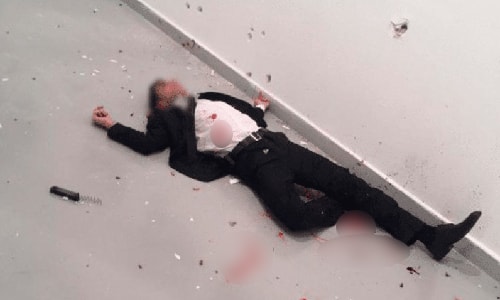 |
Altintas was shot dead at the scene. Photo: Twitter |
"I find it strange that Altintas was shot dead. They could have easily captured him alive, then interrogated him and forced him to reveal the people behind the assassination plot," Dolgov said.
Many other experts also believe that if Altintas were captured alive, the joint investigation between Russian and Turkish inspectors would proceed much more smoothly, and the real culprit would be quickly brought to light and punished according to justice.
Lieutenant Colonel Andrei Popov, a former member of the Alpha special forces unit of the Russian Federal Security Service (FSB), believes that Turkish special forces had a very favorable opportunity to capture Altintas alive, but unfortunately they failed to do so.
"When the Turkish special forces arrived, the assassin of the ambassador revealed himself as the perpetrator and had no intention of concealing the crime. From the video I saw, it was clear that the assassin did not prevent people from leaving the building and had no intention of taking hostages. When the suspect is not holding hostages, it is very easy to subdue and capture him alive," Popov said.
Turkish police deployed forces to surround the scene.
The lieutenant colonel stated that special forces are usually very well-trained for this situation. "In that case, actions to capture the suspect alive would be implemented. The suspect would be shot directly in the right shoulder, rendering him unable to fire back or commit suicide. The special forces would then simply approach and subdue him," Popov asserted.
Popov suggested that this opportunity might not have been seized because there were disagreements among the Turkish special forces regarding the attack plan, or because they had not been professionally trained.
He also did not rule out the possibility that Altintas had an accomplice within the special forces, who "decided to shoot him dead to silence him." Altintas was a member of the riot police unit in Ankara, having served in the force for two and a half years.
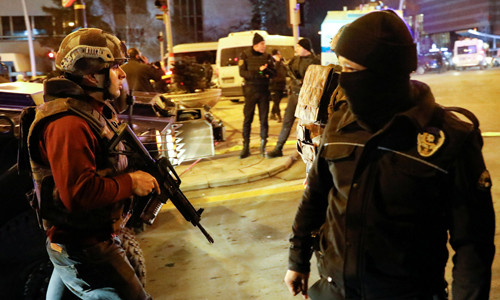 |
Turkish special forces police surrounded the scene. Photo: Reuters |
Following the assassination, Türkiye attributed the crime to the FETO terrorist movement of exiled cleric Fethullah Gulen. However, Kremlin spokesman Dimitri Peskov stated yesterday that Ankara should not rush to assign blame as the investigation is still ongoing and no final conclusions have been reached.
Russia has dispatched an 18-member investigative team from the National Investigative Committee and the Foreign Ministry to Ankara to coordinate with their Turkish counterparts in investigating the incident. The investigative team has not commented after Jabhat Fatah al-Sham (the new name for the Al-Nusra Front) in Syria claimed responsibility for the assassination.
According to VNE


