
27,000 workers are employed in traditional craft villages.
(Baonghean) - Implementing Resolution 06-NQ/TU dated November 4, 2011, of the Provincial Party Committee on the development of industry, handicrafts, and the construction of craft villages in the period 2011-2020, to date, over 27,000 workers have found employment in craft villages.
Closed production chain
We visited Quynh Hung commune (Quynh Luu district), home to two traditional wood carving villages: Nam Thang and Thuan Giang. In recent years, the market trend favoring durable and beautiful domestically produced wooden goods has led to strong sales of Quynh Hung's wood products. The two villages in the commune are developing rapidly, attracting a steadily increasing workforce. Currently, the commune has nearly 600 households engaged in these crafts, providing regular employment for approximately 900 local workers.
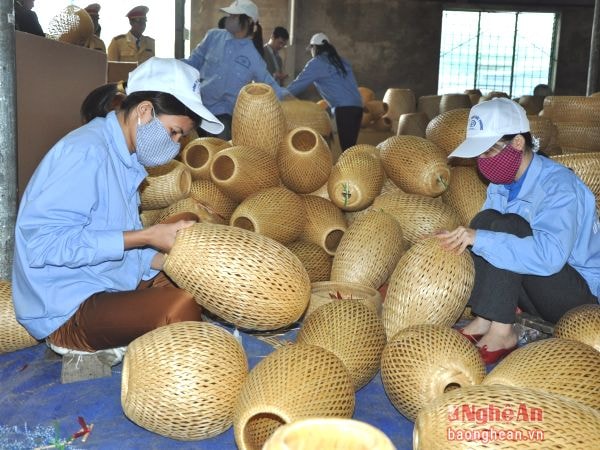 |
| Produced in the export-oriented rattan and bamboo weaving village in Nghi Thai commune (Nghi Loc district). Photo: PV |
The production facility of Mr. Le Ngoc Khoa's family is located in Nam Thang carpentry village. Previously, his family only produced and sold wooden goods at their private residence. Through years of accumulated capital from the trade, Mr. Khoa has now purchased an additional plot of land along the main road of the commune to build a showroom for selling products. His family's workshop employs 10 workers year-round, producing a wide variety of high-end interior decoration products with diverse designs. In addition, they can fulfill custom orders from customers.
Our annual sales are around 4-5 billion VND, of which over 1.2 billion VND is paid to our workers annually. Currently, to prepare for the year-end market, our team of workers is actively working overtime at night to ensure a stable supply and fully meet customer demand."
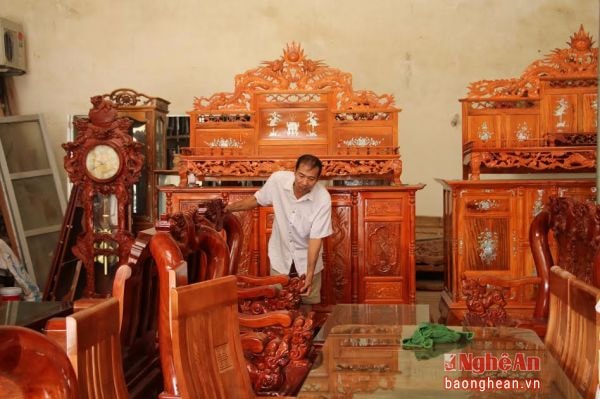 |
| Finished products from the Quỳnh Hưng craft village (Quỳnh Lưu). |
The family of Mr. Ngo Van Toan in Nam Thang carpentry village also has a large production facility and a showroom located along the central road of the commune. Each year, Mr. Toan's carpentry workshop produces over 300 products including tables, chairs, cabinets, beds, doors, ceilings, etc., supplying many provinces and cities nationwide.
Similarly, the Phu Nghia village specializing in civil and fine art woodworking (Quynh Nghia commune) has nearly 300 workers engaged in woodworking production. The village has approximately 62 workshops specializing in high-end civil and fine art woodworking, producing over 3,000 high-end products and more than 40,000 civil woodworking products annually for customers inside and outside the province. The total income from the craft reaches nearly 25 billion VND, with an average worker income of 64 million VND per year.
Recognizing the growing market potential, many households in the Phu Nghia village specializing in civil and fine art woodworking have invested in modern production machinery and hired more workers to meet the increasing demands of customers. In this village, many households, such as those of Mr. Ho Van Tinh, Mr. Ho Van Huu, and Mr. Ho Van Xinh, have fairly large workshops located along Provincial Road 537B. Next to the production workshop is a product display area, making it very convenient for customers to learn about and purchase products, as well as facilitating the transportation of raw materials and the exchange of goods.
Enhancing value through product diversification.
The development of small-scale industries and the establishment of craft villages have generated an average annual economic value of 2,000 billion VND for some localities, accounting for 30-35% of the total economic value of the districts, and creating new jobs for over 35,000 workers. Through production activities and industry development, significant changes have been made in the economic development of rural areas, contributing to the goals of economic restructuring, poverty reduction, and rural development.
Many localities have issued their own resolutions and policies to support the development of small-scale industries and craft villages, such as Quynh Luu, Yen Thanh, Dien Chau, and Nghi Loc districts.
In recent years, the activities of craft villages have produced many products for society, meeting the labor needs of tens of thousands of workers in localities, contributing to increasing workers' incomes, and changing the face of new rural areas. They also contribute to maintaining, preserving, and developing traditional crafts associated with community tourism development such as incense production, brocade weaving, and carpentry.
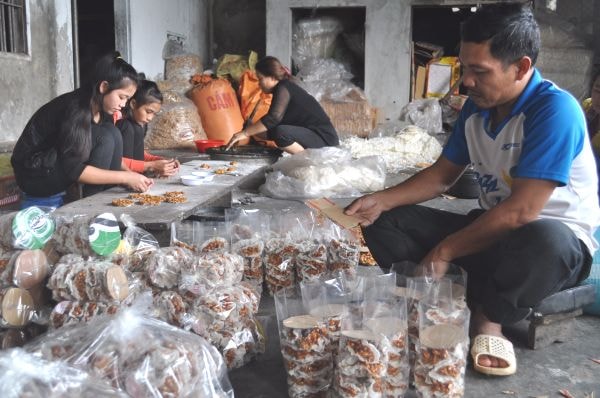 |
| Peanut candy production in Dong Ha confectionery village, Dien Van commune (Dien Chau district). Photo: Quynh Lan |
To effectively implement the objectives of Resolution 06/NQ-TU in the coming years, Mr. Tran Van Chuong - Vice Chairman of the Provincial Cooperative Union, shared: Districts need to link the development of craft villages and villages with traditional crafts with the socio-economic development strategy of the province and localities; developing craft villages in conjunction with the development of raw material areas and domestic and international markets through enterprises and cooperatives.
Developing craft villages and villages with traditional crafts is linked to job creation, efficient utilization of local labor, increased income, and sustainable poverty reduction in rural areas. To achieve this, it is necessary to improve the skills of workers, plan raw material areas, focus on quality, design, labeling, and invest in infrastructure, technology, environmental protection, and food safety and hygiene.
Developing small-scale industries and craft villages is a multi-sectoral and multi-occupational field; therefore, production needs to be organized in a way that diversifies products and expands production scale in both quality and quantity to meet the demand for goods for domestic consumption and export. In addition, attention should also be paid to developing new industries and new products.
Quynh Lan


