
5 tactics that are becoming a trend at the World Cup.
The Athletic recently published an interesting article on the topic of on-field tactics for the World Cup. Below are some of the tactics that are becoming popular at the biggest football event on the planet.
The Athletic recently published an interesting article on the topic of on-field tactics for the World Cup. Below are some of the tactics that are becoming popular at the biggest football event on the planet.
The return and resurgence of the "number 10" position.
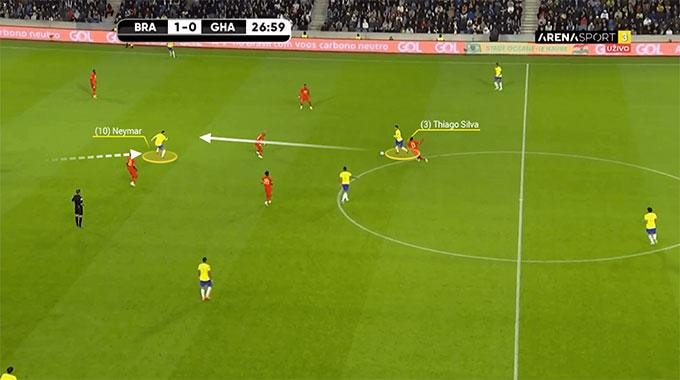
In 2019, midfielder Juan Mata suggested that the number 10 role might not disappear, but simply evolve into a different form. However, reality is proving that some teams are once again emphasizing the role of "number 10s." For example, in the England national team, manager Gareth Southgate has called up James Maddison, the Leicester City midfielder who embodies the classic "number 10" archetype.
Similarly, this applies to Neymar in the Brazilian national team, or the duo of Daichi Kamada and Takumi Minamino in the Japanese national team. In addition, there are numerous other examples such as Jamal Musiala, Thomas Mueller (Germany), Christian Eriksen (Denmark), Dusan Tadic (Serbia), Cody Gakpo (Netherlands), Davies, Junior Hoilett (Canada), De Bruyne and Eden Hazard (Belgium).
 |
 |
Take advantage of set pieces.
The 2018 World Cup set a record for the number of goals scored from set pieces (35%). Since then, teams have been extremely effective in converting set pieces into goals, which has become a new trend. Evidence of this is that three out of the next four major tournaments (Asian Cup 2019, EURO 2020, Gold Cup 2021, and Copa America 2021) had a set-piece goal rate higher than 25%. In the 2022 World Cup, Valencia also scored their first goal from a penalty kick.
 |
To play high-pressure football, teams need players who are actively moving and good at tackling, making it difficult for opponents to build up play. This style of play demands a lot of stamina and excellent coordination between the attacking players. In the opening match of the 2022 World Cup, host nation Qatar was stifled by Ecuador. However, using a similar style of play, Senegal, despite causing considerable difficulties for the Netherlands, ultimately lost to an opponent who was extremely good at maintaining distance and passing the ball effectively.
Hiding a dagger in your sleeve.
The 2022 World Cup was the first World Cup where coaches could use up to five substitutions per match. In the knockout rounds, they were allowed one more substitution if the match went into extra time. This increased flexibility allowed managers to keep key players at bay until the decisive moment, ready to deliver the knockout blow. Of course, to do this effectively, they had to select the right players.
For example, Kaoru Mitoma, the Japanese midfielder, scored twice against Australia in just seven minutes after coming on as a substitute in a match in March of this year. In the French national team, striker Olivier Giroud is also a name worth noting. This tall striker has excellent opportunism and currently ranks second on the list of players with the most goals scored from substitutes in the Premier League (20 goals).
The midfielder drops back to support the central defender.
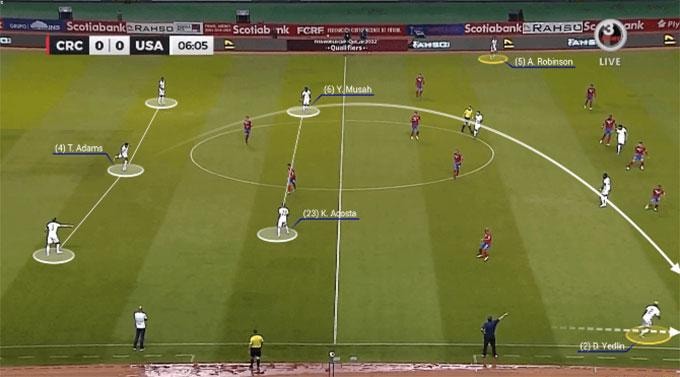
In teams playing with a four-man defense, when the two full-backs push forward, it's often very effective for the central midfielder to drop back between the two center-backs to transition into a three-man defense. This allows for more varied attacking moves while minimizing the risk of a counter-attack. In teams like the USA or Uruguay, midfielders such as Tyler Adams or Federico Valverde frequently choose this solution to help their team reduce pressure.
 |
 |


