
538 electors – those who directly vote for the US president.
Electoral College members—those who play a decisive role in the US presidential election—are chosen by party decision and the popular vote in each state.
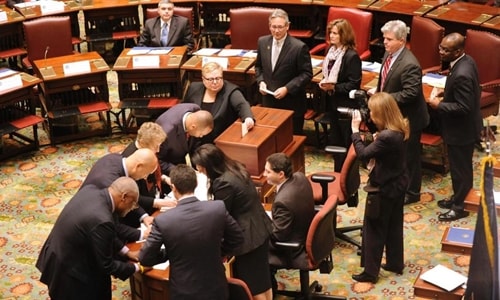 |
Electors cast their votes in New York in 2012. Photo: AP |
The American people do not directly elect the president; instead, an Electoral College composed of electors casts the votes. A candidate who wants to win the White House race must receive a majority of the votes from the Electoral College.
The U.S. Constitution has very few provisions specifying the exact criteria for becoming an elector, only stating that a congressman or a federal government official cannot be nominated as an elector, according to the U.S. National Archives.
Stemming from historical factors, the 14th Amendment to the U.S. Constitution stipulates that government officials who participate in rebellion or riots against the U.S. government, or who support or assist the enemy, are not permitted to become electors.
Each state has a certain number of electors that make up the Electoral College, based on the state's population. The United States has a total of 538 electors, the same number as seats in the U.S. Congress.
Selection method
The electoral college selection process consists of two rounds. First, the parties in each state select a list of potential electoral college candidates before Election Day. Then, on Election Day, the general electorate in each state chooses its state's electors by casting their votes for the presidential candidate.
In the initial stages, political parties in each state control the selection process, and each state has different rules. Essentially, parties nominate a list of potential electors at their state party convention, or they can choose through a vote at the party's central committee.
This process takes place in each state and follows the regulations of that state, but it may also follow the general national regulations of that party. The end result is that each presidential candidate will have a list of potential electors who support them.
Political parties typically select individuals who are deeply committed to the party to serve as electors. These may include elected state officials, state party leaders, or individuals with political or personal connections to their party's presidential candidate.
The second phase of the electoral college process takes place on Election Day. When each voter in a state casts their ballot for their preferred presidential candidate, they simultaneously choose electors for their state. The names of potential electors may or may not appear on the ballot (if they do, their names will be listed below the presidential candidate's name), depending on the electoral process and voting methods in each state.
All potential electors for the winning presidential candidate become electors in their respective states, with the exception of Nebraska and Maine. These two states allocate electors proportionally; the statewide winner receives two electors, while the winner in each county (which could be the statewide winner or a different candidate) receives one elector. This system allows electors in Maine and Nebraska to be allocated to more than one presidential candidate.
Ballot
There is no provision in the U.S. Constitution or federal law that requires electors to vote according to the popular vote results of the state they represent. However, some states do require this. Such commitments can be divided into two groups: electors bound by state law and electors bound by a commitment to their party.
The U.S. Supreme Court has affirmed that the Constitution does not require electors to have the sole right to decide which presidential candidate to vote for, so some parties can force them to pledge to vote for their party's nominee. Some states stipulate that "unfaithful electors" can be penalized or disqualified if they cast an invalid vote and will be replaced by a "stand-in" elector. However, no elector has ever been prosecuted for failing to vote as pledged.
Today, it is rare for an elector to go against the popular vote. According to the U.S. National Archives, in American history, more than 99% of electors have voted as they pledged.
According to VNE


