
6 ways to distinguish counterfeit money
The State Bank of Vietnam has just issued a warning about increasingly sophisticated counterfeit money crimes, and that many people are still falling victim to them.
Counterfeit banknotes are almost indistinguishable from real money, leading many people to mistake them for genuine ones. How to identify counterfeit money and how to handle it legally? Mr. Nguyen Hoang Minh, Deputy Director of the State Bank of Vietnam's Ho Chi Minh City Branch, offers specific advice to readers.
1. Inspect the polymer material used in printing banknotes.
|
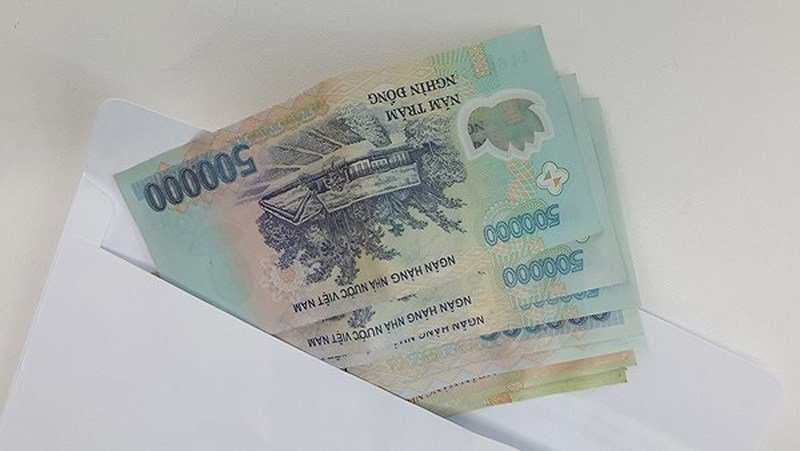
Genuine banknotes are printed on polymer material, which is highly elastic and durable. People can test the elasticity by crumpling the banknote in their palm; when released, a genuine banknote will spring back to its original shape. You can also gently pull or tear the edges of the banknote; genuine banknotes are very difficult to tear or stretch.
Counterfeit money is mostly printed on nylon, so it lacks the characteristic elasticity and durability of polymer.
2. Examine the banknotes under a light source.
|
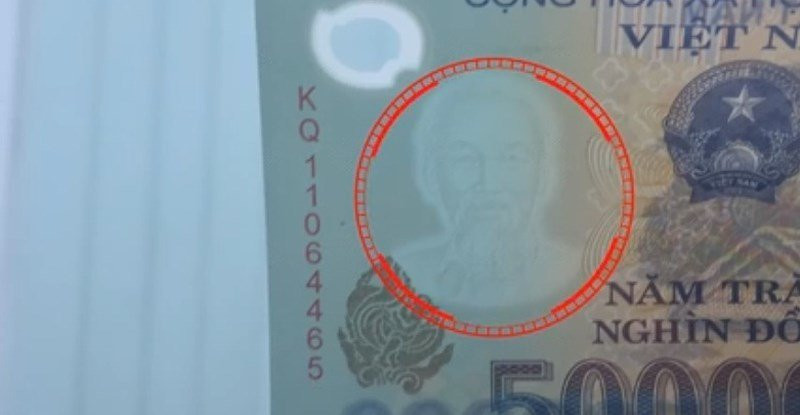
Examining counterfeit money under a light source is the clearest way to distinguish them. Under a light source, you can see that the watermarks on counterfeit money are often not very sophisticated; the letters and numbers on the security thread are not clear or sharp; and the positioning marks do not match perfectly...
Genuine banknotes have a watermark clearly visible on both sides, rendered with intricate and bright white lines. The banknotes from 20,000 to 500,000 VND feature a portrait of President Ho Chi Minh; the 10,000 VND banknote features an image of the One Pillar Pagoda.
3. Check the embossed printing elements.
|
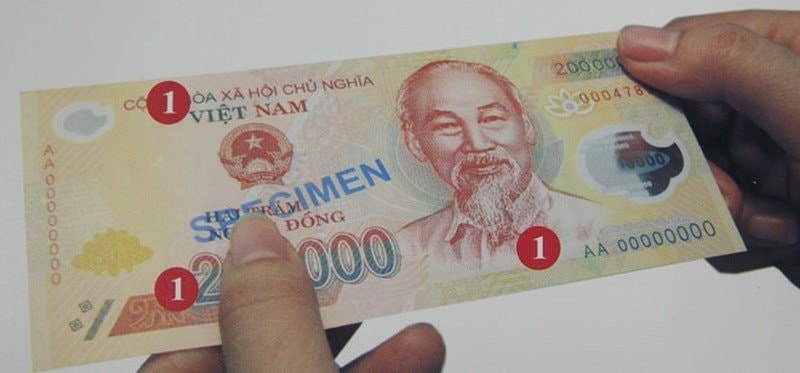
Another visual inspection method is to gently rub the banknote to check the raised, rough texture of the printing on the portrait of President Ho Chi Minh, the national emblem, the denomination in numbers and words, and the words "Socialist Republic of Vietnam" and "State Bank of Vietnam".
With counterfeit money, when you perform this action, you will feel a smooth, non-rough texture unlike real money, or a slightly bumpy sensation due to indentations on the paper, not due to the raised printing.
4. Check for color-changing ink, security thread, and hidden embossed logo.
|
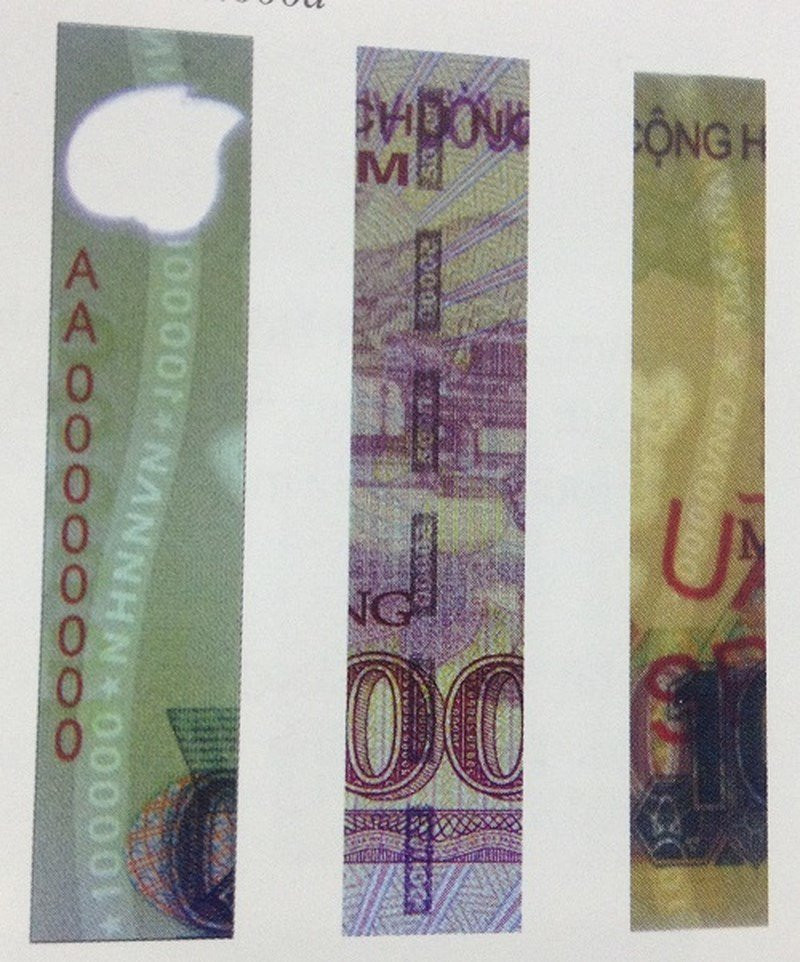
People can tilt the banknotes to check for color-changing ink or hidden embossed images. Color-changing ink is only present in three denominations: 500,000 VND, 200,000 VND, and 100,000 VND. When observed, the ink will change from yellow to green or vice versa.
In addition, the Iriodin strip (security thread) is only present on the 500,000 VND, 200,000 VND, 100,000 VND, 20,000 VND, and 10,000 VND banknotes. It is a yellow strip running along the back of the banknote; the 100,000 VND banknote has it on the front. This Iriodin strip will shimmer with a metallic sheen, displaying the denomination number or pattern when the banknote is tilted.
Counterfeit money may have color-changing elements, but the color change is not the same as with genuine money; it may lack the iridescent strip or have a fake print that doesn't sparkle.
5. Transparent windows
|
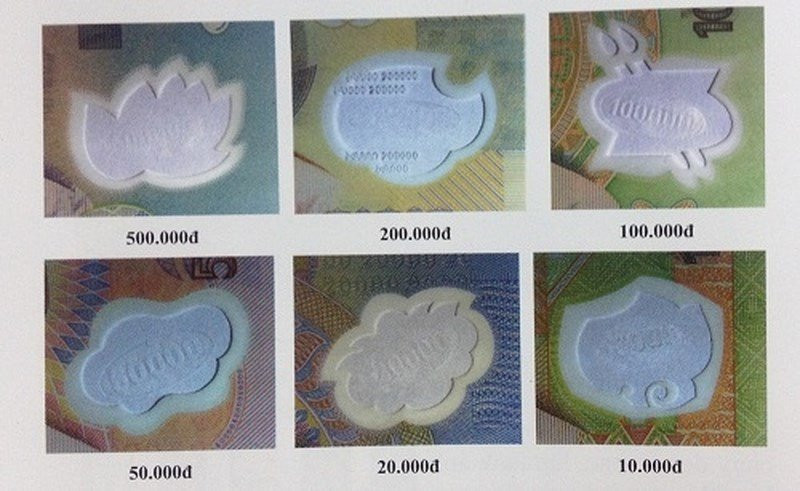
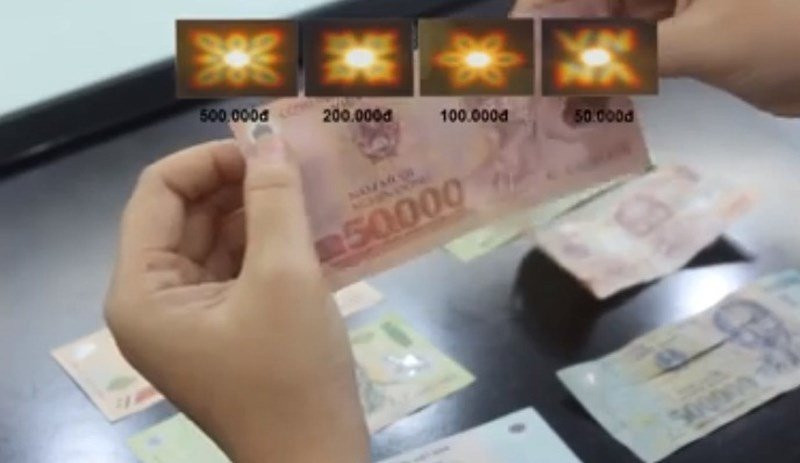
The large window on the banknote displays the embossed denomination, while the smaller window contains a hidden image element: a sharp, transparent plastic background. When the window is held close to the eye and viewed through to a red light source (incandescent bulb, fire, etc.), the hidden image surrounding the light source will be visible.
Meanwhile, in counterfeit money, the embossed denomination number in the large window is not as finely crafted as in genuine money, and there is no hidden image in the small window.
6. Use a magnifying glass and a UV light.
 |
Users can use a magnifying glass to examine the micro-printed area created by the repeated letters “NHNNVN” or “VN” or numbers representing the denomination, usually printed in the area of the banknote denomination.
In addition, the denomination numbers are printed with colorless fluorescent ink and are only visible when viewed under ultraviolet light. The vertical red fluorescent serial numbers fluoresce yellow-orange, and the horizontal black fluorescent serial numbers fluoresce cyan.


