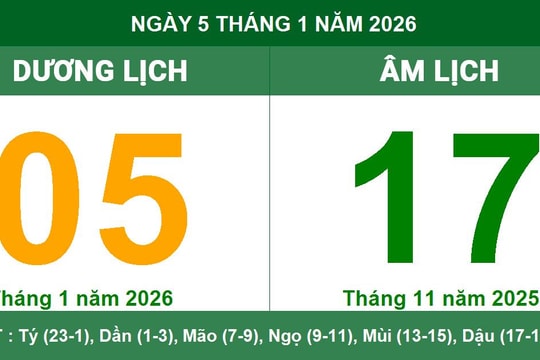
DayGregorian calendar:05-01-2026
DayLunar calendar:17-11-2025
Day of the week:Monday
DayYear of the RabbitmonthMau TyyearYear of the Snake (乙巳)
HourZodiac:Rat (23-1), Tiger (1-3), Rabbit (7-9), Horse (9-11), Goat (13-15), Rooster (17-19)
| Gregorian calendar | Lunar calendar |
|---|---|
| January 2026 | November 2025 (Year of the Snake) |
|
05
|
17
Day:Year of the Rabbit, Month:Mau Ty Solar terms:Xiao Han |
| Auspicious Hours (Good Hours) | |
| Rat (23-1), Tiger (1-3), Rabbit (7-9), Horse (9-11), Goat (13-15), Rooster (17-19) | |
|
|
Rat (23:00-23:59); Tiger (03:00-04:59); Rabbit (05:00-06:59); Horse (11:00-12:59); Goat (13:00-14:59); Rooster (17:00-18:59) |
|
|
Ox (01:00-02:59); Dragon (07:00-08:59); Snake (09:00-10:59); Monkey (15:00-16:59); Dog (19:00-20:59); Pig (21:00-22:59) |
|
|
These days are considered inauspicious: ButDay of DeathOn this day, everything is considered inauspicious; no activities should be undertaken. |
|
|
Day:Year of the Rabbit- This means that the Earth element (Wood) clashes with the Metal element (Earth), making it an inauspicious day (a day of punishment). - Elemental influence: Earth element, unfavorable for those born in the years of Quy Dau and At Dau. - This day belongs to the Earth element, which clashes with the Water element, except for those born in the years of Ding Mui and Quy Hoi, which belong to the Water element and are not affected by the Earth element. - The day of the Rabbit is in harmonious combination with the Dog, and in triple harmony with the Goat and Pig, forming a Wood element. It clashes with the Rooster, forms a harmful combination with the Rat, damages the Dragon, destroys the Horse, and completely negates the Monkey. |
|
|
ButCentury"Breaking contracts and agreements will only harm both parties." ButRabbit"It is not advisable to dig wells because the water will not be pure." |
|
|
Day:Tốc Hỷ- That is, a moderately auspicious day. The morning is good, but the afternoon is bad, so you need to act quickly. Fleeting joy should be used to plan important matters, which will lead to quicker success. It's best to carry out tasks in the morning, the earlier the better. "Tốc Hỷ is a reunion of friends." |
|
|
: Socks : Tat Nguyet O - Tran Tuan: Good (Auspicious Star) Ruling star is the crow, governs Monday. Starting any undertaking on this day is auspicious. It is especially good for building doors and windows, digging canals, draining water, excavating ditches, burying the dead, getting married, clearing land, or digging wells. Other activities such as opening a business, traveling, starting school, farming, and raising silkworms are also good. The act of traveling by boat. : - The Crow (Tatt Nguyet O): Moon star, auspicious star. Everything will go well. - The star Tất Nguyệt Ô is auspicious in the signs of Thìn, Thân, and Tý. In Thân, it is called Nguyệt Quải Khôn Sơn, meaning the moon hangs over the southwestern mountain, which is very good. The star Tất Đăng Viên on the day of Thân is considered extremely auspicious for weddings or funerals. "All creations are subject to subjective judgment." |
|
|
Truc Binh What should be doneBringing goods into storage, burying the dead, installing doors, erecting scaffolding, setting up machinery, repairing and building ships, launching ships, additional construction work (such as mud filling, earth filling, stone paving, building embankments), laying and making beds, inheriting titles or businesses, and activities that create holes or gaps (such as digging ditches, digging wells, draining water). |
|
|
Good star: - Tiancheng Star (Jade Hall of the Zodiac): Auspicious for all matters. - Auspicious conjunction of the Year Star: Good for all matters. - Active Star: Good, but bad when encountering a death star. - Japanese Star, German Era: Everything goes well Bad star: - The Heavenly Star (or Destroyer Star): Bad for all matters. - The Heavenly Star: Bad for everything. - Minor Hao Star: Unfavorable for business and seeking wealth. - Star of Death: Bad for all things (except hunting, which is good) - The Earth Thief Star: Unfavorable for starting new projects, burials, groundbreaking ceremonies, and travel. - The Six-Star Unfavorable Constellation: Bad for construction. - Moon Shape Star: Bad for all matters - The Crying Ghost Star: Unfavorable for rituals and funerals. |
|
|
DayHeavenly Way:Traveling abroad in search of wealth should be avoided; even if successful, it will be very costly, illogical, and ultimately lead to loss. |
|
|
Departing in the Northeast direction to welcome the 'God of Joy'. Departing in the South direction to welcome the 'God of Wealth'. Avoid traveling westward as you may encounter the Crane God (bad omen). |
|
|
From 11:00 AM to 1:00 PM (Noon) and from 11:00 PM to 1:00 AM (Midnight)Everything will go well; it's best to seek wealth in the southwest direction – your home will be peaceful. Those who travel will be safe. From 13:00-15:00 (Goat) and from 01:00-03:00 (Ox)Plans are difficult to succeed; seeking fortune and wealth is uncertain. Lawsuits should best be postponed. No news yet from those who have traveled far. Lost money or belongings, if found in the South, can be recovered quickly. Beware of arguments, conflicts, or petty gossip. Work will be slow and protracted, but it's best to be thorough in everything you do. From 3 PM to 5 PM (Monkey) and from 3 AM to 5 AM (Tiger)Good news is coming soon. If you are seeking fortune and wealth, head south. Business trips and meetings will bring good luck. Those who travel will receive news. Livestock farming will be prosperous. From 5 PM to 7 PM (Rooster) and from 5 AM to 7 AM (Rabbit)Arguments, quarrels, and disputes should be avoided; caution is advised. It is best to postpone departures. Guard against curses and avoid contracting illnesses. In general, activities such as meetings, debates, and official business should be avoided during this time. If it is absolutely necessary to engage in such activities during this time, it is advisable to keep quiet to minimize the risk of fights or arguments. From 7 PM to 9 PM (Tuất) and from 7 AM to 9 AM (Thìn)This is a very auspicious time; traveling often brings good fortune. Business and trade will be profitable. Travelers will soon return home. Women will receive good news. Everything in the household will be harmonious. If there is illness, prayers will bring recovery, and the whole family will be healthy. From 9 PM to 11 PM (Pig) and from 9 AM to 11 AM (Snake)Seeking wealth is not beneficial, or often leads to disappointment. Leaving home may result in loss or misfortune; important matters may be thwarted; encountering evil spirits requires offerings and rituals for peace. |
January 5th, 2026 corresponds to the 17th day of the 11th lunar month. It is the day of Kỷ Mão, the month of Mậu Tý, and the year of Ất Tỵ.
January 5th, 2026 is a Monday.
The 17th day of the 11th lunar month is an auspicious day.
November 17th in the lunar calendar is the dayHeavenly Dao.
Origin of the lunar calendar
The lunar calendar, also known as the perpetual calendar, is a type of calendar based on the cycles of the moon. It is a unique calendar. In fact, the lunar calendar is the Islamic calendar, in which each year contains exactly 12 lunar months. The characteristic of a purely lunar calendar, as in the case of the Islamic calendar, is that it is a continuous cycle of the full moon and is not tied to seasons. Therefore, the Islamic lunar year is about 11 or 12 days shorter than each solar year, and only returns to align with the solar year after every 33 or 34 Islamic years. The Islamic calendar is used primarily for religious purposes. In Saudi Arabia, the calendar is also used for commercial purposes.
Most other types of calendars, whether called "lunar calendars" or perpetual calendars, are in fact lunisolar calendars. This means that in these calendars, the months are maintained according to the cycle of the Moon, but sometimes leap months are added according to certain rules to adjust the lunar cycles to match the solar year. Currently, in Vietnamese, when people talk about the lunar calendar, they think of a calendar based on the principles of the Chinese calendar, but modified according to UTC+7 instead of UTC+8. It is a lunisolar calendar in the truest sense, not a purely lunar calendar. Because the calculation of the lunar calendar differs from that of China, the Vietnamese Lunar New Year sometimes does not completely coincide with the Spring Festival of China and other countries influenced by Chinese culture and the Sinocentric cultural sphere.
Because the purely lunar calendar has only 12 lunar months (corresponding months) in each year, this cycle (354.367 days) is sometimes also called a lunar year.
Lunar and Solar Calendar
The lunisolar calendar is a type of calendar used by many cultures, in which the dates indicate both the lunar phase (or lunar cycle) and the duration of the solar year (solar calendar). If the solar year is defined as the tropical year, the lunisolar calendar will provide indication of the seasons; if it is calculated according to the astronomical year, the calendar will predict the constellations near which a full moon (the "see-see") is likely to occur. There is usually an additional requirement that a year contains only a natural number of months, in most years 12 months, but every two (or three) years there is a year with 13 months.

Governing body: Nghe An Provincial Party Committee
Director: Tran Minh Ngoc
Electronic newspaper operating license number: 153/GP-BTTTT
Issued by the Ministry of Information and Communications on March 24, 2022