
India unveils new cruise missile with stealth capabilities.
DRDO is developing a next-generation cruise missile for the Indian Air Force, combining a range of approximately 250 km with the ability to loiter, monitor, and precisely strike both land and sea targets.
The Defence Research and Development Organisation (DRDO) of India is developing a new generation cruise missile for the Indian Air Force (IAF), combining a range of approximately 250 km with the ability to loiter over the target area, monitor, and strike with precision. This is the first weapon of its kind in India's arsenal, aimed at increasing operational flexibility and minimizing unintended casualties.
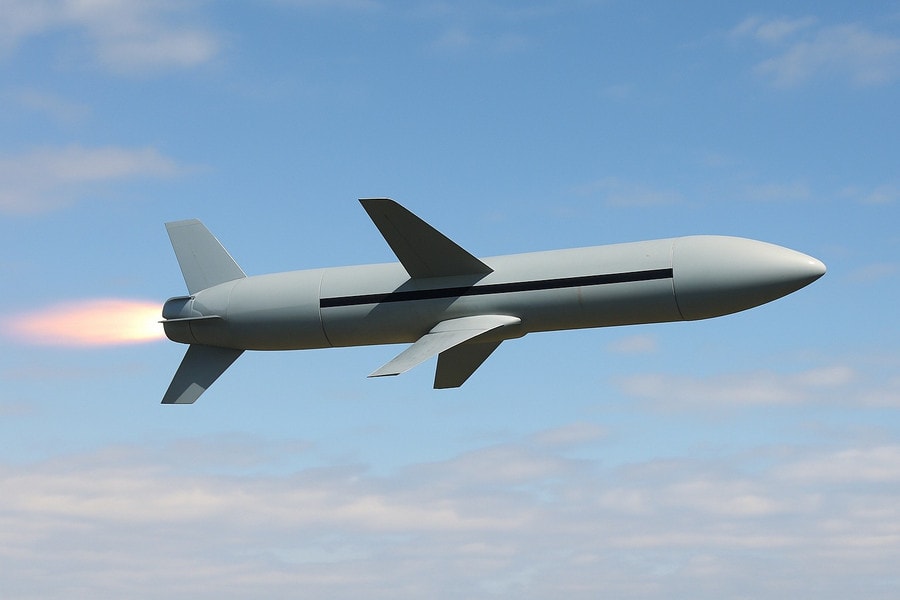
Overview of the new loitering cruise missile system.
According to available information, DRDO's project focuses on a cruise missile platform capable of performing both tasks: striking targets at long distances and maintaining surveillance over the target area for a certain period of time. This is an intermediate approach between traditional cruise missiles and loitering weapons.
Unlike conventional cruise missiles, which are typically "locked" onto a predetermined target immediately after launch, the new system allows the missile, upon reaching the target area, to loiter, observe, and transmit data back to the control crew on the launching aircraft. Only when the target is confirmed via imagery is the decision to attack made.
Modular structure and key specifications
The newly designed cruise missile carries a minimum explosive warhead of 50 kg. With this weight, the system can effectively strike a wide variety of targets, from high-value stationary targets to moving targets. Its range of approximately 250 km allows for deployment outside of the danger zone, maintaining a safe distance from the launching aircraft.
A key feature of the design is its modular structure, which allows for variable mission payloads. On the same missile frame, the engineering crew can integrate different types of seekers or guidance devices, such as infrared seekers or advanced guidance systems. This allows the same platform to be configured for different types of missions without developing an entirely new weapon system.
In terms of guidance, the missile uses an INS/GPS system combined with an onboard navigation device. This combination helps maintain accuracy over long distances, while also supporting the ability to hold its position and change its flight path when loitering around the target area.
The ability to linger and the mechanism of "people under control"
The ability to loiter is a key differentiating feature compared to traditional cruise missiles. After being launched towards the target area, the missile can circle for a predetermined period of time, instead of directly striking the designated target. During this phase, the system transmits live images back to the launching aircraft, allowing the crew to observe and assess the real-time situation.
Once the target is confirmed via transmitted data, the weapons officer on board issues the final attack order. This mechanism creates a "human-controlled" combat cycle, where the decision to fire is not entirely dependent on algorithms but receives human approval at the final stage.
This approach helps reduce the risk of unintended damage, especially in complex battlefield environments where military and civilian targets may be located close together, or where targets may change position in a short period of time.
Multitasking: attacking both land and sea targets.
According to published information, the missile can strike both land and sea targets. Its ability to engage sea targets extends its range of use from land battlefields to maritime environments, where targets such as warships or supply vessels are often mobile and may only be present for short periods.
With its loitering capability, the missile can wait for the target to appear, confirm its presence visually, and then launch an attack. This is particularly useful when dealing with hidden targets, camouflaged targets, or targets that only reveal themselves for limited periods.
The combination of INS/GPS guidance, onboard sensors, and remote control mechanisms allows the missile to adapt to a wide variety of targets: high-value stationary assets, moving ground targets, as well as ships at sea.
Strategic significance for the Indian Air Force
Strategically, the new loitering cruise missile system is considered to have multi-domain applicability, from land-based to sea-based targets. The integration of pre-attack target surveillance and confirmation capabilities gives the Indian Air Force increased flexibility and reduced risk in situations where target information may change rapidly.
This new generation cruise missile is expected to become a significant part of India's arsenal, complementing existing systems such as the Rudram-II. In the context of the growing emphasis on precision weapons, a platform capable of both offensive, surveillance, and stealth capabilities will expand India's tactical options for long-range firepower.
In the long term, the emergence of this system shows that India's weapons development trend is towards integrated solutions that optimize both offensive effectiveness and damage control. This could be the basis for DRDO to continue developing new variants on the same platform, serving various combat scenarios while still relying on proven technical specifications.
According to idrw.


