
India and Russia aim to achieve $100 billion in bilateral trade.
Indian Prime Minister Narendra Modi and Russian President Vladimir Putin attended the plenary session of the India-Russia Business Forum in New Delhi on December 5th, co-organized by the Federation of Indian Chambers of Commerce and Industry (FICCI) and the Roscongress Foundation (Russia). The event brought together numerous business leaders from both countries to promote cooperation in trade, finance, and investment.
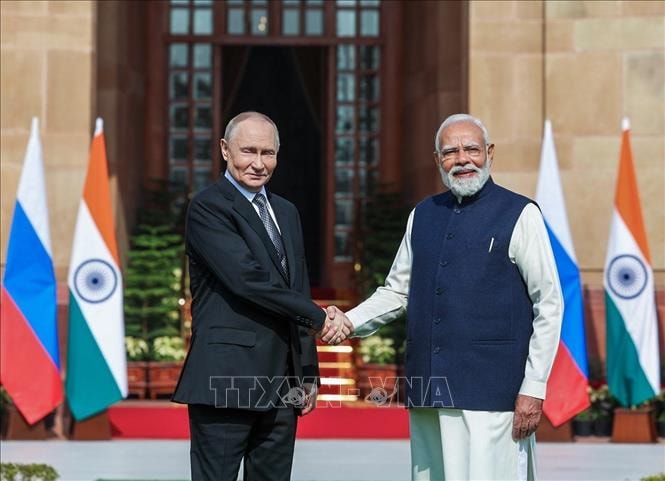
According to the VNA correspondent in New Delhi, speaking at the forum, Prime Minister Modi thanked President Putin for leading a large delegation of Russian businesses to India, affirming that "mutual trust is the greatest foundation of the India-Russia partnership," creating momentum for new cooperation initiatives. He highlighted the wide-ranging opportunities in the fields of defense, space, and civilian nuclear energy, especially after the Indian government accelerated reforms and opened up to private investment.
The Indian leader stated that New Delhi will allow the private sector to participate in the civilian nuclear energy sector, viewing this not only as an administrative reform but also as a “reform of mindset,” aimed at building a developed India. He also proposed several initiatives to enhance strategic connectivity, including the North-South International Transport Corridor (INSTC), the Northern Sea Route, and the Chennai-Vladivostok Corridor, to shorten transport times, reduce costs, and expand markets for businesses in both countries.
Leveraging digital technology, Prime Minister Modi proposed that India and Russia build a “virtual trade corridor,” connecting customs and logistics systems to expedite customs clearance, reduce bureaucracy, and create a seamless flow of trade.
Regarding bilateral trade, the two leaders reaffirmed the goal of reaching $100 billion in trade by 2030. Prime Minister Modi expressed confidence that this goal could be achieved sooner thanks to existing cooperation potential and momentum from high-level talks. He highlighted the "unprecedented transformation" of the Indian economy over the past 11 years, aiming to become the world's third-largest economy, along with key reform programs such as the GST and simplification of compliance procedures to improve the investment environment.
For his part, President Putin appreciated the role of the India-Russia Business Forum in connecting the business communities of the two countries and initiating new agreements. He affirmed that the Russian delegation's visit to India this time was not only focused on the energy sector, but also aimed to promote multifaceted cooperation, in line with the potential of one of the world's fastest-growing economies.
The Russian leader emphasized that Moscow is studying New Delhi's experience in manufacturing, light industry, information technology, and pharmaceuticals to support its import substitution program and develop high value-added products.
President Putin stated that the two sides have approved the Russia-India Economic Cooperation Expansion Program, creating a comprehensive framework to achieve the target of $100 billion in trade by 2030. He urged the business communities of both countries to expand bilateral trade and to build a more balanced exchange structure as soon as possible.
Acknowledging the current trade surplus heavily skewed toward Russia, President Putin pledged Moscow's "readiness to increase imports of goods and services from India" to narrow the gap, while welcoming New Delhi's export-boosting projects under the Indian government's new support program. He argued that increased imports from the South Asian nation would contribute to strengthening the Russian economy and create mutual benefits for both sides.
The India-Russia Business Forum is an opportunity to reaffirm the determination of New Delhi and Moscow to expand multifaceted economic relations, laying the foundation for new cooperation projects with a long-term vision and mutual benefit.


