
Electric vehicle battery safety: the trade-off between density and fast charging.
The series of incidents involving the Xiaomi SU7 Ultra, NIO ET7, Li Auto MEGA, Mercedes-Benz EQE, and Porsche Taycan reveals the dark side of the race for high energy density, large cells, and 800V–10C charging.
A series of electric vehicle fires in October, including high-end models such as the Xiaomi SU7 Ultra, NIO ET7, Li Auto MEGA, Mercedes-Benz EQE, and Porsche Taycan, once again highlighted battery safety as a top priority. Data and evidence suggest that the race for efficiency – from high energy density to ultra-fast charging – is coming at a cost in thermal stability and requires more stringent risk management (according to 36kr.com).
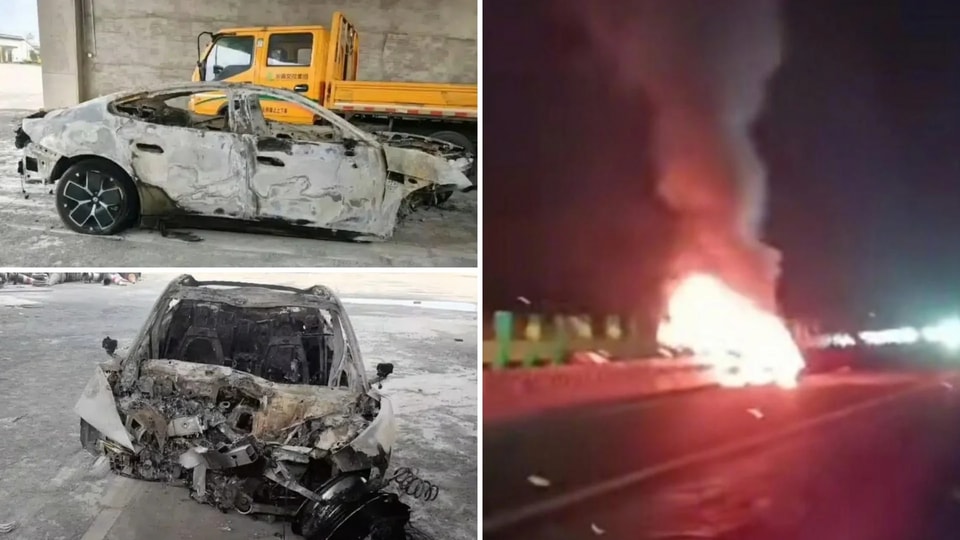
High energy density: advantages of range, thermally stable pressure.
The shift in positive materials from lithium iron phosphate (LFP) to lithium tricomponent (NCM/NCA) increases energy density and extends the operating range. However, compared to LFP, which has a stable crystal structure and is difficult to release oxygen, the high nickel material reduces thermal stability.
Market experience has forced the industry to adjust: following incidents involving NCM 811s (GAC Aion S in 2020; General Motors recalling nearly 70,000 vehicles in 2021 due to high nickel battery risks, LG Chem paying $1 billion in compensation), the common NCM ratio has shifted to 5-2-3/6-2-2 to balance performance and safety. LFP remains widely present in the sub-200,000 yuan segment due to cost, while three-component batteries are used for mid-to-high-end vehicles (for example, Tesla uses three-component batteries for its long-range models, and LFP for its standard models).
From 18650 to 4680, then CTP/CTC: high volume efficiency and high cell risk.
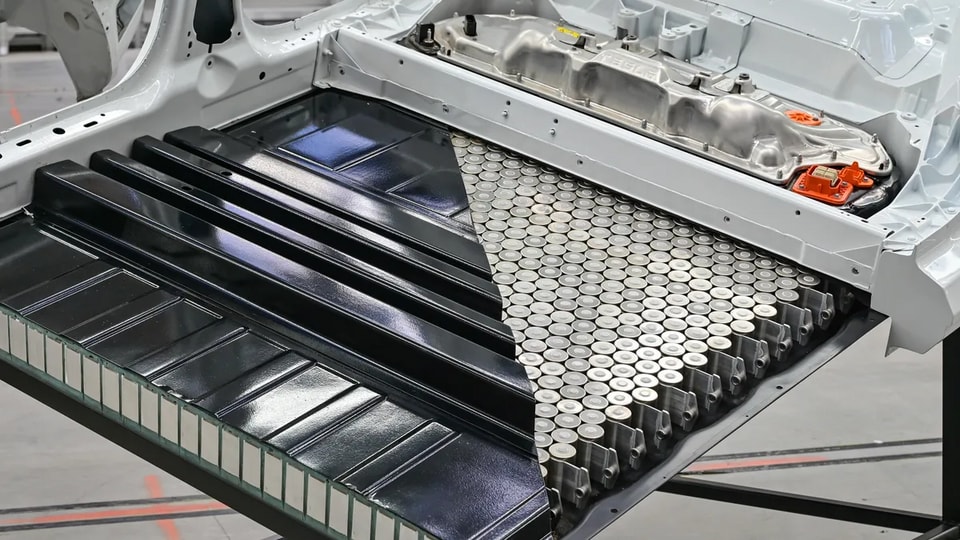
Alongside material improvements, architectural advancements help to "compress" more energy into the same volume. The first-generation Tesla Model S used a cell-module-pack structure: each module contained approximately 444 18650 cells, equipped with its own BMS and cooling system; a pack could have 16 modules, along with fire-resistant materials. The subsequent trend was to reduce and then eliminate modules (CTP – Cell to Pack) and achieve deep integration (CTC – Cell to Chassis).
Cylindrical cell sizes increased from 18650 to 21700 and 4680; on the cubic battery side, BYD optimized the Blade to increase the volume utilization rate by approximately 50%, raising cell capacity from 135 Ah to over 200 Ah. CATL with Qilin pushed the volume utilization rate to 72%, surpassing the 63% milestone of the 4680; CTC solutions were put into mass production from 2022–2023.
The downside: large-capacity cells, when experiencing an internal short circuit, can dissipate heat rapidly, forming hot spots and triggering a more intense, uncontrolled thermal chain reaction. The time from smoke to ignition is therefore very short and difficult to control. Besides the cells themselves, the pack packaging process is also a risk factor: NIO recalled 4,803 ES8 vehicles in 2019 due to improper high-voltage wiring within the pack.
The 800V–10C fast charging race: better experience, narrower safety margin.
Charging power = voltage × current. The first generation of 400V vehicles had a charging rate of less than 1C. Tesla gradually increased supercharging power from 90 kW (V1) to 250 kW (V3), achieving an additional range of approximately 250 km after 15 minutes of charging and a rate of 2–2.5C.
The Porsche Taycan pioneered the 800V platform with a fast charging capacity of 270 kW: increasing voltage reduces current and heat loss, improving safety during high-power charging. Chinese manufacturers quickly caught up with 800V, upgrading batteries to 4C or higher; charging capacities exceeding 400 kW appeared on the market. In 2023, Li Auto MEGA announced the use of CATL Qilin 5C, with a maximum power output exceeding 500 kW. BYD claimed the ability to charge at 10C, "10 minutes for 600 km"; however, industry tests show that the maximum 10C current is only sustained for a very short time.
In return, the requirements for insulation, protection, and arc suppression increase dramatically; the instantaneous short-circuit current is larger, and the thermal reaction can be more intense. At high currents, the rapid embedding/separation of lithium ions generates heat and promotes dendrite formation, shortening lifespan. According to a September statement by Li Bin (NIO), pursuing supercharging comes at a cost, including battery lifespan. NIO uses slow charging at battery swapping stations, aiming for 85% lifespan within 15 years. “Imagine if after 8 years of using the car, you have to spend 80,000 or 100,000 yuan (US$11-14,000) to replace the battery… this is an unacceptable high cost.”
Fast charging benchmarks and voltage levels (by source)
| System/Vehicle | Platform/Voltage | Maximum power | Note |
|---|---|---|---|
| Tesla Supercharger V1 → V3 | ~400V | 90 kW → 250 kW | ~250 km/15 minutes; speed 2–2.5C |
| Porsche Taycan | 800V | 270 kW | Reduce flow and heat loss. |
| Many Chinese companies | 800V | >400 kW | Battery 4C or higher |
| Li Auto MEGA + CATL Qilin 5C | 800V | 500 kW | Published in 2023 |
| BYD charger 10C | — | — | 10 minutes ~600 km; the 10C range is very short-lived (according to industry tests). |
Current technical solutions: cooling, heat-electric separation, BMS optimization.
Before solid-state batteries reach industrial scale, optimizing liquid batteries remains the main direction:
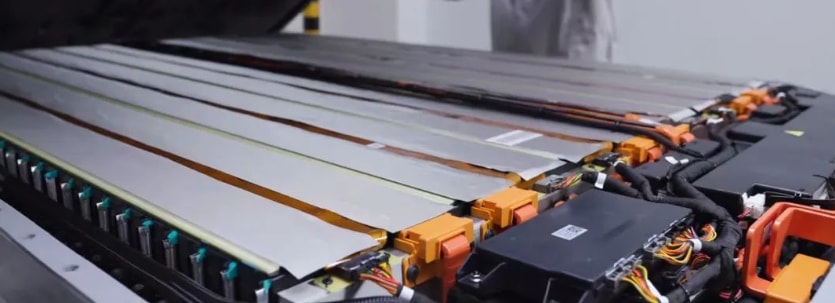
- CATL Qilin places liquid cooling pads between the cells to increase heat exchange; a pressure relief valve is positioned at the bottom of the cell, separating it from the anode/cathode at the top to "separate the heat and electricity".
- The fine-grained graphite-coated negative electrode accelerates ion embedding, supporting fast charging and reducing the risk of "lithium plating".
- The BYD Blade's long, slender shape is advantageous for heat dissipation; the densely packed arrangement provides structural support, reducing the need for traditional crossbeams. However, concerns about bending of the ultra-long cells upon impact remain.
- The BMS is enhanced with real-time monitoring of voltage, current, and temperature; it also provides circuit breakers and alerts for abnormalities. However, instantaneous short circuits can exceed the sampling/response rate.
Solid-state batteries: high potential, big hurdles.
Solid-state battery research has been underway for three decades, but it has yet to reach industrial-scale production due to R&D challenges, processes, and the cost of transitioning from the existing liquid battery ecosystem. Most automakers and battery manufacturers are not yet ready to make significant investments at this time.
Conclusion: There is no absolute safety, only a learning curve.
A well-balanced battery pack is a combination of materials, architecture, processes, and BMS. In the race for performance, investment in safety needs to increase proportionally, and information provided to users must be honest, avoiding the concealment of differences in risk.
Manufacturers aim to reduce failure rates to ppb (parts per billion). However, for consumers, a "one in a billion" accident still means a 100% chance of occurring. Each incident serves as both a warning and data for optimization, much like how Tesla improved its BMS through early spontaneous combustion incidents; Chinese automakers and battery manufacturers are also pursuing a similar learning and improvement path.


