
Arsenal and the set-piece revolution in the Premier League.
From 'Love Train' to NFL-style throw-ins, Arsenal lead the Premier League in set pieces with 24 goals from corners since 2023; Villa, Brentford, and Tottenham catch up.
The Arsenal players converged on the far post, then suddenly attacked the near post. The opposing defense was momentarily disorganized, and Gabriel rose high to head the ball into the net. Such scenarios are no longer spontaneous: they are the product of a set-piece revolution shaping the Premier League.

Brentford, Tottenham, and Aston Villa join the fray; Arsenal leads the trend.
Set-piece fever has gripped the league for the last five seasons. Brentford threaten defensive structures with powerful throw-ins. Tottenham Hotspur, Aston Villa, and Crystal Palace can turn any static piece of play into a well-executed goal-scoring setup. Arsenal, meanwhile, dominate from corners and free kicks, with such meticulous preparation that it has become the norm.
The breakthrough stems from two changes: first, the level of detail in preparation, where set-piece scenarios are no longer as simple as dividing the area into four corners or targeting the tallest player. Second, the wave of hiring set-piece specialists: Arsenal signed Nicolas Jover in 2021, Tottenham brought in Gianni Vio in 2022, and Brentford had a long-standing advantage thanks to Andreas Georgson. Now, almost every Premier League club is looking for such a specialist.
Furthermore, it's becoming increasingly clear that coaches are borrowing ideas from American football, from how to create movement clusters and shielding to techniques for escaping handball.
'Love Train' and its inspiration from American football.
The 2018 World Cup was a memorable opening. England reached the semi-finals and scored 12 goals, 75% of which came from set pieces, surpassing Portugal's record at the 1966 World Cup. Corner kicks became a weapon in the 'Love Train' tactical setup.
Coach Gareth Southgate revealed that the team had worked with the Atlanta Falcons' coaches before the tournament. He told Sky Sports at Super Bowl LIII: “We’re always looking for set pieces. The amount of detail their coaches use is incredible.”
The 'Love Train' essentially consists of a line of 3-4 players standing in a straight line, either vertically or horizontally, near the edge of the penalty area. When the ball is crossed in, they split up in various directions, creating a wave of movement that makes it difficult for defenders to track them. The horizontal formation helped Harry Kane score against Tunisia; the vertical formation opened the way for Harry Maguire's header to beat Sweden.
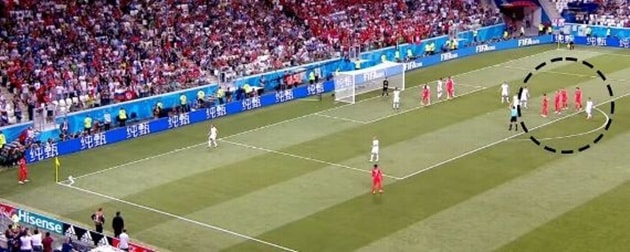
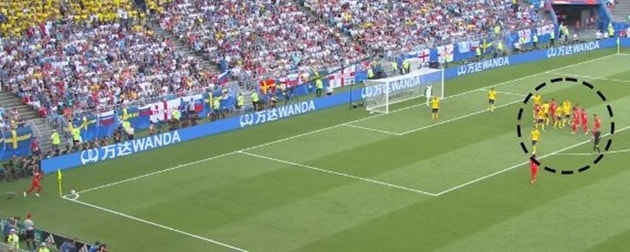
Arsenal unlocked the near post to free Gabriel.
Since the start of the 2023 season, Arsenal have created the most expected goals from set pieces, scoring 24 from corners. Mikel Arteta's association with LA Rams head coach Sean McVay – within the same ecosystem owned by Stan Kroenke – and expert Nicolas Jover shows a learning-from the American football model.
A typical setup: seven Arsenal players stand together at the far post, leaving the two near posts open. When the ball crosses in, almost all of them rush towards the near post, creating chaos that makes it difficult for opposing defenses – like West Ham – to keep up. Gabriel Magalhaes often finds himself in a clear position to head the ball in.
This is no coincidence: much of the tactical approach is aimed at freeing Gabriel, while William Saliba and Leandro Trossard are dedicated to shielding and disrupting him. Manager Marco Silva once said after the Fulham match: “Gabriel jumps incredibly high, he’s unstoppable. Any touch of the ball from him at the far post is extremely difficult to control.”

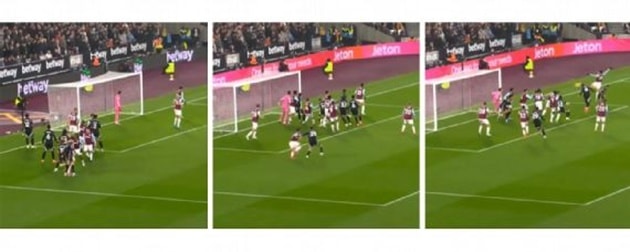
NFL-style tackling: Aston Villa and the lines
Following their defeat to Aston Villa in the 2024 UEFA Conference League quarter-finals, Lille manager Paulo Fonseca complained: “The first goal was a foul. It was a foul, a clear foul.” The controversial situation arose from Morgan Rogers pushing a Lille player at the far post, creating space for Ollie Watkins to head the ball in. This is a familiar tactic of Aston Villa, similar to tackles in American football; finesse dictates the difference between a legitimate foul and a legitimate foul.
This technique also appears in free kicks. Against Chelsea, Eberechi Eze scored but the goal was disallowed because Marc Guehi pushed through the wall and pushed Moises Caicedo to create a gap. In MLS, Rwan Cruz once smashed through the Portland Timbers wall like a snowplow, creating a clear path for his teammates.
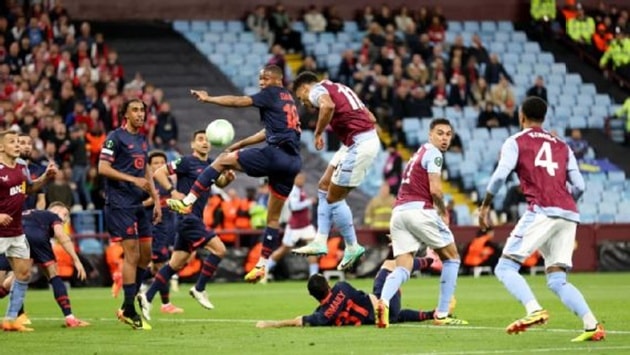
Handball escape: Merino and a direct lesson from the NFL.
Mikel Merino shared that he worked with Cam Jordan of the New Orleans Saints to learn handball techniques to escape marking. He applied a chopping motion – a downward cut to break through a shirt grab – to get past Reece James before scoring against Chelsea. In another instance, Merino used Saquon Barkley's backward spin to get past James.
In the League Cup victory against Brighton, Merino even made a sudden stop to shake off his marker and sprint into the six-meter box. Small details make a big difference, especially in set-piece situations where time and space open up in a split second.

Long-term impact: dead ball situations are the new advantage.
Like American football, soccer is a sport that replicates very quickly. Teams that invest in set pieces, like Arsenal, Villa, and Brentford, are clearly benefiting; those that don't keep up are easily left behind. Merino says, "Mentally, soccer can learn a lot from American football. Every play is an opportunity."
The tactical arsenal of American football contains hundreds of concepts and thousands of tactical setups. Dead-ball specialists in football are still tapping into that wealth of ideas. This revolution, therefore, shows no signs of stopping.


