
President Ho Chi Minh spoke about the law.
(Baonghean.vn) - President Ho Chi Minh made the greatest contribution to the constitutional and legislative work of our country. During his lifetime, he always emphasized the importance of law, striving to bring laws to the lives of every citizen, in accordance with the interests of the people. Over time, his thoughts and teachings on law have always been remembered and followed by generations.
After seizing power, on August 28, 1945, the Ministry of Justice of the Democratic Republic of Vietnam was established under the direct leadership of President Ho Chi Minh, who served as the head of the government. Later, in a letter to the Judicial Work Conference in February 1948, he wrote: “Judicial officials must be absolutely loyal,” and “you are the ones responsible for enforcing the law; naturally, you must set a high example of ‘serving the public and upholding the law, being completely impartial’ for the people to follow.”
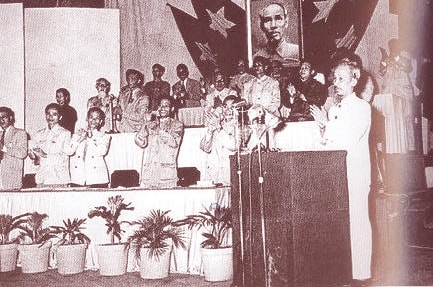
 |
| In February 1946, he addressed over 100,000 people in Hanoi after the general election that elected the first National Assembly of the Democratic Republic of Vietnam. |
In his keynote address at the 1950 National Judicial Conference, he emphasized: “…Our current laws protect the rights of millions of workers… Our laws are truly democratic laws, because they protect the broad freedoms and democratic rights of the working people… Anyone who abuses their freedom excessively and infringes upon the freedom of others is breaking the law.”
He instructed: "...We must strive to make the legal system more and better... We must be close to the people, understand the people, help the people, and learn from the people. Helping the people and learning from the people will help us become more honest and fair. Furthermore, we must always strive to study theory and the government's policies and guidelines..." He was extremely concerned with building and perfecting the legal system, as a basis for all citizens and officials to respect and implement it.
As someone who dedicated his life to fighting for truth and justice, he regarded corruption and abuse of power as an enemy that needed to be eradicated. He demonstrated a strict attitude towards acts that violated the law and infringed upon the rights of the people.
 |
| President Ho Chi Minh speaking at the fifth session of the First National Assembly on September 20, 1955.jpg |
He said, “The government has strived for integrity. But if setting an example fails, then we will use the law to punish those who accept bribes.” He emphasized virtuous governance, but it must be virtuous governance coupled with rule of law. In his last will and testament before his passing to the other world with Karl Marx and Lenin, he wrote, “For victims of the old social system, such as thieves, prostitutes, gamblers, smugglers, etc., the State must use both education and law to reform them, helping them become honest workers.”
Even when speaking about the Party, in connection with the issue of anti-corruption laws, he affirmed, "If a political party is needed, it will be the Vietnamese National Party. That party will have only one purpose: to make our nation completely independent. The members of that party will be all Vietnamese citizens, except for traitors and corrupt individuals."
It is clear that he equated corruption with treason. Both offenses were punishable by death according to the Ten Rewards and Ten Punishments Decree of January 26, 1946, which he himself signed.
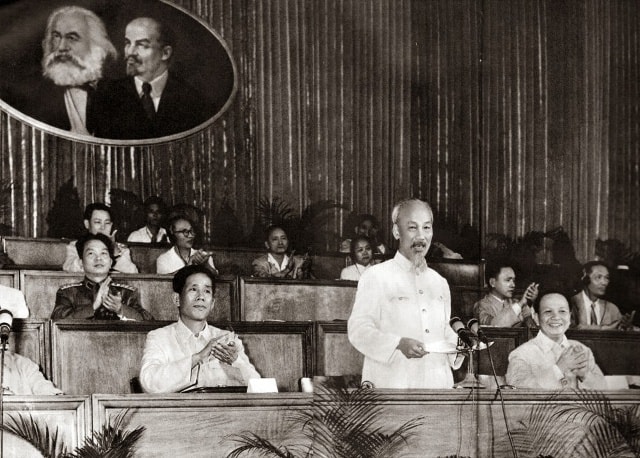 |
| On September 5, 1960, the Vietnam Workers' Party held its 3rd National Congress. In his opening address, President Ho Chi Minh stated: “The second Congress was a congress of resistance. This Congress is a congress of building socialism in the North and fighting for peaceful reunification of the country.” |
At the second session of the First National Assembly (November 1946), a National Assembly representative questioned the Government about recent cases of bribery, embezzlement, and corruption. On behalf of the Government, President Ho Chi Minh frankly replied: “The current Government has tried its best to be honest. But within the Government, from Ho Chi Minh himself to those working in village committees, there are many people, and the situation is very complex. In any case, the Government has done its utmost to set an example, and if setting an example is not enough, then we will use the law to punish those who accept bribes. We have punished, are punishing, and will continue to punish until they are all gone.” Ho Chi Minh's thought on the strictness of the law was truly resolute: “The law must severely punish those who are dishonest, regardless of their position or profession.”
As the leader of the Party, the State, and the Government, he set an example for all cadres, intellectuals, workers, and farmers to follow in upholding and protecting the law. More than anyone else, he understood the immense role and impact of leaders on the strict enforcement of the law.
Peace
(Synthetic)


