
Uncle Ho and the folk songs of the Ví and Giặm styles.
(Baonghean.vn) - During his lifetime, despite the busy work of the Party and the State, beloved Uncle Ho still devoted his precious time to the folk songs of his homeland, which he cherished since his youth and often listened to from the weaving guilds…
 |
| Photo: Archival material |
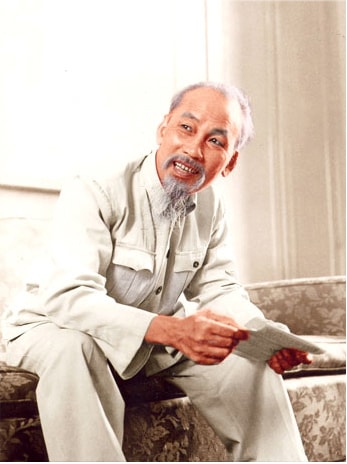
In 1969, just one day before the 79th anniversary of President Ho Chi Minh's birthday – May 18, 1969 – the outstanding performers of the Military Arts Troupe of Military Region 4 braved the bombs and bullets of the war to travel from Vinh City to the capital to celebrate President Ho Chi Minh's birthday. On that day, President Ho Chi Minh's health had deteriorated significantly. But it was a joyous occasion, and with the presence of young soldiers and some people from the Presidential Palace offering their congratulations, he was very happy. Assessing President Ho Chi Minh's condition, the organizers arranged a short and concise musical program, featuring folk songs from Nghe An and Ha Tinh provinces.
The garden of the Presidential Palace was so peaceful that day. The sky was high. White clouds drifted by. Only the leaves rustled in the wind blowing from the Red River. Those present were filled with indescribable anticipation and joy, waiting for Uncle Ho to arrive. The clock seemed to tick slower than usual. The moment of eager anticipation had arrived. The doors swung open, and our benevolent Uncle Ho appeared as everyone stood ready. Applause erupted. Somewhere, there were tears and sobs of emotion and joy, of happiness at meeting Uncle Ho.
After a few gentle yet profound folk songs, it was actress Mai Tu's turn to perform the song "Song of the Ferryman": "When will the waters of the Lam River ever dry up, just like the revolutionary spirit of our people..." Everyone saw that Uncle Ho's eyes welled up with tears, and then he asked the comrades sitting around him, "Is it good, comrades...?" Everyone happily replied, "Yes, Uncle Ho, it's wonderful, it's been a long time since we've heard it..." Uncle Ho didn't say anything more, but seeing his joy and approval, everyone felt reassured by their answer.
Uncle Ho asked actress Mai Tu: "My dear, do we still weave cloth here?" "Yes, Uncle, we still weave," she replied. "Do you know how to sing the 'phuong vai' folk songs?" "Yes, Uncle, I know how to sing." "Then sing a few lines for everyone to hear!" "Uncle, which song should I sing?" Uncle Ho said: "Sing the songs that our people used to sing in the old days." Overjoyed at being asked so affectionately by Uncle Ho, Mai Tu replied: "Yes, we sing the 'phuong vai' folk songs, but I don't know the old lyrics, Uncle." Then, Uncle Ho kindly told Mai Tu: "Then, take this line and sing it for everyone to hear… (those present were surprised once again) 'Advise others not to marry students…' Continue singing." "Yes, Uncle, is it the line 'Long back wastes cloth, eats well and then lies down'?" Uncle Ho cheerfully reminded the young military performer: "Now, continue singing." At this point, Mai Tư seemed hesitant, but Uncle Ho immediately reminded her clearly, "A long back is supported by a curved hammock, and a long dress is made of the red silk bestowed by the king." Proud and overjoyed to be a descendant of Uncle Ho, to be at the place where he lived and worked, and to sing a birthday song for him, actress Mai Tư confidently sang the Nghệ-Tĩnh folk songs, feeling as if the images of the Lam River and Hồng Mountain from Nghệ An province were rushing back to this place.
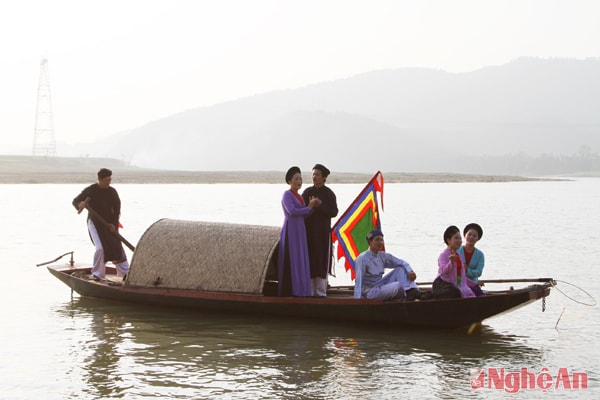 |
| Singing folk songs and traditional melodies on the Lam River. |
The room buzzed with whispers about President Ho Chi Minh's erudition and long memory. At this point, artist Minh Hue (one of the performers in the troupe) stood up: "Uncle, I would like to sing a lullaby – a Central Vietnamese folk song – with the old lyrics." President Ho was very pleased and told the artist to go ahead and sing. Minh Hue immediately began, "Ah oh oh… Lullaby, lu ...
At this moment, Uncle Ho smiled affectionately and said, "Buy betel nuts from Cam Pho, not from Sai Market," which surprised everyone and deeply impressed them with his memory.
That year, our beloved Uncle Ho entered the 79th spring of his life. Not long before that, he had proactively drafted his historic Last Will and Testament, leaving behind for the entire Party and the entire people "Innumerable expressions of love," which he called a "top secret" document. Even further back, in the years before the spring of 1941, he had traveled across the globe, through magnificent snow-covered Paris, through winter nights warmed only by a red brick, and through the harsh imprisonment of the Kuomintang… For decades, he never forgot the names of his villages, hamlets, and the folk songs and proverbs of his homeland. These are things that seem ordinary, but how great they are.
The author of this article, while working with musician Tran Hoan at the Ministry of Information, recalled what Mr. Vu Ky (Secretary to President Ho Chi Minh) said: President Ho Chi Minh loved folk songs, from the "vi" and "dam" styles to Hue folk songs and Bac Ninh Quan Ho... In 1965, when President Ho Chi Minh was seriously ill and the war was raging, the Central Committee had to move him to a place far from Hanoi for his safety and care. One day, President Ho Chi Minh remembered something from his memories and asked Mr. Vu Ky: "Is there anyone here who knows how to sing 'vi', 'dam', or Hue folk songs? Can you let me listen?"
Later, the song "Uncle Ho's Last Words Before His Departure" by composer Tran Hoan vividly captured the image of our beloved Uncle Ho: "The story goes that, before he departed... / The story goes that Uncle Ho wanted to hear a folk song / Remembering Lang Sen village from his childhood, while everything around him remained silent / Uncle Ho waited and waited, endlessly... / Uncle Ho wanted to hear a folk song from Nghe An province, because Lang Sen village lingered in his heart... / Uncle Ho wanted to hear a couple of folk songs, before he departed to the other side of the sky / He wanted to take with him to infinity, the song of the nation... to the vastness..."
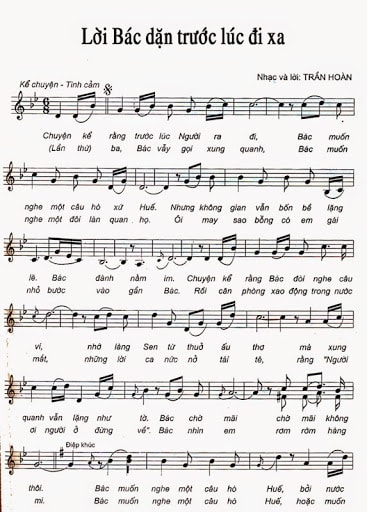 |
| The song "Uncle Ho's Last Words Before His Departure" was written by composer Tran Hoan 20 years after Uncle Ho's passing. |
That's how it is, simple yet warm, deeply imbued with love for our country. With our infinitely beloved Uncle Ho, the love of the entire nation and party, from the noble mission of the Fatherland and the country to the folk songs of our land, everything, absolutely everything, follows in his footsteps everywhere, across the length, breadth, and depth of our beloved and enduring Vietnam. Vast and boundless like the land, sky, and sea of our beloved and everlasting Fatherland./.
Ví and Giặm folk songs are cultural products of the rural landscapes, riverside areas, banyan trees, and village courtyards of Nghe An and Ha Tinh provinces, and were recognized by UNESCO as a Representative Intangible Cultural Heritage of Humanity (November 27, 2014). |
Peace
| RELATED NEWS |
|---|


